
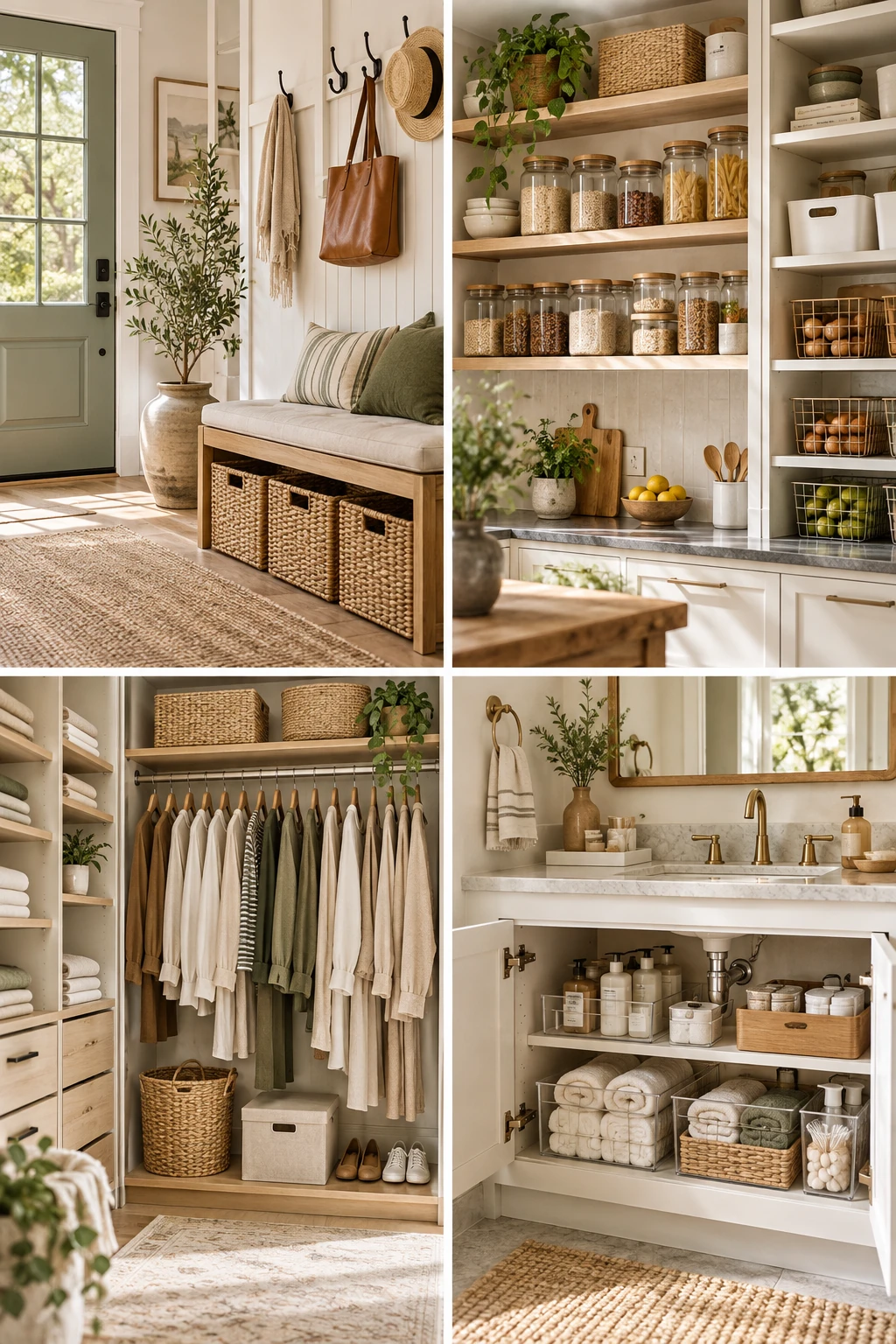
The Finished Result
An organized home is easier to use, easier to reset, and easier to maintain. Categories have clear locations, storage matches real behavior, and every room has a practical next step rather than a generic shopping list.
- Start with the right problem
- Choose the right room or method
- Measure before adding storage
- Use maintenance routines
- Route product decisions to detailed guides
Quick Answer
Home organization begins by identifying the problem, reducing what must be stored, grouping similar items, assigning practical storage locations, and creating routines that keep each room functional. Use this guide to find the correct whole-home, room, situation, maintenance, or storage guide.
Start Here: What Home Organization Problem Are You Solving?
The Basic Home Organization Process
For the complete method, follow how to organize your home step by step.
Choose the Part of Your Home You Want to Organize
Each main guide below gives you the complete plan for that area. The smaller guides underneath solve one specific storage or clutter problem.
Entryway Organization
Start with the complete Entryway Organization guide, then choose the specific problem that matches your space.
Kitchen Organization
Start with the complete Kitchen Organization guide, then choose the specific problem that matches your space.
Pantry Organization
Start with the complete Pantry Organization guide, then choose the specific problem that matches your space.
Closet Organization
Start with the complete Closet Organization guide, then choose the specific problem that matches your space.
Bathroom Organization
Start with the complete Bathroom Organization guide, then choose the specific problem that matches your space.
Laundry Room Organization
Start with the complete Laundry Room Organization guide, then choose the specific problem that matches your space.
Small-Space Storage
Start with the complete Small-Space Storage guide, then choose the specific problem that matches your space.
Find a Guide by Your Situation
If you rent
Prioritize freestanding, portable, removable, and lease-compatible systems.
Entryway storage for renters · Rental kitchen organization · Add storage to a small apartment
If you have children
Use broad categories, reachable storage, personal zones, and simple reset routines.
Organize a home with kids · Family entryway storage · Kids closet organization
If you live in a small home
Control both storage location and category volume.
Small-space storage guide · Vertical storage · Under-bed storage
If you feel overwhelmed
Start with one small, high-impact boundary rather than an entire room.
If your systems never stay organized
Check capacity, accessibility, placement, and maintenance before buying more storage.
Solve Common Home Organization Problems
I have too much visible clutter
- Keep an entryway clutter-free
- Keep kitchen counters clutter-free
- Open vs. closed storage
I do not have enough storage
- Add storage to a small apartment
- Use vertical storage
- Storage without closets
Storage exists, but it is hard to use
- Diagnose the system
- Pull-out shelves vs. shelf risers
- Shoe cabinet vs. entryway bench
My family does not put things away
I keep buying organizers but still have clutter
I do not know which storage format to choose
- Open vs. closed storage
- Open shelves vs. pantry cabinets
- Open shelves vs. bathroom cabinets
Compare Storage Solutions
Use comparison pages only after the category, location, dimensions, and access needs are clear.
Home Organization Checklists and Measurement Guides
Implementation checklists
Entryway checklist · Kitchen checklist · Pantry checklist · Closet checklist · Bathroom checklist · Laundry checklist · Small apartment checklist
Measurement guides
Entryway bench height · Pantry shelf spacing · Closet shelf height · Closet rod height
Why measurements matter
Measure walkways, doors, drawers, reach, operating clearance, and the largest stored item before installing or purchasing storage.
Create a Home Organization Maintenance Routine
Daily maintenance
Remove active clutter, return misplaced items, reset high-use spaces, and prepare for the next day.
Weekly maintenance
Empty temporary baskets, process papers, restock essentials, reset overfilled categories, and prepare the home for the coming week.
Organization systems should reduce maintenance effort rather than create long daily routines.
How to Choose the Right Organization Guide
| Reader problem | Best guide |
|---|---|
| I do not know where to start | How to Organize Your Home |
| I want a room order | How to Organize a Home Room by Room |
| I feel overwhelmed | How to Organize When You Feel Overwhelmed |
| I have children | How to Organize a Home With Kids |
| Clutter keeps returning | Home Organization Mistakes to Avoid |
| I need a daily routine | Daily Home Reset Routine |
| I need a weekly routine | Weekly Home Reset Checklist |
| I need help with one room | Choose the main guide for that room above |
| I lack storage | Small Space Storage Guide |
| I am comparing storage options | Choose the comparison that matches your storage problem above |
Frequently Asked Questions About Home Organization
These concise answers route broad questions to the most useful detailed guide.
Where should I start when organizing my home?
Start with one high-impact area that affects daily routines and can be completed in a realistic session. Good first projects include the entryway, one kitchen counter, a bathroom vanity, or one closet section. Follow the complete organization process for the full sequence.
What room should I organize first?
Start with the manageable room causing the greatest daily friction, often the entryway, kitchen, or main bathroom. Use the room-by-room organization plan for the full order.
Should I declutter before organizing?
Yes. Remove trash, relocate misplaced items, reduce unused or duplicate belongings, group what remains, and only then assign permanent storage.
Is it better to organize room by room or by category?
Room-by-room works well for visible progress. Category organization works well when similar items are scattered. A hybrid method is best for many homes.
How do I organize my home when I feel overwhelmed?
Choose one small physical boundary, organize only that area, and restore it before stopping. Use the overwhelmed organization guide.
Should I buy storage containers before organizing?
Usually no. Declutter, define the permanent category location, measure the available space and operating clearance, test with existing storage, and buy only if a genuine functional gap remains.
How do I keep my home organized after decluttering?
Use permanent item locations, capacity limits, a short daily reset, a weekly reset, and clear processes for incoming and outgoing items.
What is a daily home reset?
A daily reset returns high-use spaces and belongings to a functional starting point without becoming a deep clean or reorganization project. Use the daily reset guide.
What belongs in a weekly home reset?
A weekly reset may include emptying temporary baskets, processing papers, returning misplaced items, restocking supplies, and preparing the household for the coming week.
Why does clutter come back so quickly?
Common causes include missing item homes, inconvenient storage, excessive inventory, too many return steps, unclear household responsibility, and missing maintenance routines.
How do I organize a home with children?
Use reachable storage, broad categories, personal zones, capacity limits, simple resets, and age-appropriate responsibilities. See how to organize a home with kids.
How do I organize a small home with little storage?
Reduce inventory first, then use vertical space, underused areas, multifunctional furniture, seasonal rotation, and closed storage for visually mixed categories.
Is open or closed storage better?
Open storage is better for frequent, simple categories. Closed storage is better for mixed items, backstock, seasonal belongings, and visual calm. Most homes need both.
How do I know when a room is fully organized?
A room is organized when items have assigned homes, daily items are accessible, storage is not overloaded, surfaces work, and the room can be reset quickly.