
How to Organize a Walk-In Closet by Zone
Organize a walk-in closet by reducing the wardrobe to realistic capacity, measuring every wall and walkway, and assigning each section a clear function. Keep frequently worn clothes near the entrance and at eye level, separate long and short hanging sections, use shelves and drawers for folded categories, and preserve enough open floor space to dress, turn, and return clothing easily.
The Finished Result
Every wall has a purpose, daily clothing is easy to reach, long garments no longer cover shelves, shoes stay in one defined zone, bags remain upright, seasonal items move higher or farther away, and the center remains open for movement and laundry.
- One main function per wall
- Active clothing near the entrance
- Short and long hanging separated
- One primary shoe zone
- Clear circulation and drawer paths
Quick Answer
Audit the wardrobe first, then measure each wall, corner, opening, rod, shelf, drawer, and walkway separately. Assign related functions wall by wall, keep active clothing closest to the entrance, group long and short hanging separately, preserve a clear center, and add closet systems, drawers, shoe storage, lighting, or furniture only where they improve the measured workflow.
Use the Closet Organization Guide for the full cluster. For compact layouts, see How to Organize a Small Closet.
Why Walk-In Closets Become Disorganized
| Closet symptom | Likely cause | First correction |
|---|---|---|
| Center floor is covered | No temporary-item boundary | Clear circulation and create one processing zone |
| Clothes are hard to find | Walls lack category functions | Assign one main purpose to each wall |
| Long clothes cover shelves | Hanging heights are mismatched | Separate long and short garments |
| Shoes spread throughout | Shoe capacity is undefined | Create one footwear zone |
| High shelves are overfilled | Seasonal storage is unmanaged | Limit and label occasional inventory |
| Shared closet causes conflict | No physical division | Assign zones before adding organizers |
| Drawers stay messy | Categories are too broad | Simplify drawer functions |
| Closet feels full despite size | Inventory expanded to fill it | Audit the wardrobe |
| Corners collect clutter | Transition space lacks a plan | Assign narrow or occasional categories |
| Laundry remains outside | Return path is too complex | Rebuild around dressing and laundry routines |
More space still needs limits
A walk-in closet can be over capacity. Extra square footage does not remove the need for inventory boundaries, visibility, and circulation.
Measure Every Wall and Opening
Measure the room
- Each wall length
- Ceiling height
- Closet width and depth
- Door width and swing
- Entrance position
- Corner dimensions
- Windows, outlets, lights, and baseboards
- Sloped ceilings and obstructions
Measure storage and clothing
- Rod lengths and heights
- Shelf width, depth, and spacing
- Drawer dimensions
- Long garments
- Folded stacks
- Shoes and boots
- Bags, bins, garment bags, and luggage
Measure each usable wall separately
Do not treat the closet as one rectangle. Every wall, opening, corner, and transition has different constraints.
Measure the walkway
Confirm enough space to enter and exit, turn, open drawers, remove bins, stand in front of shelves, access corners, use a mirror, and carry laundry in and out.
Circulation is part of storage capacity
Storage should never consume the clearance required to use the closet.
Audit the Wardrobe
Review shirts, jackets, pants, skirts, dresses, coats, sweaters, T-shirts, activewear, sleepwear, underwear, shoes, bags, accessories, seasonal clothing, formalwear, and travel items. You can work one wall or category at a time.
Remove items that should not return
- Damaged or uncomfortable clothing
- Clothing that no longer fits
- Duplicates and unworn pieces
- Items that do not match current routines
- Excess hangers
- Empty boxes and shopping bags
- Unused storage accessories
- Unrelated household clutter
Avoid rigid clothing-count rules. The correct amount depends on climate, work, lifestyle, laundry frequency, household size, and available secondary storage.
Separate active, seasonal, and occasional wardrobes
Active
Current-season clothes used regularly.
Seasonal
Off-season clothing not needed now.
Occasional
Formalwear, costumes, specialty clothing, and rare items.
Prime-space rule
The easiest walls, rods, drawers, and shelves should serve the active wardrobe.
Identify the dominant storage need
Determine whether the wardrobe is mostly short hanging, long garments, folded clothing, shoes, bags, workwear, activewear, seasonal inventory, or shared storage. The layout should follow the wardrobe—not a showroom template.
Create a Walk-In Closet Map
Assign one main function to each wall
Short hanging
Shirts, jackets, skirts, and folded trousers.
Long hanging
Dresses, coats, robes, and full-length garments.
Folded clothing
Sweaters, jeans, activewear, T-shirts, and sleepwear.
Shoes
One vertical or low-wall zone for active footwear.
Bags and accessories
Dedicated shelves, hooks, drawers, or shallow organizers.
Seasonal storage
Lightweight, clearly labeled occasional categories.
A wall can contain related subcategories, but it should not become miscellaneous storage.
Keep daily clothing near the entrance
Daily shirts, workwear, current-season jackets, frequently worn shoes, everyday bags, and active accessories belong in the easiest positions. Less frequent categories can move higher, deeper, farther from the entrance, or into secondary storage.
Use corners carefully
Corners may hold narrow shelves, bags, shoes, short folded stacks, accessories, or occasional clothing. Avoid overlapping full-depth rods, deep bins, heavy daily items, and long garments that block the adjoining wall.
Keep the center open
The center should support movement, dressing, laundry transport, drawer access, mirror use, and one tightly controlled outfit-staging point. Avoid loose shoes, boxes, shopping bags, oversized islands, and permanent donation piles.
Organize Hanging Clothes
Separate short and long hanging
Do not use full-height hanging space for garments that require only half the height. Use double hanging only on walls dominated by shirts, jackets, folded trousers, skirts, or children’s clothing.
Double-hanging verdict
It should follow the wardrobe audit—not be added automatically to every wall.
Group by broad category first
Use a sequence such as work shirts, casual shirts, jackets, pants, skirts, dresses, and formalwear. Color or sleeve length can be a secondary sort, but category should come first.
Avoid rod overcrowding
Clothes should slide, categories should remain visible, garments should come out individually, empty hangers should have a home, and clean laundry should return without reshuffling the entire wall.
Organize Shelves, Folded Clothing, and Drawers
Use short, defined stacks
One category per stack, limited height, most-used items at eye or waist level, and heavy folded clothing lower. If removing one garment collapses the stack, the section is too tall or too broad.
Use shelf dividers selectively
They work well for sweaters, jeans, bags, linens, and adjacent categories. Confirm shelf thickness, depth, stack width, divider height, and removal clearance.
Use bins for occasional categories
Lightweight seasonal accessories, swimwear, travel items, special-event pieces, or small bags may fit bins. Frequently used clothing should not disappear behind opaque storage.
Assign one broad function to each drawer
Use drawers for underwear, socks, sleepwear, activewear, T-shirts, accessories, or seasonal small items. Dividers help only when they improve visibility; too many tiny compartments slow laundry return.
Keep drawer paths clear
Check full extension, opposite-wall clearance, door interference, center furniture, hanging garments, and nearby bins.
Organize Shoes, Bags, and Accessories
Create one primary shoe zone
Choose low shelves, a vertical tower, adjustable rack, pull-out shelves, clear boxes, or floor-level cubbies. Keep active shoes closest to the entrance and move formal, travel, and off-season footwear higher or farther away.
Use How to Organize Shoes in a Closet for detailed footwear planning once published.
Create one dedicated boot section
Plan around boot height, shaft support, shelf spacing, seasonal rotation, and visibility. Do not design every shoe shelf around the tallest boot.
Store bags upright
Use dividers, cubbies, hooks, or one dedicated shelf. Prime shelves should hold frequently used bags; occasional bags can move higher or farther from the entrance.
Contain small accessories
Use trays, drawer dividers, small boxes, hanging pockets, shallow bins, or accessory drawers. Small items need visibility and boundaries, not dozens of decorative compartments.
Use High and Seasonal Storage
High shelves are best for lightweight seasonal clothing, travel bags, formal accessories, empty luggage, garment bags, and special-event items. Avoid heavy shoe boxes, large unstable bins, daily clothing, fragile products, and unclear labels.
Keep overhead storage light
Heavy filled bins should not be stored where retrieval becomes difficult or unsafe.
Adapt a Small Walk-In Closet
Prioritize one function per wall, a clear walkway, double hanging only where appropriate, narrow shelves, limited furniture, no default center island, seasonal storage elsewhere, and strict inventory limits.
See How to Organize a Small Closet for stronger capacity rules.
Small walk-in principle
Open circulation may be more valuable than another piece of furniture.
Evaluate an Island, Dresser, or Bench
Closet island
Useful for drawers, jewelry, folded clothing, or one preparation surface only when walkway and drawer clearance remain on every side.
Verdict: not a default feature.
Dresser
Useful where the closet lacks drawers and short hanging leaves floor space. It may require anchoring and can become a drop zone.
Bench or ottoman
Useful for dressing or limited storage in a sufficiently large walk-in. It can also block movement and collect clothing.
Improve Lighting and Visibility
Use brighter overhead lighting, motion-activated lights, shelf lighting, clear labels, light-colored surfaces, mirrors, and reduced visual layering to make colors, labels, corners, drawers, and shoes easier to scan. Follow manufacturer and electrical safety guidance.
Build a Dressing and Laundry Workflow
Arrange the routine in a logical sequence: base layers, tops, bottoms, dresses or outer layers, shoes, accessories, bag, and mirror or staging area. Related steps should be reasonably close without forcing everything onto one wall.
Make clean laundry easy to return
Use broad clothing categories, clear wall functions, accessible hangers, short folded stacks, dedicated drawer purposes, and a predictable return order.
Complexity test
If returning laundry requires too many decisions, the system is too detailed.
Maintain the Walk-In Closet
Weekly reset
- Return shoes
- Rehang clothes
- Refold collapsed stacks
- Clear the center floor
- Return accessories
- Remove empty hangers
- Process temporary clothing
- Correct category overflow
- Put away clean laundry
- Remove shopping bags and packaging
Monthly capacity review
- Are rods overcrowded?
- Do drawers close easily?
- Are shoes leaving their zone?
- Are high shelves manageable?
- Are corners collecting clutter?
- Is seasonal clothing occupying prime space?
- Is shared storage crossing boundaries?
- Has furniture become a drop zone?
Overflow rule
If the walk-in repeatedly overflows, reduce or relocate inventory before adding another organizer.
How to Organize a Walk-In Closet Step by Step
Measure every wall, shelf, rod, drawer, opening, and walkway
Use the actual usable dimensions.
Gather clothing, shoes, bags, and accessories by category
See the full inventory.
Remove damaged, unused, and unsuitable items
Reduce before designing storage.
Separate active, seasonal, and occasional wardrobes
Protect prime access.
Identify the dominant storage needs
Short hanging, long hanging, folded clothes, shoes, bags, or shared storage.
Assign one main function to each wall
Create a clear map.
Keep frequently used clothing near the entrance
Support daily dressing.
Separate short and long hanging
Use vertical space correctly.
Create folded-clothing and drawer zones
Use broad functions.
Assign one primary shoe area
Stop footwear spreading across the floor.
Create bag and accessory storage
Preserve visibility.
Use upper shelves for lightweight occasional items
Keep active storage accessible.
Preserve the center walkway
Keep circulation usable.
Divide shared space physically where relevant
Use clear boundaries.
Add lighting, organizers, or furniture only where they improve the workflow
Do not fill the closet automatically.
Test dressing and laundry return
Observe real friction.
Add weekly and monthly resets
Maintain capacity and visibility.
Walk-In Closet Organization Mistakes
Filling every wall
Circulation and visibility decline.
Assuming more space means no decluttering
Inventory expands until the closet is over capacity.
Adding an island without measuring
Drawers and walkways become blocked.
Mixing long and short garments
Vertical hanging space is wasted.
Using corners for miscellaneous storage
Categories become inaccessible.
Storing shoes across the floor
Cleaning and movement become difficult.
Displaying every bag in prime space
Daily clothing loses accessible storage.
Keeping seasonal clothing at eye level
Active clothing becomes crowded.
Creating too many drawer categories
Laundry return becomes slow.
Dividing shared storage only with labels
Ownership boundaries remain unclear.
Storing heavy bins overhead
Retrieval becomes difficult or unsafe.
Using furniture as a clothing drop zone
Temporary clutter becomes permanent.
Ignoring the dressing workflow
Related categories remain inconveniently separated.
Buying organizers before auditing the wardrobe
The system supports unnecessary inventory.
Which Walk-In Closet Strategy Should You Use?
| Reader situation | Best starting strategy |
|---|---|
| Mostly short garments | Double hanging |
| Many long dresses or coats | Dedicated long-hanging wall |
| Large folded wardrobe | Shelves and drawer zones |
| Extensive shoe collection | One vertical shoe wall or tower |
| Many bags | Divided shelf section |
| Small walk-in | One function per wall and open center |
| Shared closet | Physical division by need |
| Seasonal wardrobe | High or secondary labeled storage |
| Closet lacks drawers | Compact dresser or drawer unit |
| Corners are inaccessible | Narrow or occasional categories |
| Center floor is cluttered | Remove furniture and define temporary storage |
| Rods are overcrowded | Reduce inventory before adding hanging capacity |
| Poor lighting | Improve visibility before adding storage |
| Laundry stays outside | Simplify categories and return order |
Final recommendation
Assign one main function to each wall, keep daily clothing near the entrance, separate long and short hanging, create one defined shoe zone, and preserve the center as circulation space rather than storage.
Verified Product Examples
Do not treat these as one universal setup. Map each wall, preserve corners and circulation, and choose only the organizer that solves the measured need.
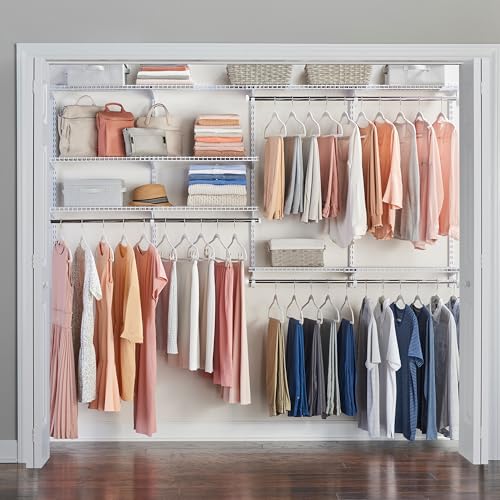
Rubbermaid Configurations Deluxe Custom Closet Kit, 4–8 Feet
Creates adjustable hanging and shelf infrastructure for one measured wall. Check usable width, wall construction, baseboards, door swing, corner transitions, rod heights, shelf depth, installation, and remaining walkway clearance.
Verified ASIN: B00123800Q
Simple Houseware Adjustable Closet Hanging Rod, White
Adds a second hanging level for a wall dominated by short garments. Check garment length, lower-level access, load, and clearance beneath the rod.
Verified ASIN: B0BN78VZ96
Clear Acrylic Shelf Dividers for Closet Organization, 6-Pack
Keeps sweaters, jeans, bags, and folded sections upright. Confirm shelf thickness, depth, stack width, divider height, and removal clearance.
Verified ASIN: B077W69BQC
IRIS USA 3-Drawer Wide Storage Cart with Wheels
Adds contained storage where built-in drawers are missing. Check full dimensions, drawer-opening path, opposite-wall clearance, baseboards, wheels, stability, and hanging-clothing clearance.
Verified ASIN: B08S9FDH1T
Simple Houseware 3-Tier Stackable Mesh Shoe Rack
Creates one visible footwear zone. Check shoe count, rack width and depth, boot needs, garment length, and walkway clearance.
Verified ASIN: B0B6GZV3R4
HBlife 6-Pack Clear Shelf Dividers and Purse Organizers
Keeps frequently used bags upright and visible. Confirm shelf thickness, bag width and height, shelf depth, and removal access.
Verified ASIN: B093C7BZV5
Rev-A-Shelf 14-Inch Pull-Out Valet Rod
Supports outfit planning, steaming preparation, packing, or next-day clothing. Confirm mounting surface, extension path, cabinet depth, load suitability, and walkway clearance.
Verified ASIN: B09475HBDK
EZVALO Rechargeable Motion Sensor Closet Lights, 4-Pack
Improves visibility on dark shelves, corners, drawers, and shoe zones. Check charging access, sensor placement, adhesive compatibility, and removal marks.
Verified ASIN: B0FQB6Z836
MISSLO 60-Inch Gusseted Garment Bags, 3-Pack
Protects long occasional garments in a defined long-hanging section. Use only for clothing that genuinely needs protection because bulky bags reduce visibility and rod capacity.
Verified ASIN: B0CDFYLW7N
Sterilite 32-Quart Latching Boxes, 6-Pack
Creates contained seasonal or occasional storage. Six large bins can quickly consume upper and circulation capacity, and heavy filled bins should not be placed overhead.
Verified ASIN: B01NAL6MND
SONGMICS 30-Inch Folding Storage Ottoman Bench
Provides seating and limited storage only in a sufficiently large walk-in. Check full footprint, surrounding walkway, lid access, doorway clearance, and whether seating is genuinely needed.
Verified ASIN: B07JQ22YYSRecommended product logic
Map the walls first, use an adjustable kit only where infrastructure fails, add double hanging only to a short-garment wall, use dividers for folded clothing and bags, add one drawer unit and one shoe zone only where circulation remains clear, use a valet rod only for controlled staging, and add lighting before adding more storage to dark areas.
Affiliate disclosure: Inplanty may earn a commission from qualifying purchases made through links on this page, at no additional cost to you.
Frequently Asked Questions
What is the best way to organize a walk-in closet?
Audit the wardrobe, measure every wall and walkway, assign one main function to each wall, keep active clothing near the entrance, and preserve the center as circulation space.
How should a walk-in closet be divided into zones?
Use separate zones for short hanging, long hanging, folded clothing, drawers, shoes, bags, accessories, seasonal storage, and shared-person boundaries.
What should go near the entrance of a walk-in closet?
Daily shirts, workwear, current-season jackets, frequently worn shoes, everyday bags, and active accessories.
How do you organize a small walk-in closet?
Use one main function per wall, keep the center open, limit furniture, use double hanging only where needed, and move seasonal storage elsewhere.
Should a walk-in closet have an island?
Only when there is enough room to preserve walkway and drawer clearance on every side and the island solves a real storage need.
How do you organize shoes in a walk-in closet?
Create one primary shoe zone, keep active pairs closest to the entrance, and move formal or off-season footwear higher or farther away.
How do you organize bags in a walk-in closet?
Store frequently used bags upright on one dedicated shelf using dividers or cubbies, and move occasional bags higher or farther from the entrance.
How should two people share a walk-in closet?
Divide walls, rods, drawers, and shoe zones physically based on actual storage needs rather than equal width alone.
What should go on high closet shelves?
Lightweight seasonal clothing, travel bags, formal accessories, empty luggage, garment bags, and clearly labeled occasional items.
Should long and short clothes be stored separately?
Yes. Separating them prevents long garments from covering shelves and allows double hanging where short garments dominate.
How much walkway space should remain?
Enough to enter, turn, open drawers, remove bins, stand in front of shelves, access corners, and carry laundry comfortably.
How do you organize seasonal clothes in a walk-in closet?
Use clearly labeled high or secondary storage, bring active-season clothing forward, and review the category at every rotation.
How do renters organize a walk-in closet?
Use portable or permitted systems, freestanding drawers, removable lighting, and nonpermanent organizers after checking lease and manufacturer requirements.
How do you keep a walk-in closet organized after laundry?
Use broad categories, clear wall functions, short folded stacks, dedicated drawer purposes, empty-hanger storage, and a predictable return order.