
How to Organize a Small Closet So Everything Fits
Organize a small closet by removing clothing and accessories you no longer use, separating daily and seasonal items, and assigning each area a clear function. Use the easiest hanging and shelf space for frequently worn clothes, add a second rod or adjustable storage only when it matches your wardrobe, and keep shoes, accessories, and occasional items within strict capacity limits.
The Finished Result
The closet holds the active wardrobe without crowding. Short and long garments use separate vertical zones, folded stacks remain stable, shoes stay within one boundary, seasonal items move to secondary storage, and clean laundry has an obvious destination.
- Active and seasonal clothing are separated
- Rod space matches garment length
- Folded storage fits actual volume
- Shoes and accessories have fixed limits
- Functional open capacity remains
Quick Answer
Reduce the wardrobe to what the closet can realistically hold, measure the closet and representative garments, divide the interior into short hanging, long hanging, folded, shoe, and accessory zones, and reserve prime space for current-season daily clothing. Add a second rod, hanging shelves, drawer unit, shoe rack, or door organizer only when the category and clearance justify it.
Use the closet organization guide to find the right solution for every closet type. For whole-room storage, see the Bedroom Organization Guide and Small Bedroom Storage Ideas.
Why Small Closets Become Overcrowded
| Closet symptom | Likely cause | First correction |
|---|---|---|
| Clothes are difficult to slide | Hanging section is over capacity | Reduce inventory or move seasonal items |
| Floor is covered with shoes | No defined shoe limit | Create one shoe zone |
| Shelf stacks collapse | Categories are too broad or unsupported | Use shorter stacks or dividers |
| Closet looks full but stores little | Vertical space is unused | Reassess rod and shelf placement |
| Door will not close | Storage blocks clearance | Reduce depth or relocate door storage |
| Clothes remain outside | Daily categories lack accessible homes | Reassign prime storage |
| Bins are never opened | Contents are hidden or hard to reach | Improve visibility or move the category |
| Closet becomes messy after laundry | Return system is too detailed | Simplify categories |
Capacity comes first
A small closet is primarily a capacity and access problem. Organizers cannot compensate for an inventory that greatly exceeds the available space.
Measure Every Usable Area
Measure the closet
- Interior width and depth
- Floor-to-ceiling height
- Rod height and length
- Shelf width, depth, and spacing
- Door opening and swing
- Sliding-door overlap
- Side-wall space
- Floor area and baseboards
- Existing fixtures
- Reach to upper storage
Measure the wardrobe
- Long dresses and coats
- Shirts and jackets
- Folded sweaters
- Shoe and boot height
- Handbags
- Storage bins
- Hanging organizers
- Drawer units
Use usable dimensions
The system must fit both the closet and the wardrobe. Outer wall measurements alone are not enough.
Check door and movement clearance
- Hangers do not block the door.
- Drawers open fully.
- Shoe racks clear hanging clothing.
- Door organizers clear interior shelves.
- Bins can be removed.
- Clothing can slide along the rod.
- The closet light remains accessible.
- The floor remains cleanable.
Reduce the Inventory to Closet Capacity
Work one category at a time
- Hanging tops
- Pants and skirts
- Dresses and long garments
- Sweaters
- Shoes
- Bags
- Accessories
- Seasonal clothing
- Unrelated household items
You do not need to empty the entire closet at once if doing so makes the project unmanageable.
Remove clothing that should not return
- Damaged items not being repaired
- Clothing that no longer fits
- Uncomfortable pieces
- Duplicates
- Items not worn
- Clothes that do not match current routines
- Pieces retained only from guilt
- Empty boxes and shopping bags
- Unused hangers
- Unrelated clutter
Avoid rigid clothing-count rules
The right inventory depends on climate, routine, laundry frequency, work needs, personal preferences, and secondary storage.
Separate active, seasonal, and occasional clothing
Active wardrobe
Current-season clothing used in normal daily routines.
Seasonal wardrobe
Clothing needed in another season.
Occasional wardrobe
Formalwear, costumes, specialty clothing, and rarely used pieces.
Prime-space rule
Prime small-closet storage should serve the active wardrobe first.
Set category boundaries
Use one rod section for shirts, one shelf for sweaters, one rack for shoes, one bin for seasonal accessories, one hook section for bags, and one drawer for small items. When a category exceeds its boundary, reduce, rotate, or relocate before adding storage.
Divide the Closet by Function
Short hanging
Shirts, blouses, jackets, folded-over pants, skirts, and children’s clothing.
Long hanging
Dresses, coats, robes, jumpsuits, and other full-length garments.
Folded clothing
Sweaters, jeans, activewear, T-shirts, sleepwear, and underwear.
Shoes
Current-season footwear inside one measured floor, shelf, or door boundary.
Bags and accessories
Daily bags, belts, scarves, hats, ties, jewelry, and small items.
Seasonal storage
Lightweight occasional categories in labeled upper or secondary storage.
Each zone should contain items with similar size, frequency, and storage needs.
Put frequently worn clothing in prime storage
Use eye-level hanging space, easy shelves, front shoe positions, accessible drawers, and main hooks for daily tops, work clothes, frequently worn pants, current-season shoes, and everyday accessories.
Use upper storage for lightweight occasional items
Upper shelves may hold seasonal clothing, travel bags, formal accessories, lightweight garment bags, or empty luggage where appropriate. Avoid heavy bins, daily clothes, loose small items, and containers that cannot be removed safely.
Use the floor deliberately
The floor may support one shoe rack, a low drawer unit, a compact hamper, or one stable basket beneath short garments. Avoid loose shoes, unidentified boxes, shopping bags, and anything that prevents cleaning.
Improve Hanging Storage
Separate short and long garments
Do not reserve full-height hanging space for garments that use only the upper half. Group short pieces together, then keep one dedicated long-hanging section for dresses, coats, robes, and jumpsuits.
Add a second rod only when appropriate
Best for
- Shirts
- Folded pants
- Skirts
- Children’s clothing
- Wardrobes dominated by short garments
Limitations
- Reduces long-hanging space
- May block shoes or drawers
- Can make lower garments harder to view
- Requires sufficient height
- Must support the intended load
Second-rod verdict
A second rod is useful only when the wardrobe contains enough short garments to justify trading away long-hanging space.
Use slim hangers carefully
Slim non-slip hangers can reduce hanger bulk and help slippery garments stay in place, but they do not solve excessive inventory and may not suit heavy jackets, structured garments, or fabrics needing padded support.
Hanger principle
Use slim hangers after editing the wardrobe—not to avoid editing it.
Keep hangers appropriate to clothing needs
Use slim non-slip hangers, sturdy jacket hangers, clip hangers, padded hangers, and trouser hangers according to garment construction. Clothing protection matters more than a perfectly matching hanger collection.
Avoid overfilling the rod
A functional hanging section allows garments to slide, categories to remain visible, individual pieces to be removed without pulling several items, and clean laundry to return easily. If clothes cannot move, the section is over capacity.
Improve Shelf Storage
Use short folded stacks
Keep sweaters, jeans, sweatshirts, activewear, and T-shirts in low stacks separated by broad category. A stack should be easy to remove from the middle and easy to return after laundry.
Add shelf dividers where stacks collapse
Shelf dividers can support sweaters, jeans, bags, linens, and several small shelf categories. Confirm shelf thickness, depth, divider height, stack width, and removal clearance.
Use shelf risers only for suitable categories
Risers can help with small bags, folded accessories, shoes, or short storage boxes where vertical shelf space is genuinely wasted. They do not solve categories that already exceed capacity.
Use under-shelf baskets selectively
They may hold scarves, small bags, flat accessories, or lightweight seasonal items, but they reduce clearance below, can interfere with hanging clothing, and are unsuitable for heavy inventory.
Add Folded-Clothing Storage
Hanging shelf organizer
Best for sweaters, T-shirts, jeans, accessories, and small bags when rod width is more available than floor space.
Trade-off: it consumes hanging capacity and may sag when overloaded.
Stackable drawer unit
Best for underwear, socks, activewear, sleepwear, T-shirts, and accessories beneath short garments.
Trade-off: it consumes floor and shoe space and needs full drawer clearance.
Open bins or baskets
Best for broad categories that do not require precise folding.
Trade-off: deep containers can hide clothing and encourage mixing.
Space-trade principle
A hanging organizer trades rod width for folded storage; a drawer unit trades floor space for contained storage. Choose the resource the closet has more of.
Organize Shoes
Limit shoes to one defined zone
Choose one floor rack, one shelf, one door organizer, one under-hanging section, or one seasonal bin elsewhere. Shoe storage should not expand across the entire closet floor.
Use a low shoe rack when it fits
A low rack keeps frequently worn pairs visible and uses vertical floor space. Check rack depth, shoe height, garment length, door clearance, and floor-cleaning access. Boots and tall footwear may require a separate solution.
Rotate seasonal shoes
Keep current-season daily shoes and work footwear active. Move off-season boots, formal shoes, and rarely worn specialty footwear elsewhere where practical.
Use How to Organize Shoes in a Closet for the full footwear system once published.
Organize Accessories and Bags
Use hooks for active accessories
Hooks may support belts, scarves, hats, small bags, robes, or outfit staging. Avoid overloading, blocking the door, layering many items on one hook, and attaching heavy bags to unsuitable hardware.
Store bags upright
Use shelf dividers, one shelf section, hooks, or a small bin. Only frequently used bags should occupy prime storage.
Contain small accessories
Belts, scarves, jewelry, ties, sunglasses, and hair accessories need visibility and clear boundaries rather than excessive micro-compartments.
Use the Closet Door Carefully
Over-the-door organizers may hold shoes, scarves, belts, accessories, or small bags when the door is hinged and compatible. They can also prevent closure, collide with shelves, swing during use, or overload unsuitable hardware.
Skip door storage when
The closet has sliding doors, insufficient clearance, interior shelf collisions, unsuitable hardware, or already feels visually overcrowded.
Use Upper and Seasonal Storage
Store off-season clothing on an upper shelf, under the bed, in another closet, inside luggage, in a storage bench, garment bag, or clearly labeled bin. Keep current-season clothing in prime small-closet space.
Avoid heavy containers overhead
Upper storage should remain lightweight, clearly identified, and safe to remove.
Small-Closet Solutions by Situation
Small reach-in closet
Prioritize short and long hanging zones, one second rod where justified, shelf dividers, low shoe storage, and doorway visibility.
Narrow closet
Use shallow organizers, front-facing categories, limited door storage, clear floor access, and no oversized drawers.
Small closet with one rod
Separate long and short garments, add a lower rod only under short clothing, use the top shelf efficiently, and consider one compact floor unit.
Small closet with no shelves
Measure first, identify hanging versus folded needs, then add portable hanging shelves or a low drawer unit while preserving long-hanging space.
Small closet without drawers
Use a hanging shelf organizer, portable drawer unit, stackable bins, or shelf dividers according to rod width and floor capacity.
Rental closet
Prioritize portable rods, freestanding drawers, hanging shelves, shelf dividers, and compatible door storage. Check lease and manufacturer requirements.
Shared small closet
Divide physical zones before purchasing organizers, separate active categories, limit shared floor storage, and agree on laundry-return rules.
Organize by Lifestyle
Office or formal wardrobe
Prioritize hanging space, garment protection, jackets, trousers, dresses, accessories, and seasonal rotation.
Casual wardrobe
Prioritize folded clothing, short hanging, activewear, shoes, and broad drawer or bin categories.
Minimal wardrobe
Use open visibility, few broad categories, no unnecessary organizer layers, and flexible shelf capacity.
Large wardrobe in a small closet
Use seasonal rotation, secondary storage, category limits, wardrobe editing, and occasional-wear relocation. The solution is inventory distribution—not increasingly dense storage.
Create a Laundry-Return System
Organize clean clothing into broad categories such as work tops, casual tops, pants, dresses, sweaters, activewear, sleepwear, underwear, and accessories. The system should make laundry easy to return without prolonged sorting.
Define temporary clothing storage
Give worn-but-reusable clothing, repair items, dry cleaning, donations, and tomorrow’s outfit one small boundary and a processing deadline. Do not let temporary clothing become a permanent chair, floor, or door pile.
Maintain the Small Closet
Weekly reset
- Return shoes
- Rehang clothing
- Refold collapsed stacks
- Clear the floor
- Return accessories
- Process temporary clothing
- Remove empty hangers
- Correct category overflow
- Put laundry away
Monthly capacity review
- Can clothing still slide?
- Are stacks collapsing?
- Are shoes leaving their zone?
- Are bins being used?
- Are seasonal items occupying prime space?
- Are clothes left outside?
- Have new items entered without space?
Overflow rule
If the closet repeatedly overflows, reduce or relocate inventory before adding another organizer.
Use a capacity-based new-item rule
- Identify the category.
- Confirm it fits the category boundary.
- Assign its permanent storage position.
- Remove or relocate an item if the category is full.
- Avoid leaving the new item in a bag or temporary pile.
How to Organize a Small Closet Step by Step
Identify the closet’s main function
Bedroom, entryway, wardrobe, or shared storage.
Measure the interior, doors, rods, shelves, and floor
Use usable dimensions.
Gather clothing, shoes, bags, and accessories
See the full inventory.
Remove damaged, unused, and unsuitable items
Reduce before organizing.
Separate active, seasonal, and occasional categories
Protect prime space.
Decide what must remain in the closet
Move secondary categories elsewhere.
Create hanging, folded, shoe, and accessory zones
Match category size and frequency.
Assign prime storage to frequently used items
Support daily dressing.
Add a second rod only if short garments justify it
Preserve long-hanging needs.
Improve shelves with dividers, drawers, or hanging storage
Choose according to available rod width and floor space.
Give shoes and accessories clear limits
One measured boundary per category.
Use upper and door storage selectively
Preserve clearance and safety.
Move seasonal and occasional items elsewhere
Keep the active wardrobe accessible.
Test during normal dressing and laundry
Observe real friction.
Add weekly and monthly capacity reviews
Maintain the system.
Small-Closet Organization Mistakes
Buying organizers before reducing clothing
The system is built around excess inventory.
Using slim hangers to avoid decluttering
The rod becomes more densely overcrowded.
Hanging everything
Folded categories consume unnecessary rod space.
Folding everything
Shelves and drawers become overloaded.
Mixing long and short garments
Vertical hanging space is wasted.
Keeping every season in prime storage
Daily clothing becomes difficult to reach.
Storing shoes loose on the floor
The closet becomes difficult to clean.
Using too many deep bins
Clothing becomes hidden.
Filling every inch
Garments cannot move and laundry cannot return.
Adding door storage without clearance checks
The door no longer closes properly.
Keeping heavy bins overhead
Retrieval becomes difficult or unsafe.
Creating too many categories
Laundry return becomes too slow.
Ignoring temporary clothing
The floor or chair becomes overflow.
Adding clothes without assigning space
The system gradually fails.
Which Small-Closet Storage Method Should You Choose?
| Reader situation | Best starting method |
|---|---|
| Too many clothes | Reduce and rotate inventory |
| Mostly shirts and short garments | Add a second hanging rod |
| Many folded clothes | Hanging shelves or drawer unit |
| Sweater stacks collapse | Shelf dividers |
| Shoes cover the floor | Low shoe rack or defined shelf |
| Closet has no drawers | Portable drawer unit or bins |
| Closet has no shelves | Hanging shelves or portable shelving |
| Rental closet | Nonpermanent rods, drawers, and dividers |
| Deep upper shelf | Labeled seasonal bins |
| Door has usable clearance | Limited over-door storage |
| Wardrobe is seasonal | Rotate off-season clothing |
| Shared small closet | Divide physical zones first |
| Rod is tightly packed | Reduce inventory before changing hangers |
| Clothes remain outside | Simplify the return system |
Final recommendation
Reduce the wardrobe to realistic capacity, separate active and seasonal clothing, divide the closet into clear hanging, folded, shoe, and accessory zones, and add organizers only where they improve daily access.
Verified Product Examples
Do not buy the complete list as one setup. Measure the closet, edit the wardrobe, identify whether rod width, shelf space, floor space, door clearance, seasonal storage, or visibility is the actual constraint, then choose only the relevant format.

Simple Houseware Adjustable Closet Hanging Rod, White
Adds a second hanging level beneath an existing rod for short garments. Check existing rod height, lower-garment length, closet width, floor clearance, door movement, and intended clothing load.
Verified ASIN: B0BN78VZ96
Amazon Basics Slim Velvet Non-Slip Space Saving Suit Clothes Hangers, 50-Pack
Reduces hanger bulk for suitable garments after the rod is edited. It does not solve excessive clothing inventory and may not suit heavy or structured garments.
Verified ASIN: B0756D8W87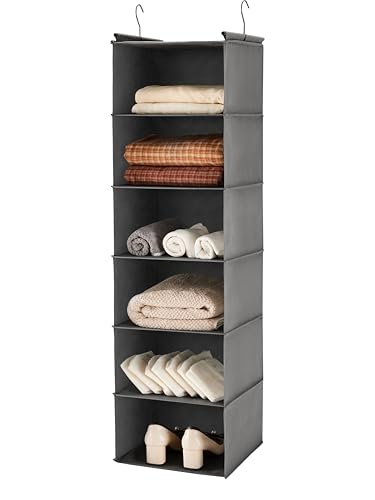
MAX Houser 6 Tier Shelf Hanging Closet Organizer
Converts rod width into shelves for sweaters, T-shirts, jeans, accessories, or small bags. Check organizer length, closet depth, garment clearance, and category weight.
Verified ASIN: B07FX8RZJZ
Clear Acrylic Shelf Dividers for Closet Organization, 6-Pack
Keeps sweater, jeans, sweatshirt, bag, or linen stacks from collapsing. Confirm shelf thickness, depth, divider height, stack width, and removal clearance.
Verified ASIN: B077W69BQC
Simple Houseware 3-Tier Stackable Mesh Shoe Rack, Black
Creates one floor boundary for frequently worn shoes. Check width, depth, shoe height, garment length, door clearance, and floor-cleaning access.
Verified ASIN: B0B6GZV3R4
IRIS USA 3-Drawer Wide Storage Cart with Wheels, Black
Adds contained storage for underwear, socks, activewear, sleepwear, T-shirts, or accessories. Check footprint, drawer extension, baseboards, hanging clearance, wheels, and stability.
Verified ASIN: B08S9FDH1T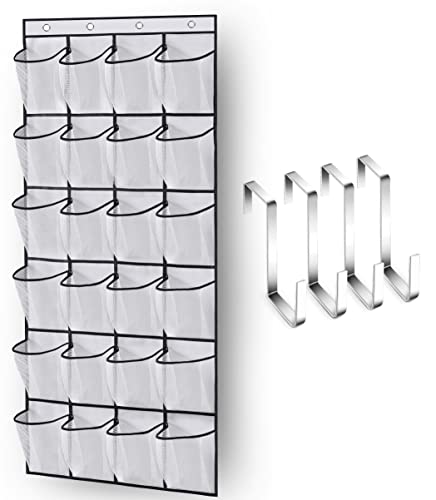
MISSLO Over The Door Shoe Organizer, 24 Large Mesh Pockets
Moves lightweight shoes and accessories off shelves and the floor. Use only on a compatible hinged door after checking thickness, top clearance, projection, shelf collisions, and loaded closure.
Verified ASIN: B01N2JICUM
Sterilite 15 Qt Latching Storage Box, Pack of 12
Creates visible storage for lightweight seasonal accessories or small occasional categories. A twelve-pack is excessive for many small closets and should not encourage unnecessary inventory.
Verified ASIN: B01NBMM34J
EZVALO 10-Inch Rechargeable Motion Sensor Closet Lights, 2-Pack
Improves visibility when poor lighting remains after decluttering and zoning. Check adhesive compatibility, charging access, sensor position, and removal marks, and follow manufacturer instructions.
Verified ASIN: B0F7VV8512Recommended product logic
Reduce and rotate first, use a second rod only for a short-garment-heavy wardrobe, add slim hangers after the rod is under control, choose either hanging shelves or a drawer unit according to available rod width and floor space, give shoes one zone, and use upper bins or lighting only when the measured need remains.
Affiliate disclosure: Inplanty may earn a commission from qualifying purchases made through links on this page, at no additional cost to you.
Frequently Asked Questions
What is the best way to organize a small closet?
Reduce the wardrobe to realistic capacity, separate active and seasonal clothing, create hanging, folded, shoe, and accessory zones, and add organizers only where access improves.
How do you maximize space in a small closet?
Measure the wardrobe, separate short and long garments, use upper and floor space deliberately, and keep only the current active wardrobe in prime storage.
Should clothes be hung or folded in a small closet?
Hang garments that benefit from hanging and fold categories such as sweaters, jeans, activewear, and T-shirts when folded storage is more efficient.
Are slim hangers worth using in a small closet?
Yes for suitable garments after the wardrobe has been edited, but they should not be used to make an already overcrowded rod denser.
How do you organize a small closet with one rod?
Separate long and short garments, add a lower rod only beneath short clothing, and use the upper shelf and floor according to folded and shoe needs.
How do you organize a small closet with no shelves?
Measure first, then use portable hanging shelves, a low drawer unit, or compatible shelving while preserving long-hanging space.
How do you organize shoes in a small closet?
Give shoes one defined floor, shelf, or door zone and rotate off-season or rarely worn footwear elsewhere.
Can you add a second rod to a small closet?
Yes when short garments dominate and the lower rod will not interfere with long clothing, drawers, shoes, or door movement.
How do renters organize a small closet?
Use portable rods, hanging shelves, freestanding drawers, shelf dividers, and compatible door storage while checking lease and stability requirements.
What should be stored on the top closet shelf?
Use it for lightweight seasonal clothing, travel bags, formal accessories, or clearly labeled occasional categories.
How do you organize seasonal clothing in a small closet?
Keep current-season clothes in prime storage and move off-season items to labeled upper or secondary storage.
How do two people share a small closet?
Divide physical zones first, separate active categories, limit shared floor storage, and agree on category and laundry-return rules.
How much empty space should remain in a closet?
Leave enough room for garments to slide, drawers to open, bins to be removed, laundry to return, and categories to expand slightly during normal use.
How do you keep a small closet organized after laundry?
Use broad obvious categories, assign every item a permanent home, process temporary clothing, and complete a weekly reset.