
How to Organize a Small Bathroom So It Stays Clear
Organize a small bathroom by reducing what lives in the room, separating daily items from backstock, and assigning clear sink, shower, toilet, towel, and cleaning zones. Measure cabinet openings, plumbing, door movement, and floor gaps before adding organizers.
What the Organized Bathroom Should Do
The finished space should support the morning and evening routine without forcing the reader to move unrelated products. It should keep wet-zone storage ventilated, preserve access to plumbing, and leave enough open surface and floor area for cleaning.
Result checklist
- Counter holds only daily essentials
- Shower products stay contained
- Backstock stays separate
- Towels have a drying location
- Plumbing remains accessible
- Floor and door paths stay clear
Quick Answer
Start by removing duplicates, expired products, empty packaging, and items used outside the bathroom. Keep daily products near the sink or shower, move bulk refills to secondary storage, and give each remaining routine one broad zone. Add a shallow under-sink organizer, narrow cart, wall shelf, shower caddy, hooks, or drawer trays only when the measured space and clearance justify them.
Table of Contents
Why Small Bathrooms Become Cluttered
The visible clutter is usually a symptom of excess inventory, poor routine placement, or storage that blocks access. Diagnose the failure before purchasing another container.
| Symptom | Likely cause | First correction |
|---|---|---|
| Counter is always covered | Daily and occasional products are mixed | Keep only daily-use items in the sink zone |
| Cabinet is full but hard to use | Deep storage and plumbing hide products | Create shallow removable groups around pipes |
| Shower floor holds bottles | No defined wet-zone storage | Add one measured shower shelf or caddy |
| Extra toiletries take over | Backstock is stored with active products | Move bulk refills to secondary storage |
| Towels stay damp or pile up | No clear drying and clean-towel zones | Separate towel use, drying, and storage |
| Cleaning is difficult | Too many objects sit on the floor and surfaces | Reduce freestanding storage and preserve open access |
Audit the Complete Bathroom Inventory
Gather items from the vanity, shower, medicine cabinet, bathroom floor, linen storage, bedroom, and any refill boxes stored elsewhere. Group them by routine rather than by package appearance.
Active Products
Tooth care, daily skincare, deodorant, regular hair care, current shower products, and medication stored according to its instructions.
Secondary Products
Special treatments, travel items, styling tools, first-aid supplies, guest products, and infrequently used grooming items.
Backstock
Unopened shampoo, soap, toilet paper, cotton products, replacement toothbrushes, and duplicate consumables.
Reduce Before Organizing
Remove empty packages, damaged tools, expired products where applicable, products that irritate or are no longer used, excessive samples, duplicates beyond a realistic refill quantity, and items that belong in another room.
The Small-Bathroom Capacity Rule
The bathroom should hold the active routine plus a limited working reserve—not the household’s complete bulk inventory. If refills occupy prime daily storage, move them to a nearby dry secondary location.
Measure Before Adding Bathroom Storage
Vanity and Cabinet
Measure cabinet opening width, usable depth, shelf height, plumbing position, pipe clearance, door hinges, drawer extension, and access to shutoff valves.
Walls and Toilet Area
Measure wall width, toilet tank height and depth, ceiling clearance, baseboards, trim, vents, outlets, and the space needed to service the toilet.
Narrow Floor Gaps
Measure the smallest width at the floor and countertop, cart depth, wheel movement, drawer or door opening, and whether the unit can be removed for cleaning.
Shower and Door
Check wall material, approved mounting surface, shower-door movement, splash exposure, bottle height, drainage, and access to fixtures.
Do not block shutoff valves, traps, vents, heaters, outlets, or service panels. Avoid heavy overhead storage and follow manufacturer instructions for wall mounting, adhesives, load limits, and damp-area use.
Create Functional Bathroom Zones
Sink Zone
Daily tooth care, hand soap, and the smallest realistic set of morning and evening products.
Shower Zone
Only products actively used in the shower, stored off the floor with drainage and fixture clearance.
Under-Sink Zone
Refills, cleaning supplies, and less-frequent products grouped around plumbing rather than stacked behind it.
Towel Zone
One drying location per active towel and a separate compact location for clean towels.
Toilet Zone
A small working supply of toilet paper and only the items needed near the toilet.
Backstock Zone
Unopened extras stored outside prime space and replenished into the active zones as needed.
Compare Small-Bathroom Storage Methods
| Storage method | Best for | Advantage | Limitation |
|---|---|---|---|
| Under-sink tier | Refills and cleaning supplies | Uses vertical cabinet space | Must fit around pipes |
| Slim rolling cart | Narrow unused floor gap | Portable vertical storage | Uses floor and movement space |
| Over-toilet shelf | Bathrooms with clear wall height | Adds storage without a cabinet | Can feel bulky and needs stability |
| Adhesive shower caddy | Active shower bottles | Keeps floor clear | Surface and load compatibility matter |
| Drawer trays | Small daily grooming items | Creates visible boundaries | Too many trays create micro-categories |
| Wall or door hooks | Towels and robes | Fast return | Can interfere with doors or finishes |
| Turntable | Bottles in a deep cabinet | Brings items forward | Wastes some rectangular capacity |
| Handled bin | One removable category | Easy to pull out for cleaning | Deep bins can hide products |
Adapt the System to the Bathroom
Bathroom With No Vanity
Use one narrow cart or wall cabinet, limited shower storage, hooks, and a nearby secondary supply location. Avoid adding several separate floor units.
Rental Bathroom
Choose freestanding shelves, rolling storage, portable drawer trays, and mounting products approved for the surface. Lease requirements and removal risks still apply.
Shared Bathroom
Give each person one clear daily bin or drawer section while keeping shared categories such as toilet paper and cleaning supplies separate.
Bathroom Used by Children
Place safe daily items within reach, keep hazardous or unsuitable products secured, and use broad categories that are easy to return.
How to Organize a Small Bathroom Step by Step
Empty every bathroom storage area
Gather products from all rooms so the system reflects the complete inventory.
Remove unusable and misplaced items
Discard empty packaging and relocate products that do not belong in the bathroom.
Separate daily products from backstock
Prime space should support the current routine, not bulk inventory.
Measure cabinets, walls, gaps, and doors
Record usable dimensions and operating clearance before selecting organizers.
Create sink and shower zones
Keep routine products closest to where they are used.
Organize around plumbing
Use shallow removable groups and preserve access to valves and pipes.
Choose one vertical storage solution
Use the toilet wall, a narrow gap, or a suitable wall—not every available surface.
Create towel and toilet-paper boundaries
Separate active-use items from clean reserves and bulk packages.
Restock with open capacity
Leave enough room to remove products and wipe every surface.
Test the routine
Complete the morning, shower, and cleaning routines without moving unrelated items.
Add a daily and weekly reset
Clear the counter daily and correct overflow before it becomes permanent.
Small-Bathroom Organization Mistakes
Buying organizers before measuring
The product fits the room but blocks plumbing, doors, or access.
Keeping all refills in the bathroom
Backstock consumes the space needed for daily routines.
Filling the entire counter
Cleaning becomes difficult and occasional products compete with essentials.
Using several floor units
Movement and cleaning space disappear even though storage increases.
Creating too many tiny categories
Putting products away requires too many decisions.
Ignoring wet-zone limitations
Mounting, drainage, ventilation, or material conditions are not respected.
Which Small-Bathroom Strategy Should You Use?
| Reader situation | Best starting method |
|---|---|
| Counter is crowded | Reduce to daily essentials and use one drawer or cabinet zone |
| Under-sink cabinet is deep | Shallow two-tier organizer or removable handled bins |
| No cabinet storage | One slim cart or measured over-toilet unit |
| Shower floor holds bottles | One surface-compatible caddy with drainage |
| Towels have no home | One hook per active towel plus separate clean-towel storage |
| Bathroom stores bulk supplies | Move backstock to a nearby dry secondary zone |
| Shared bathroom becomes mixed | One broad personal zone per user plus shared household zones |
| Cleaning is difficult | Reduce objects touching the floor and counter |
Final Recommendation
For most small bathrooms, keep the counter nearly clear, store active products at the point of use, place limited refills under the sink, use only one major vertical-storage solution, and move bulk backstock elsewhere. The room is organized when every routine works without moving unrelated items and every surface remains easy to clean.
Verified Product Examples
These Amazon US examples were verified on July 28, 2026. They are alternatives for different measured problems—not one universal package.
Affiliate disclosure: As an Amazon Associate, Inplanty may earn from qualifying purchases.

Simple Houseware 2-Tier Under Sink Organizer
Why it helps: Adds vertical storage for refills or cleaning supplies.
Trade-off: It must fit around pipes and preserve valve access.
Check: Cabinet opening, usable height, pipe position, shelf clearance, and door hinges.
Verified ASIN: B09YHZGN61
Check on Amazon
SPACEKEEPER 4-Tier Slim Rolling Storage Cart
Why it helps: Uses a narrow floor gap for removable vertical storage.
Trade-off: It occupies floor and movement space and can become overflow.
Check: Gap width at floor and counter, cart depth, wheel path, and cleaning access.
Verified ASIN: B07QL7GGNF
Check on Amazon
Kitsure 2-Pack Adhesive Shower Caddy
Why it helps: Moves active shower bottles off the floor.
Trade-off: Adhesive compatibility, load, removal, and surface condition determine whether it is suitable.
Check: Wall material, bottle height, shower-door movement, drainage, and installation instructions.
Verified ASIN: B09Z2XJ34K
Check on Amazon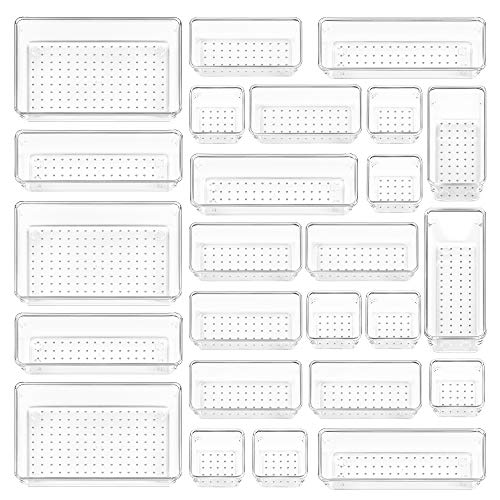
Vtopmart 25-Piece Clear Drawer Organizer Set
Why it helps: Separates small grooming and skincare items inside existing drawers.
Trade-off: A large set can create unnecessary micro-categories.
Check: Drawer interior width, depth, height, and the number of categories actually used.
Verified ASIN: B08KXKVT4K
Check on Amazon
Command Bath Large Towel Hooks
Why it helps: Creates fast towel return without a permanent rack.
Trade-off: Surface compatibility, installation, removal, and load limits matter.
Check: Towel weight, door or wall clearance, finish, and manufacturer instructions.
Verified ASIN: B01C60C4EG
Check on Amazon
iDesign 11.5-Inch Lazy Susan Turntable
Why it helps: Brings bottles forward in a deep vanity or linen cabinet.
Trade-off: The circular footprint uses rectangular cabinet space inefficiently.
Check: Cabinet depth, diameter, bottle height, rotation clearance, and plumbing.
Verified ASIN: B08VTT2SDD
Check on AmazonFrequently Asked Questions About Small-Bathroom Organization
What is the best way to organize a small bathroom?
Keep only daily-use items in prime storage, move backups and rarely used products elsewhere, create separate sink, shower, toilet, towel, and backstock zones, and use organizers only after measuring clearances.
How do you organize a small bathroom with no storage?
Use the wall above the toilet, one slim rolling cart, approved shower storage, door or wall hooks, and a limited number of portable bins. Keep the floor and door path clear.
What should stay on a small bathroom counter?
Keep only products used every day and items that can return in seconds. Store occasional skincare, backups, tools, and cleaning products elsewhere.
How should the area under the bathroom sink be organized?
Measure around pipes, separate daily refills from cleaning supplies, and use removable bins or a shallow two-tier organizer that preserves valve and leak access.
How can renters add bathroom storage?
Use freestanding over-toilet shelves, rolling carts, portable drawer organizers, approved adhesive or tension shower storage, and water-resistant hooks while following lease and surface instructions.
Where should extra toilet paper and toiletries be stored?
Keep a small working supply in the bathroom and move bulk backstock to a nearby closet, linen cabinet, or other dry secondary location.
How do you keep a small bathroom organized?
Reset the counter daily, return products to broad zones, clear the floor weekly, remove empty packaging, and review backstock monthly.
Should every bathroom product have its own container?
No. Use containers only when they create a clear boundary, improve access, protect small items, or make cleaning easier.