
Shoe Cabinet vs Entryway Bench: Which Is Better for Your Space?
Choose based on real operating depth, seating value, footwear type, visual-clutter tolerance, family access, ventilation, and whether the entryway can support floor furniture at all.
The Finished Result
The selected format solves the actual problem instead of adding furniture for tradition’s sake. Daily shoes fit, doors and drawers operate, seated use remains practical, wet footwear has a separate plan, and the walkway stays clear.
- Cabinet or bench is chosen by function
- Operating clearance is tested
- Real footwear dimensions are used
- Seating earns its footprint
- Neither option is forced into a too-small hall
Quick Verdict
A shoe cabinet is usually better for narrow or highly visible entryways because it provides concealed storage in a shallower footprint. An entryway bench is better when seating is genuinely useful and the space can accommodate its greater depth. Choose based on operating clearance, footwear size, household access, and whether wet shoes need ventilation.
For the full cluster, use the complete entryway organization guide. For complete footwear planning, see how to organize shoes by the front door.
Shoe Cabinet vs Entryway Bench at a Glance
| Factor | Shoe cabinet | Entryway bench |
|---|---|---|
| Typical footprint | Shallower | Deeper |
| Seating | No | Yes |
| Visual concealment | Usually strong | Depends on storage type |
| Daily access | Good, but requires opening | Usually faster |
| Wet-shoe ventilation | Often limited | Better with open cubbies |
| Tall boots | Often difficult | Depends on lower storage design |
| Narrow hallway fit | Usually better | Often difficult |
| Child access | Depends on doors and height | Often easier |
| Surface-clutter risk | Low without a large top | Seat may become a bag drop |
| Anchoring | Often required | Depends on height and design |
| Best use | Concealed dry-shoe storage | Seating plus accessible storage |
Dimensions vary by design
Compare categories first, then verify the actual product’s exterior dimensions, internal openings, operating footprint, and installation requirements.
What Is a Shoe Cabinet?
A shoe cabinet is typically a vertical unit with tilt-out compartments, hinged doors, shelves, or drawers. Its main advantage is keeping dry shoes visually contained in a relatively shallow, furniture-style footprint.
Advantages
- Usually better for narrow entryways
- Conceals footwear
- Keeps the floor visually calmer
- May provide a small landing surface
- Efficient for sneakers, flats, children’s shoes, and other low-profile footwear
Disadvantages
- No seating
- Tall boots may not fit
- Doors and drawers need operating clearance
- Wet shoes may lack ventilation
- Tall narrow units may require anchoring
- Internal dimensions can be much smaller than exterior dimensions
Choose a shoe cabinet when
- The entryway is narrow.
- Visual concealment matters.
- Most daily footwear is low-profile.
- Seating is unnecessary.
- The entrance opens into a living area.
- Wet shoes can dry elsewhere.
- Anchoring can be completed when required.
Avoid or reconsider a shoe cabinet when
- Tall boots dominate.
- Wet shoes need immediate storage.
- The open-drawer footprint blocks circulation.
- Children cannot operate the compartments safely.
- The household strongly prefers one-step open access.
What Is an Entryway Storage Bench?
An entryway bench combines seating with open shelves, cubbies, baskets, drawers, cabinets, or lift-top storage. Its value comes from supporting shoe changes while storing daily footwear or accessories.
Advantages
- Provides real seating
- Can combine several entryway functions
- Often easier for children
- Open designs offer ventilation
- Creates a defined shoe-removal zone
Disadvantages
- Requires more depth
- The seat can become clutter
- Open storage stays visible
- Large-looking benches may store less than expected
- Seating may be unusable in a narrow hall
- Lift-top designs need lid clearance
Choose a bench when
- Seating is genuinely needed.
- The entryway has sufficient depth.
- Children use the area.
- Daily shoes need quick access.
- The bench replaces separate seating and storage.
- Open or basket storage works for the household.
Avoid or reconsider a bench when
- The hallway is extremely narrow.
- Seated use would block circulation.
- The seat would mainly become a drop surface.
- Visual concealment is the top priority.
- No one needs seating.
- The bench cannot fit the largest footwear or baskets.
Which Uses Less Space?
A shoe cabinet usually uses less continuous floor depth. However, compare closed depth, tilt-out or open-door depth, bench depth, seated-use clearance, shoe overhang, door swing, and the remaining walking path.
Space verdict
A cabinet may be shallower while closed but temporarily occupy more space when opened. A bench occupies its full depth continuously and needs extra room for knees and feet.
Use the narrow entryway storage guide when circulation is the deciding factor.
Which Stores More Shoes?
The answer depends on internal compartment dimensions, shelf count, shoe size, footwear height, pair orientation, baskets, dividers, and whether boots are included.
Cabinet capacity advantage
A tall cabinet may store more low-profile shoes vertically.
Bench capacity advantage
A wider bench may store fewer total pairs but accommodate bulkier footwear more easily.
Do not trust advertised pair counts alone
Measure the household’s actual footwear and compare it with internal openings, shelf spacing, and tilt-out geometry.
Which Is Better for Your Situation?
For a narrow entryway
A slim shoe cabinet is usually the better starting option when furniture depth is the main constraint, seating is unnecessary, and dry shoes need concealment. A bench should be selected only when seated clearance is confirmed and the seating function is genuinely valuable.
For families with children
A bench is often better for young children because low open storage and seating simplify shoe changes. A cabinet may be better for older children and visually prominent entryways, provided doors and compartments are easy and safe to use.
See entryway storage for families.
For older adults or limited mobility
A bench is usually better when seated shoe changes matter. Evaluate finished seat height, firmness, stability, depth, ease of standing, clear floor space, and support where appropriate. This is practical planning, not individualized medical advice.
Use the entryway bench height guide.
For wet shoes
An open bench shelf or separate ventilated rack is generally better for damp footwear. Closed storage should hold dry shoes unless the design specifically supports appropriate ventilation.
Best wet-shoe system
Use a boot tray or open rack for wet footwear and move shoes into the cabinet or bench only after drying.
For boots
A bench with open lower storage or a separate open rack is often better for tall or bulky boots. Tilt-out cabinets can be restrictive because of compartment height, shoe length, and drawer angle.
For visual calm
A closed shoe cabinet usually looks calmer. A closed bench can also conceal footwear but uses more depth. Either option fails when overfilled or when its top becomes an unrestricted drop zone.
For the easiest reset
The easier format is the one household members can use in one or two steps. Open bench storage is faster but more visible. Cabinets conceal shoes but require opening and closing.
For renters
A low portable bench may be easier to move and reuse, while a slim cabinet may fit more rental layouts. Neither should be used contrary to anchoring instructions.
See renter-friendly entryway storage.
With coat storage
A cabinet pairs well with wall hooks, a peg rail, or a small shelf. A bench pairs well with hooks or a coat panel above. Measure finished furniture height, coat length, hook position, loaded coat depth, and all door or lid movement.
Measurements to Take Before Choosing
| Measure | For a cabinet | For a bench |
|---|---|---|
| Usable wall width | Cabinet width and anchoring position | Bench width and seated access |
| Furniture depth | Closed depth | Full continuous depth |
| Operating clearance | Tilt-out or door depth | Drawer, basket, cabinet, or lift-top movement |
| Human clearance | Standing access | Seated knees, feet, and passing space |
| Footwear | Longest shoe, tallest usable compartment | Shelf, cubby, or basket openings |
| Fixed obstacles | Baseboards, outlets, door swing | Baseboards, door swing, adjacent furniture |
Use the entryway organization checklist for the final measurement and implementation sequence.
Compare Real Capacity, Not Advertised Pair Counts
- Count active pairs.
- Measure the largest footwear.
- Review internal dimensions.
- Deduct space for frames, doors, and dividers.
- Leave limited spare capacity.
- Create separate wet-shoe storage.
Capacity changes with adult versus child footwear, high-tops, boots, heel height, shoe width, pair orientation, baskets, and shelf spacing.
Choose a Shoe Cabinet If…
- Your entryway is narrow.
- You want footwear concealed.
- Most active shoes are low-profile.
- Seating is unnecessary.
- The entrance opens into a living room.
- You have another solution for wet shoes.
- The unit can be anchored where required.
- Opening clearance is available.
Choose an Entryway Bench If…
- You need seating.
- Children use the entryway.
- The space has enough depth.
- Open or basket storage works.
- You store bulkier footwear.
- The bench replaces separate seating and shoe storage.
- The seat can remain clear.
- The storage is easy to reset.
Choose Neither If Floor Furniture Will Not Work
Neither option may be appropriate when the hallway is too narrow, door swings use the only wall, the household needs minimal shoe storage, wet footwear is the main issue, vertical storage is more practical, storage around the corner works better, suitable seating already exists elsewhere, or seasonal overflow has not been reduced.
Alternative categories
- Wall-mounted shoe storage
- Narrow open rack
- Boot tray
- Over-door storage
- Adjacent closet storage
- Small daily shoe basket
- Vertical shoe tower
Best next step
Use the complete no-closet entryway guide or the small-space storage guide to distribute functions beyond the literal foyer.
Can You Use a Shoe Cabinet and Bench Together?
Yes, but only when the entrance has adequate space, the functions are distinct, combined capacity is necessary, the bench is actually used, and wet footwear remains separate.
Combined-system warning
Do not use both simply to maximize storage. Too much furniture can create the problem the storage is meant to solve.
Shoe Cabinet vs Entryway Bench by Reader Situation
| Reader situation | Better starting choice | Why |
|---|---|---|
| Extremely narrow hallway | Shoe cabinet | Shallower footprint |
| Need seated shoe changes | Bench | Provides usable seating |
| Young children | Bench | Easier access and sitting |
| Door opens into living room | Shoe cabinet | Better visual concealment |
| Frequent wet shoes | Open bench or rack | Better airflow |
| Tall boots | Bench with open shelf | More flexible clearance |
| Many low-profile shoes | Tall cabinet | Uses vertical space efficiently |
| Rental apartment | Depends | Anchoring and portability decide |
| Strong clutter concern | Closed cabinet | Hides shoes |
| Older adult household | Bench | Supports seated use |
| Almost no floor space | Neither | Use wall or adjacent storage |
| Need fastest reset | Open bench storage | Fewer access steps |
Comparison Mistakes to Avoid
Choosing a bench because entryways “should” have seating
Seating must be useful and physically workable.
Choosing a cabinet by exterior depth only
Open-door and internal shoe dimensions matter.
Trusting advertised shoe capacity
Real footwear may be larger or bulkier.
Ignoring wet shoes and boots
These categories often decide the right format.
Ignoring anchoring requirements
Tall furniture may require secure installation.
Using closed storage to hide excess inventory
Hidden overcapacity still creates an unusable system.
Letting the bench become a drop zone
The seating function disappears.
Failing to test the walkway
Furniture can fit the wall and still fail in use.
Review common entryway organization mistakes before buying.
How to Choose Between a Shoe Cabinet and Bench
Count the daily shoes
Do not plan around the full household collection.
Measure the largest shoe and tallest boot
Use real footwear dimensions.
Mark the door swing and walking path
Protect circulation first.
Determine maximum furniture depth
Include operating and seated clearance.
Decide whether seating is genuinely needed
Do not buy a bench by default.
Decide whether concealment matters
Consider visibility from adjoining rooms.
Plan a separate wet-shoe area
Keep damp footwear ventilated.
Compare internal dimensions
Exterior measurements are not enough.
Check opening, sitting, and anchoring requirements
Confirm every operating condition.
Test the footprint with tape or boxes
Simulate real use.
Choose the smallest option that solves the required functions
More furniture is not the goal.
Move seasonal and occasional footwear elsewhere
Protect active capacity.
Copy This Setup
Narrow visible entry
- Slim closed shoe cabinet
- Separate wet-shoe tray
- No seating
- Minimal landing surface
- Anchoring completed if required
Family shoe-changing zone
- Measured bench depth
- Comfortable finished seat height
- Accessible cubbies or doors
- Seat kept clear
- Passing space tested
Almost no floor space
- Narrow open rack or wall storage
- Boot tray beyond narrowest point
- Adjacent seasonal storage
- No decorative floor furniture
- Strict active-shoe limit
Verified Product Examples by Format
Use these as format examples after the category decision is made. Verify every actual dimension, internal opening, operating clearance, seating requirement, and anchoring instruction before purchase.
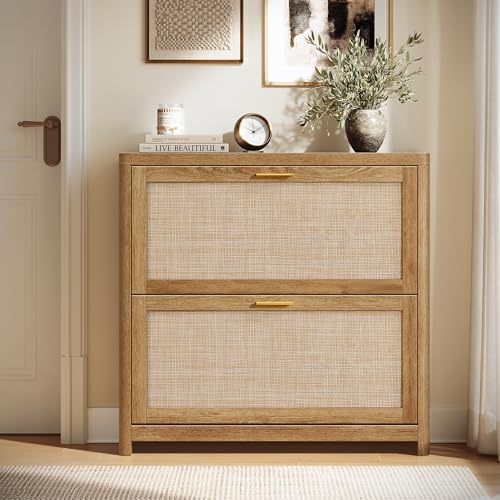
VASAGLE ELLAN Slim Shoe Storage Cabinet
Represents the cabinet side of the comparison: concealed dry-shoe storage in a relatively shallow furniture-style format. Best for narrow or living-room-facing entrances without a seating need. Avoid when tall boots dominate, wet shoes need immediate storage, or tilt-out clearance blocks circulation.
Verified ASIN: B0GTV6DTTZ
VASAGLE Shoe Storage Bench With Cushion and Doors
Represents the bench side: genuine seating with concealed dry-shoe storage and adjustable shelves. Best for families and households that benefit from seated shoe changes. Avoid where seated use blocks circulation or the seat is likely to become a permanent bag-drop surface.
Verified ASIN: B0GC26Q46L
SONGMICS Bamboo 3-Tier Shoe Bench
Shows the advantages of quick access, ventilation, and a smaller bench footprint. Best for small households and daily shoes when visible storage is acceptable. Trade-off: less concealment and limited tall-boot accommodation.
Verified ASIN: B082ZZ9JYP
HOOBRO Narrow 3-Tier Shoe Bench
Provides a shallower bench example for readers who need seating but have tighter depth limits. Test the footprint physically; a shallower seat may be less supportive and open footwear remains visible.
Verified ASIN: B0DYDKPLBR
VASAGLE Farmhouse Narrow Shoe Cabinet
Higher-capacity cabinet alternative for low-profile dry shoes. Best when concealment and vertical capacity matter more than seating. Do not rely on advertised pair capacity without checking shoe size, internal dimensions, and tilt-out clearance.
Verified ASIN: B0GSVFSJ51
VASAGLE ELLAN Shoe Bench With Cushion and Four Doors
Combines seating with a visually calmer closed-storage appearance. Best for wider, highly visible entryways where both seating and concealment matter. It still needs cabinet-door and seated-use clearance.
Verified ASIN: B0GTVT2725
SONGMICS Bamboo Shoe Rack Bench
Lower-cost seating and open shoe storage for a limited active rotation. Best for small households that value quick access and ventilation.
Verified ASIN: B01N125MU5Affiliate disclosure: Inplanty may earn a commission from qualifying purchases made through links on this page, at no additional cost to you.
Frequently Asked Questions
Is a shoe cabinet or entryway bench better?
A cabinet is better when shallow depth and concealment matter most. A bench is better when seating is genuinely useful and there is enough room.
Which takes up less space?
A slim cabinet usually uses less continuous floor depth, but its open doors or tilt-out drawers still need operating clearance.
Which stores more shoes?
A tall cabinet may store more low-profile shoes, while a bench may fit bulkier footwear more easily. Internal dimensions decide.
Can wet shoes go in a shoe cabinet?
Wet shoes should dry in a ventilated area before going into an unventilated closed cabinet.
Which is better for children?
A bench is often easier for young children because it provides seating and low-access storage, while a cabinet may suit older children and visually prominent entrances.
What should I use if neither fits?
Use a narrow open rack, boot tray, wall-mounted or over-door storage, an adjacent closet, or storage around the corner.