
Entryway Storage Ideas for Renters That Avoid Permanent Built-Ins
Create a functional entryway with portable, removable, and lease-compatible storage for coats, shoes, bags, keys, and daily essentials.
The Finished Result
The rental entryway feels intentional rather than temporary. One freestanding storage piece solves the largest problem, a small compatible vertical solution handles daily accessories, wet footwear has its own zone, and every item can move with you.
- Lease restrictions are respected
- Surfaces and doors are protected
- Circulation stays clear
- Tall furniture is used safely
- Storage can work in another home
Quick Answer
Renters can create functional entryway storage by combining one freestanding storage piece, one vertical or over-door solution, and a small landing zone for daily essentials. Choose options that comply with the lease, protect the door and walkway, and can move with you. Do not assume that every adhesive or removable organizer is damage-free.
For the full cluster, use the complete entryway organization guide. If the rental also lacks a closet, see how to organize a rental entryway without a closet.
Check the Lease Before Installing Entryway Storage
Review drilling restrictions, wall-anchor rules, adhesive-product restrictions, painting and repair requirements, door-modification rules, shared-hallway restrictions, furniture-anchoring instructions, circulation and exit requirements, common-area rules, and move-out restoration expectations.
| Term | What it actually means |
|---|---|
| No-drill | Does not require holes, but may still touch, press, rub, or mark surfaces. |
| Removable | Can be taken down, but removal may still affect weak paint, wallpaper, or veneer. |
| Low-damage | Designed to reduce damage risk, not eliminate it. |
| Repairable | May require patching, repainting, or restoration permitted by the lease. |
| Landlord-approved | Explicitly permitted under the lease or written instructions. |
Removable does not mean damage-free
Weak paint, textured walls, wallpaper, painted doors, humid surfaces, and recently painted walls may still be affected.
Decide What the Rental Entryway Must Store
List daily coats, shoes, bags, backpacks, keys, wallets, mail, umbrellas, pet supplies, children’s items, seasonal accessories, deliveries, and returns. Separate them into daily items, current-season items, temporary incoming items, and overflow that belongs elsewhere.
Capacity rule
A small rental entryway should not become whole-home overflow storage.
Choose Storage That Can Move With You
Evaluate each option by installation requirements, portability, weight, assembly, wall and door contact, floor footprint, compatibility with future homes, reuse potential, anchoring needs, and visual fit with adjoining rooms.
Best renter principle
Choose storage that solves today’s problem without becoming useless after the next move.
Best Freestanding Entryway Storage for Renters
Freestanding Coat Rack
Best for renters who cannot drill, small households, and temporary layouts. It is portable and easy to reposition, but it has limited real capacity and can become unstable when unevenly loaded. For a focused comparison, see renter-friendly coat storage options.
Portable Garment Rack
Best when more hanging capacity is needed and the home has usable floor width. It moves easily and uses hangers, but its large footprint can make a small entry feel like clothing storage.
Storage Bench
Best when seating provides meaningful value and the entryway has enough depth. It combines seating and shoe storage but can block circulation in narrow halls. Compare a shoe cabinet and entryway bench before deciding.
Slim Freestanding Shoe Cabinet
Best for dry daily shoes in narrow, visible entryways. Closed storage improves visual calm, but some units require anchoring and all need operating clearance. Wet footwear should dry separately before being enclosed.
Narrow Console Table
Best for keys, wallets, mail, and small essentials. It can define an open-plan entry but does not solve coat or shoe storage by itself. Keep the surface intentionally limited.
Rolling Cart
Best for flexible storage, pet supplies, mail, and daily accessories that move between the entryway and nearby rooms. It is portable but visually open and unsuitable for heavy coat storage.
Freestanding Wardrobe
Best for concealed coat storage in larger rentals. It offers closet-like function but uses significant floor space and may require anchoring. Damp outerwear needs airflow before being stored inside.
Best No-Drill Vertical Storage Options
Over-the-door storage
Best for compatible interior doors and lightweight shoes or accessories. Check door closure, hinges, handles, edge protection, and loaded projection.
Tension-pole storage
Best for adjustable vertical storage in compatible corners. Ceiling type, installation, pressure, stability, and product limits matter.
Removable hooks
Best for keys, hats, umbrellas, lightweight bags, and very light jackets where permitted. Heavy winter coats are not the default use case.
Over-door hooks
Best for lightweight temporary items on compatible doors. They may affect door fit, edges, hinges, and closing noise.
No-drill does not mean risk-free
Always follow the lease and the product’s installation, load, surface, and removal instructions.
Renter-Friendly Coat and Shoe Storage
Coats
Use a coat tree for a small daily rotation, a garment rack when more capacity is needed, and a wardrobe when concealment is worth the footprint. Store seasonal coats elsewhere.
Shoes
Use a slim cabinet for dry daily shoes, an open rack for airflow, a boot tray for wet footwear, and under-bed or closet storage for seasonal pairs. See how to organize shoes by the front door.
Create a Rental Entryway Drop Zone
Use a narrow console, shallow freestanding shelf, tray, small drawer, key bowl, mail holder, outgoing basket, rolling cart, or shelf attached to a freestanding unit.
Keep the drop zone small
Keys, wallet, mail, sunglasses, daily carry items, and one controlled outgoing category are enough. Unrestricted miscellaneous storage quickly becomes clutter.
Best Rental Entryway Setup by Space
If the entryway is very narrow
Use a slim cabinet, compact coat rack, shallow console, minimal daily inventory, and storage around the corner. Measure door swing, closed depth, open depth, walkway width, and loaded coat projection. See storage for a narrow rental entryway.
If the door opens into the living room
Use furniture-style closed storage, a narrow console, coordinated baskets, a limited coat rotation, and one rug or furniture grouping to define the zone.
If there is no entryway at all
Create one with a narrow freestanding unit, a small rug, a shoe zone, a landing surface, and storage on the nearest adjacent wall.
If the rental has no closet
Use a four-zone system for coats and bags, shoes, small essentials, and overflow elsewhere.
If the entryway is shared
Follow building rules, fire-exit requirements, theft-risk considerations, and personal storage boundaries. Do not place furniture or belongings in a shared hallway without explicit permission.
How to Protect Walls, Doors, and Floors
- Test removable products in a hidden area where appropriate.
- Follow manufacturer installation and removal instructions.
- Avoid overloaded adhesive hooks.
- Use felt pads beneath furniture.
- Protect flooring beneath wet shoes.
- Prevent door-edge scratches.
- Check baseboards before positioning furniture.
- Avoid trapping moisture behind cabinets.
- Document existing damage.
- Restore approved holes according to the lease.
This is practical planning guidance, not legal advice. Follow the lease, landlord instructions, building rules, and product specifications.
Furniture Anchoring in a Rental
Tall, narrow, top-heavy units, furniture with drawers or doors, and storage used by children may require anchoring. Check manufacturer instructions and ask the landlord before drilling.
Safety rule
Rental restrictions do not override safety requirements. When anchoring is not allowed, choose a lower, wider alternative rather than using tall furniture unsafely.
Storage That Can Be Reused After Moving
Strong reusable options include neutral benches, narrow consoles, freestanding wardrobes, rolling carts, modular cubbies, garment racks, baskets, coat trees, and adjustable shelving.
Evaluate standard dimensions, disassembly, weight, versatility, neutral appearance, durability during moves, and whether the item could serve another room later.
Open or Closed Storage in a Rental Entryway
| Storage type | Best for | Main advantage | Main drawback |
|---|---|---|---|
| Open rack | Daily access and wet items | Fast and ventilated | Visible clutter |
| Closed cabinet | Living-room-facing entry | Visual calm | May require anchoring |
| Bench baskets | Families and portable storage | Flexible | More floor depth |
| Coat tree | No-drill hanging | Portable | Limited capacity |
| Wardrobe | Concealed coats | Closet-like function | Large footprint |
| Over-door storage | Minimal floor space | Removable | Door compatibility |
Best overall approach
Use open storage for a limited number of frequently used or wet items, and closed storage for dry overflow and visually busy categories.
Step-by-Step Rental Entryway Plan
Review the lease
Confirm installation, door, surface, and common-area restrictions.
List daily entryway items
Separate daily access from seasonal overflow.
Remove occasional and seasonal items
Protect prime rental entryway capacity.
Measure the wall, floor, door swing, and walkway
Include open doors, drawers, and loaded coats.
Choose one primary freestanding piece
Solve the largest storage need first.
Add one compatible vertical solution
Use it only where the lease, surface, and product allow.
Create a small landing zone
Keys, mail, daily carry, and one outgoing category.
Add a wet-shoe area
Keep damp footwear out of closed storage.
Confirm anchoring needs
Do not use tall storage in an unsafe configuration.
Test for one week
Watch for damage, obstruction, crowding, and unused capacity.
Remove anything that causes problems
Circulation and surface protection come first.
Keep the system portable and below capacity
Make future moves easier.
Copy This Setup
Portable mixed system
- One slim freestanding shoe cabinet
- One compact coat rack
- Small landing tray
- Separate waterproof boot tray
- Seasonal overflow elsewhere
Depth-first setup
- Shallow cabinet
- Minimal coat storage
- No bench unless depth allows
- Storage around the corner
- Strict daily inventory
Multi-room furniture
- Modular rack
- Neutral baskets
- Portable cart
- Under-bed seasonal storage
- No highly specialized built-in look
Furniture-style storage
- Closed shoe cabinet
- Narrow console
- Limited visible coats
- Coordinated finishes
- One defined rug or boundary
Common Rental Entryway Storage Mistakes
See common entryway storage mistakes for deeper diagnosis.
Which Renter Entryway Setup Should You Choose?
| Reader situation | Best starting setup |
|---|---|
| Very narrow rental hallway | Slim cabinet and compact coat rack |
| No drilling allowed | Freestanding rack and portable bench |
| No floor space | Compatible over-door or tension storage |
| Entry opens into living room | Furniture-style cabinet and narrow console |
| Family rental | Bench with baskets and stable coat storage |
| Frequent moves | Modular or multifunctional furniture |
| No built-in closet | Four-zone freestanding system |
| Wet climate | Open shoe tray plus dry closed storage |
| Strong visual-clutter concern | Closed cabinet or wardrobe |
Final recommendation
For most rental entryways, start with one portable freestanding unit for the largest storage need, add a small no-drill vertical solution only where compatible, and keep seasonal overflow elsewhere.
Recommended Renter-Friendly Shoe Storage Products
These products support portable, visible, ventilated, concealed, and seasonal shoe-storage decisions. Choose only after measuring door swing, walkway width, operating clearance, anchoring requirements, and under-bed clearance.
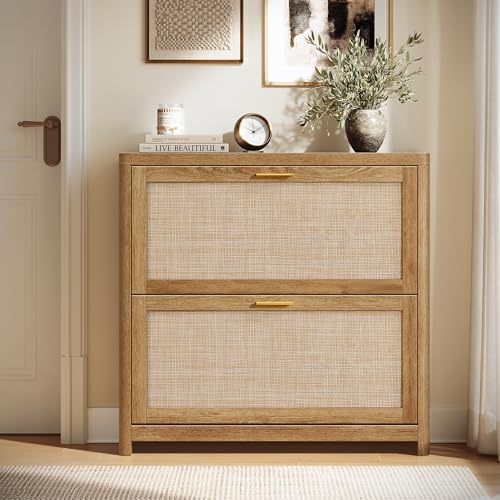
VASAGLE ELLAN Slim Shoe Storage Cabinet
Conceals dry, frequently worn shoes in a shallow furniture-style unit. Best for apartments, entrances opening into living rooms, and renters prioritizing visual calm. Measure closed depth, open-drawer depth, door swing, baseboards, longest shoe, remaining walkway, and any anchoring requirements.
Verified ASIN: B0GTV6DTTZ
Ottomanson Waterproof Boot Tray
Creates a separate place for wet, snowy, or muddy shoes to drain and dry before entering closed storage. It complements rather than replaces primary shoe storage and must remain outside the door swing and walkway.
Verified ASIN: B09R2632SG
Simple Houseware 3-Tier Stackable Wire Shoe Rack
Gives daily footwear quick access and airflow while making capacity easy to see. Best where access matters more than concealment. Shoes remain visible, so use a strict capacity limit.
Verified ASIN: B0B6GZ1DZY
VASAGLE ELLAN Shoe Bench With Cushion
Combines seated shoe changes with enclosed storage and adjustable organization. Best for families, children, older adults, and wider entryways. Confirm total depth, seating clearance, door operation, and walkway width.
Verified ASIN: B0GTVT2725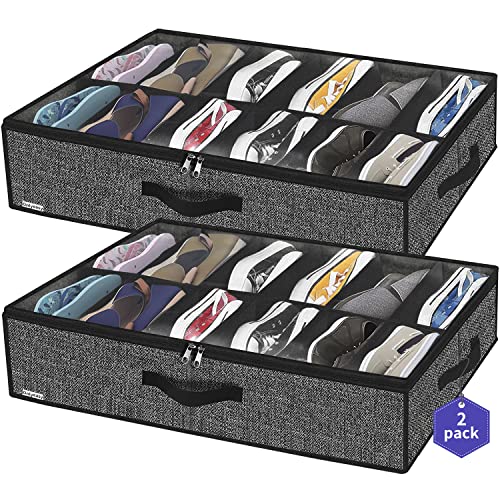
Onlyeasy Under-Bed Shoe Storage Organizer, Set of Two
Moves special-event, out-of-season, and rarely worn shoes away from prime entryway storage. Measure under-bed clearance and store only clean, dry footwear suitable for the format.
Verified ASIN: B07VBJ5MSH
Simple Houseware 3-Tier Shoe Rack, Bronze
Lower-cost open storage for daily dry shoes or ventilated footwear. Best where visible storage is acceptable.
Verified ASIN: B08BNJ8XB2
VASAGLE Shoe Storage Bench With Cushion and Doors
Larger seated storage with doors and adjustable shelves for families needing structured dry-shoe capacity. Its footprint makes it unsuitable for many narrow halls, so measure depth and seated-use clearance carefully.
Verified ASIN: B0GC26Q46LAffiliate disclosure: Inplanty may earn a commission from qualifying purchases made through links on this page, at no additional cost to you.
Frequently Asked Questions
How can renters add entryway storage without drilling?
Use freestanding furniture, compatible over-door storage, tension systems, portable baskets, and removable accessories within the lease and manufacturer instructions.
Are removable hooks really damage-free?
No guarantee exists for every surface. Paint condition, wall texture, humidity, wallpaper, and removal technique can all affect the result.
What is the best coat storage for a rental apartment?
A coat tree works for a small daily rotation, a garment rack works when more capacity is needed, and a wardrobe works when concealment is worth the footprint.
Can a renter use a shoe cabinet without anchoring it?
Only when the manufacturer allows safe use without anchoring. Rental restrictions do not override safety instructions.
Can entryway storage be placed in a shared hallway?
Only when building rules and the landlord explicitly allow it and the storage does not obstruct circulation or exits.