
A capacity-first system for choosing the right cabinet, rack, bench, or tray—without letting your entry become a permanent shoe pile.
Quick Answer
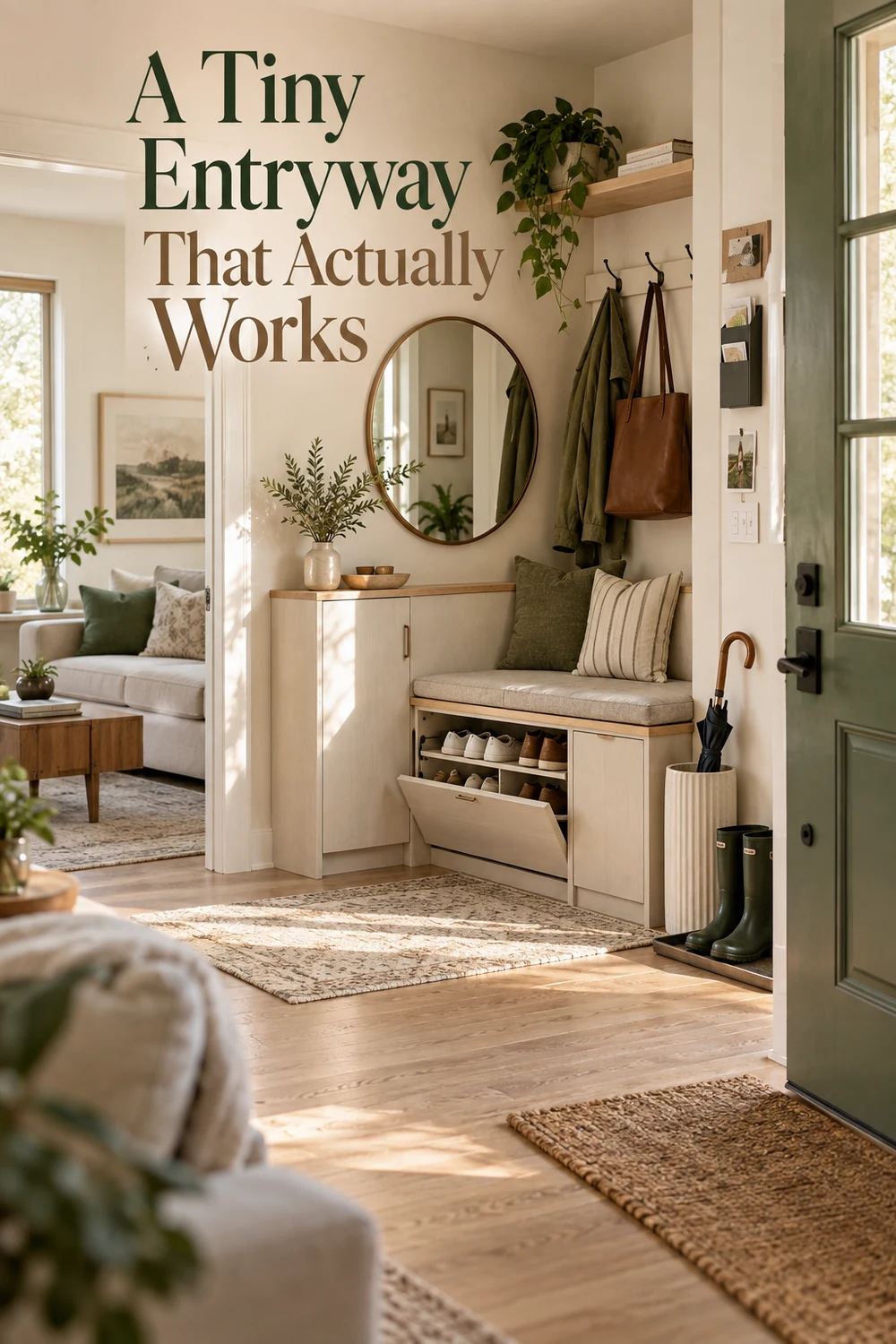
Keep only frequently worn, in-season shoes by the front door. Count how many pairs need daily access, then choose one storage system that holds that number without blocking the doorway. Use closed storage for visual calm, open storage for airflow and speed, and a separate washable tray or ventilated area for wet footwear.
Shoes usually pile up by the front door for one of two reasons: too many pairs are competing for daily access, or the storage format does not match how the household actually uses the entrance. Buying a larger rack can temporarily hide the problem, but it rarely solves it.
The better approach is to decide which shoes deserve entryway space, calculate the capacity you truly need, and then select storage that fits the available width, depth, household routine, and climate. Shoes are only one part of the entrance, so readers dealing with coats, bags, and keys should also see the complete entryway organization guide.
Limit the rotation
The entryway holds daily footwear, not the entire collection.
Plan wet and dry zones
Dry shoes and damp boots should not share one closed compartment.
Set a capacity ceiling
A visible pair limit stops the system from expanding into clutter.
First, Decide Which Shoes Actually Belong by the Door
If your entryway is already crowded, do not start by shopping for furniture. Remove every pair first and sort them by frequency and season. Only footwear used regularly during the current season should compete for prime space near the entrance.
| Shoe category | Store by front door? | Better location |
|---|---|---|
| Daily shoes | Yes | Primary entryway storage |
| Current wet-weather shoes | Yes | Boot tray or ventilated rack |
| Work or school shoes | Usually | Assigned section near the door |
| Dog-walking shoes | Usually | Easy-clean lower shelf or tray |
| Occasional shoes | Usually no | Bedroom or main closet |
| Out-of-season shoes | No | Seasonal storage |
| Special-event shoes | No | Protected closet storage |
| Guest slippers | Optional | Small labeled basket |
Use the seven-day test
Set aside the shoes actually worn during a normal week. That group is a much better starting point for entryway capacity than the total number of pairs your household owns.
Count How Much Shoe Storage You Need
If you live alone, one compact storage zone may be enough. If you have children, winter boots, or several adults leaving at the same time, you need assigned sections and a separate weather-footwear zone.
Simple planning formula
Household members × daily pairs per person + weather footwear = minimum entryway capacity.
This is a planning tool, not a universal rule. Start with one or two daily pairs per person, then add current rain or snow footwear only where needed.
One person or a couple
A slim cabinet, small bench, or narrow rack often provides enough capacity. Keep backup and occasional pairs elsewhere.
Family with children
Use low assigned cubbies or baskets. Children are more likely to follow a system when each section is obvious and reachable.
Shoe-free household
Leave enough clear floor area for removing shoes and transitioning into slippers. Storage alone does not create a usable drop zone.
Wet or snowy climate
Plan boot capacity separately. Tall, wet footwear consumes more vertical space and should dry before entering closed storage.
Choose the Best Shoe Storage for Your Entryway
Slim shoe cabinet
If your hallway is narrow or your front door opens directly into a living space, a shallow tilt-out cabinet is usually the strongest starting point. It hides shoes, uses wall height efficiently, and looks more like furniture than utility storage.
Choose it when: visual calm matters and most daily shoes are low-profile. Avoid it when: you mainly store tall boots, need maximum ventilation, or cannot safely anchor a tall unit where required.
Entryway bench with shoe storage
If you have children, mobility needs, or enough floor depth, a bench combines seating and storage. Cubbies make assigned family sections easy, while baskets can conceal casual footwear.
Choose it when: seated shoe changes improve daily use. Avoid it when: the bench would constrict the walkway or block the front-door swing.
Open shoe rack
If speed, airflow, and price matter more than concealment, an open rack is practical. It works especially well at a secondary entrance, inside a mudroom, or beside a dedicated wet-shoe tray.
Choose it when: shoes need ventilation and the collection is edited. Avoid it when: the entry is highly visible and open footwear creates visual noise.
Baskets and bins
If you have young children or want a very low-effort reset, labeled baskets can work beneath a bench. Keep them shallow enough that pairs remain visible and do not become crushed.
Choose them when: children need an easy toss-and-go system. Avoid one large shared basket: mixed shoes become hard to find, and the container tends to absorb unlimited overflow.
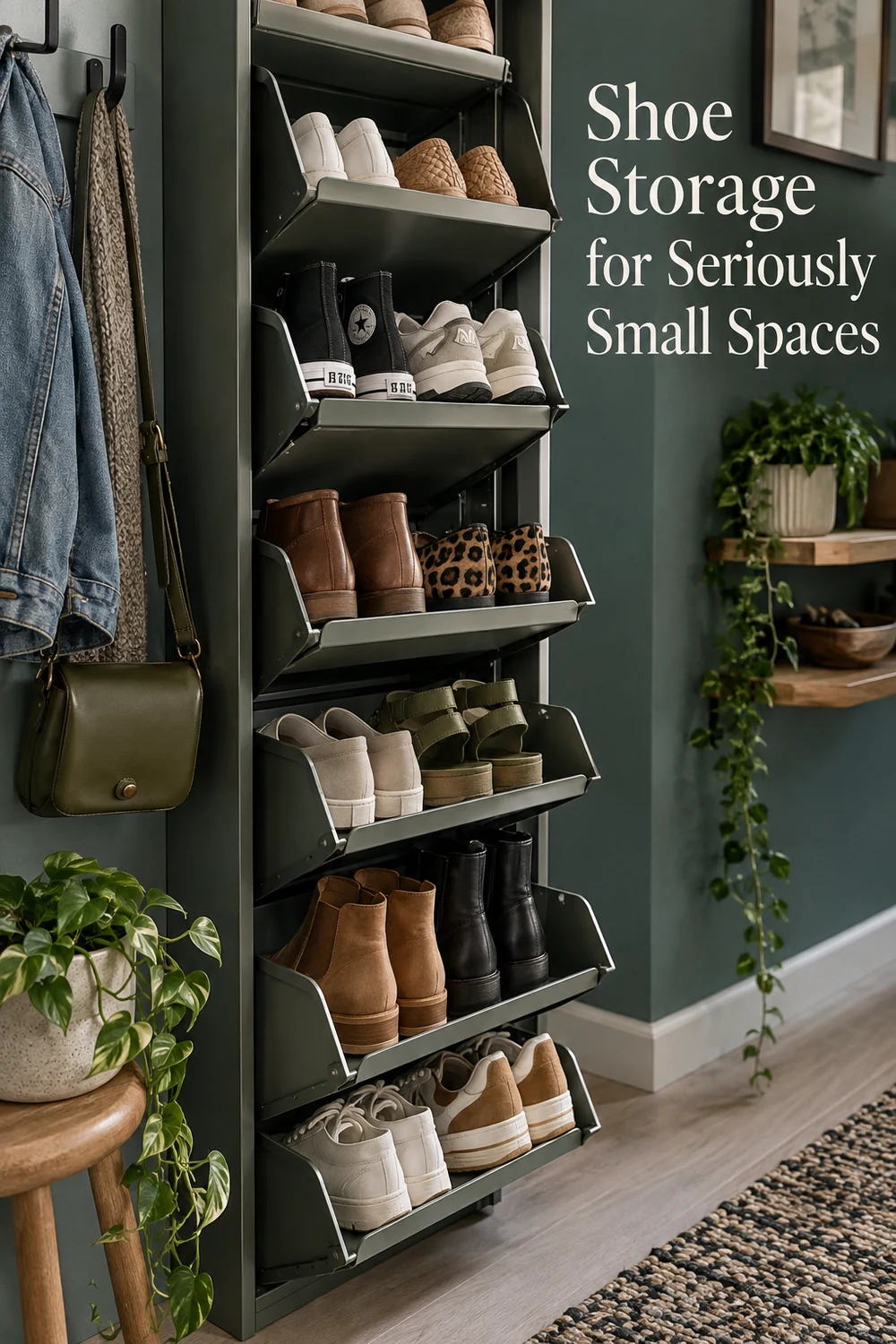
Wall-mounted or vertical storage
If floor space is extremely limited, a wall-mounted system can preserve circulation. Check the loaded depth after shoes are added; a shallow frame may still project too far into a tight hallway.
Over-the-door organizer
If you rent or have no available wall and floor area, an over-door organizer may hold lightweight shoes. It is better on a secondary or concealed door than on a highly visible front door. Confirm that the organizer and contents do not interfere with the door, frame, lock, or hardware.
| Storage type | Best for | Main advantage | Main drawback |
|---|---|---|---|
| Open rack | Daily shoes and airflow | Fast access | Visible clutter |
| Closed cabinet | Living-room-facing entrances | Calm appearance | Less ventilation |
| Bench cubbies | Families and seated use | Multifunctional | Takes more depth |
| Baskets | Children and quick resets | Easy to use | Shoes become mixed |
| Wall storage | Minimal floor space | Saves floor area | Adds visual density |
Open or closed: the practical verdict
Choose closed storage when the entry is highly visible. Choose open storage when wet shoes, airflow, or instant access matters more. In many homes, the best solution combines a closed cabinet for dry daily shoes with a small open tray for wet footwear.
Best Shoe Storage by Entryway Situation
If your entryway is narrow
Prioritize a shallow cabinet or wall-mounted system placed parallel to the wall. Limit the daily rotation, measure operating depth, and skip a deep bench unless the remaining walking path is comfortable.
See more storage ideas for a narrow entryway.
If your front door opens into the living room
Use furniture-style closed storage in a finish that relates to the adjoining room. Keep visible footwear to a minimum and place a small wet-shoe tray beside or inside the defined removal zone.
If you rent
Choose freestanding racks, unfixed benches, or over-door organizers that suit the door hardware. Follow weight limits, protect floors, and seek approval before anchoring furniture where required.
Explore renter-friendly entryway storage.
If you have children
Use low assigned cubbies or labeled baskets, limit each child to one or two active pairs, and choose easy-clean surfaces. The best family system is one children can reset without adult help.
Build a complete family entryway storage system.
If you have many shoes
Treat the entryway as an access point, not total collection storage. Keep a small current rotation near the door and move seasonal, occasional, and special-event shoes elsewhere.
If you have pets
Reserve one easy-clean spot for dog-walking shoes, store leashes above shoe level, and add a washable mat or paw-cleaning station without mixing damp pet items with dry footwear.
If you live in a wet or snowy climate
Use a boot tray, ventilated rack, moisture-resistant finish, and enough drip clearance. Dry shoes before transferring them into closed storage and rotate bulky winter footwear when the season changes.
If there is no entryway closet
Combine one primary shoe unit with wall hooks, a narrow shelf, and a separate overflow location. For the complete layout, see how to organize a small entryway with no closet.
Measure Before Choosing Shoe Storage
If you are comparing a shoe cabinet with an entryway bench, the footprint shown in product photos is not enough. Measure the space during actual use: doors open, drawers extended, shoes protruding, and a person standing or sitting in front.
| Measure | Why it matters |
|---|---|
| Available wall width | Determines overall furniture size. |
| Unit depth | Protects the walking path. |
| Depth when open | Prevents doors or drawers from blocking circulation. |
| Tallest boot height | Determines shelf or compartment clearance. |
| Longest shoe length | Prevents footwear from protruding. |
| Front-door swing | Keeps storage from blocking entry and exit. |
| Baseboard projection | Explains gaps behind furniture and affects anchoring. |
| Outlets, switches, hooks, and windows | Protects access to existing features. |
| Cleaning clearance | Allows dirt and salt to be removed beneath the unit. |
| Household capacity | Avoids buying storage that is too small immediately. |
A bench can be worth the extra depth when seating solves a real daily problem. Otherwise, a shallower cabinet usually protects circulation better. This decision is covered in more detail in shoe cabinet vs. entryway bench.
How to Store Wet Shoes and Boots
If your household deals with rain, mud, or snow, wet footwear needs its own temporary landing zone. A rubber boot tray, raised rack, or washable mat protects the floor while allowing moisture and debris to remain contained.
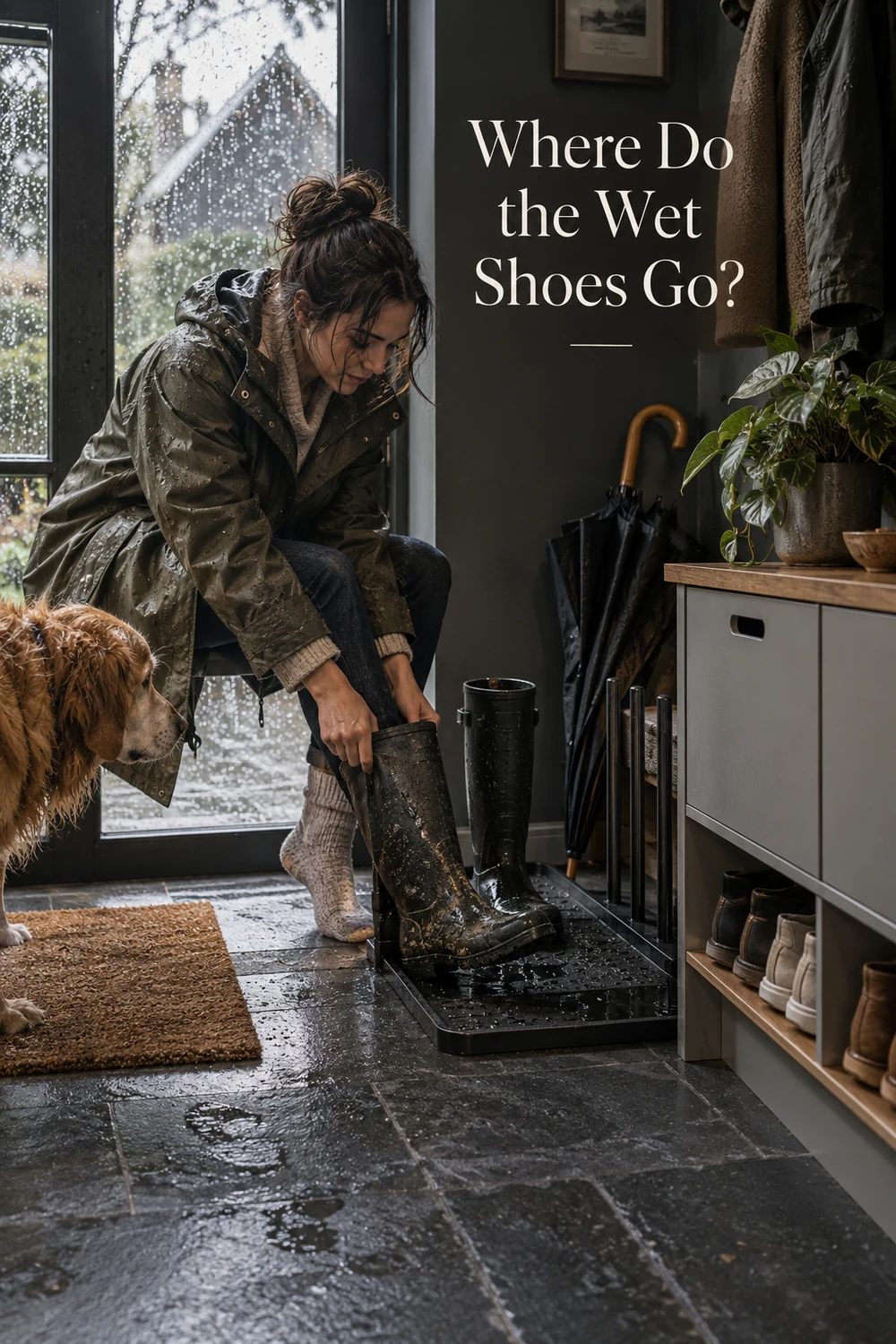
- Shake off loose dirt outdoors where practical.
- Place damp shoes on a waterproof tray or ventilated rack.
- Leave space between pairs so air can circulate.
- Wipe salt, mud, and standing water before it reaches walls or trim.
- Move shoes into closed storage only after they are dry.
- Rotate bulky boots out of the entryway when the season ends.
Do not trap moisture
Never place visibly wet footwear directly into an unventilated closed cabinet. Moisture, odors, and surface damage are harder to manage than a small, separate drying zone.
Build a Shoe Drop Zone That Stays Organized
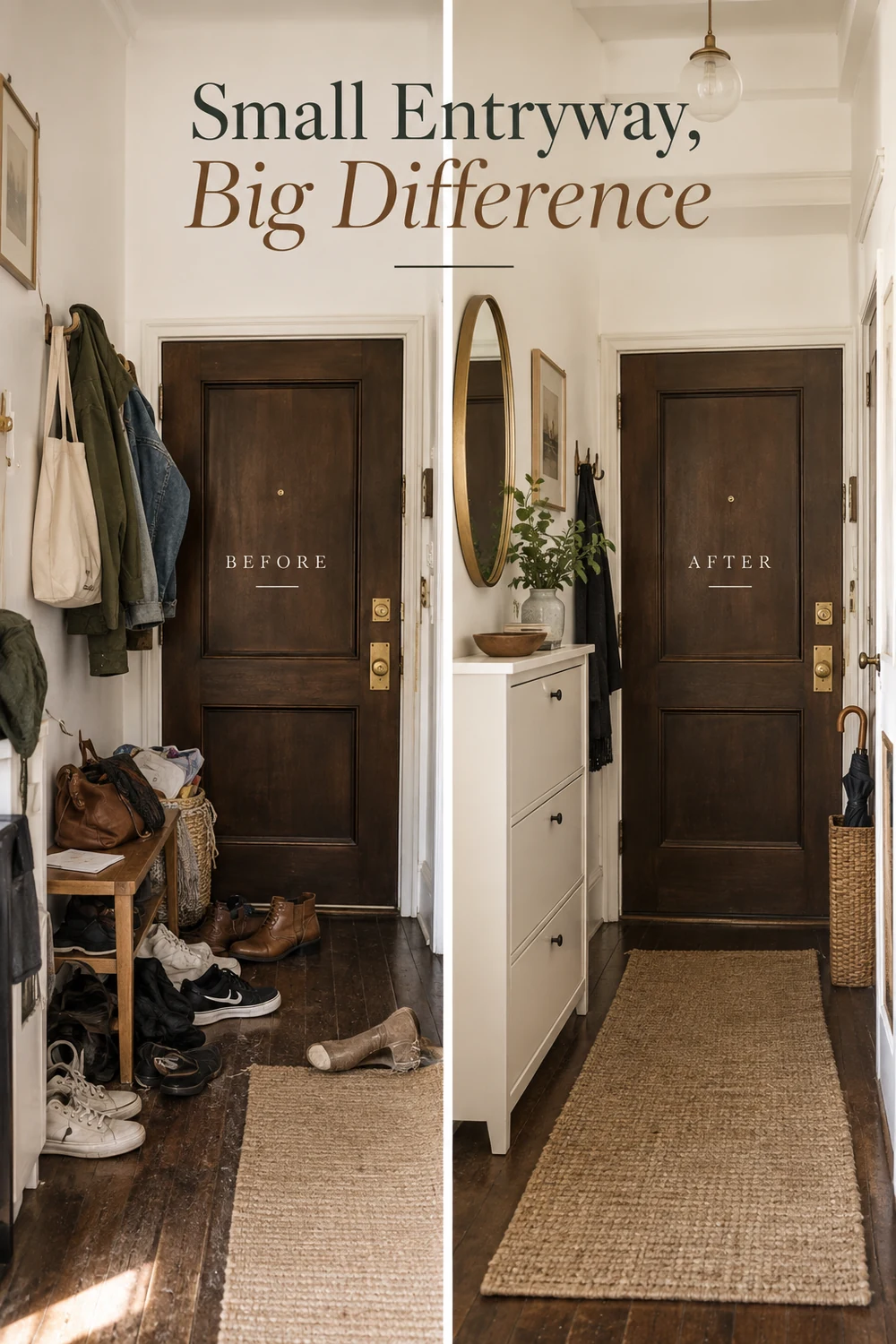
A durable system needs a removal area, one primary storage unit, a wet-footwear zone, an overflow location, and a visible capacity limit. Without those boundaries, even an attractive cabinet eventually becomes overfilled.
Remove every shoe
Start with an empty entry so the current pile does not determine the new system.
Sort by use and season
Separate daily, wet-weather, seasonal, occasional, and unwanted footwear.
Count the active pairs
Calculate the number that genuinely needs daily access.
Measure the operating space
Include door swing, opened storage, baseboards, and the walking path.
Choose one primary format
Select a cabinet, bench, rack, or vertical system based on the situation.
Create a wet-shoe zone
Add a washable tray or ventilated rack outside closed storage.
Assign household sections
Use labels, cubbies, or baskets where multiple people share the entrance.
Relocate overflow
Move seasonal and occasional footwear to a secondary storage area.
Test for one week
Watch where shoes actually land and adjust the system around real behavior.
Reset weekly
Return stray pairs and remove anything that exceeds the entryway limit.
Once the shoe zone works, use the same boundaries for coats, bags, mail, and keys to keep the entire entryway clutter-free.
Common Entryway Shoe Storage Mistakes
Which Entryway Shoe Storage Solution Should You Choose?
| Reader situation | Best starting solution |
|---|---|
| Very narrow hallway | Slim closed shoe cabinet |
| No floor space | Wall-mounted or over-door storage |
| Family with children | Bench with assigned baskets or cubbies |
| Entry opens into living room | Furniture-style closed cabinet |
| Frequent rain or snow | Ventilated rack plus boot tray |
| Renter | Freestanding rack or removable system |
| Many shoes | Small daily rotation plus storage elsewhere |
| Need seating | Shoe-storage bench |
| Strong visual-clutter concern | Closed cabinet |
| Need fastest access | Open rack |
Best starting system for most small entryways
A shallow closed shoe cabinet for dry daily footwear, a small washable tray for wet shoes, and a strict seasonal rotation for everything else.
Recommended Entryway Shoe Storage Products
These products match the page’s narrow-space, concealed-storage, family-capacity, and wet-footwear recommendations. Choose according to the storage format your entryway needs rather than buying the largest option automatically.

Karl home White Rattan Shoe Cabinet, 3 Tilt-Out Compartments
Best for narrow, highly visible entryways where shoes need to disappear behind furniture-style doors. The shallow tilt-out format supports a calm closed-storage system for dry daily footwear.
Verified ASIN: B0GGMRBXY4
VASAGLE CUSTOS 15-Compartment Shoe Storage Bench
Best for families, children, and readers who need seating while changing shoes. Individual compartments help prevent footwear from becoming mixed.
Verified ASIN: B07ZBBPMXC
SONGMICS 8-Tier Slim Metal Shoe Rack
Open vertical storage for renters, narrow spaces, larger daily rotations, or secondary entrances where airflow and fast access matter more than concealment.
Verified ASIN: B0BTGQK21X
SUPENUIN Heavy-Duty Rubber Boot Tray
Creates a separate wet-shoe and boot zone that protects the floor and prevents damp footwear from being placed inside an enclosed cabinet.
Verified ASIN: B0C58DWX1Z
DINZI LVJ 9-Cubby Shoe Storage Bench
A compact seated-storage alternative with adjustable compartments for households storing different shoe sizes.
Verified ASIN: B08RZGBJ69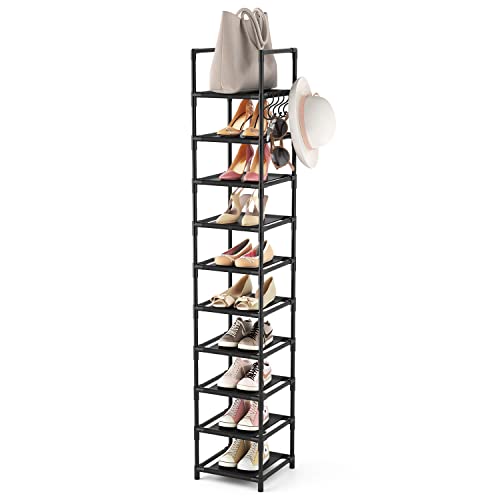
LANTEFUL 10-Tier Tall Narrow Shoe Rack
A low-cost vertical option when floor width is limited and concealed storage is not essential.
Verified ASIN: B0BZ42GY8V
VASAGLE CUSTOS 20-Compartment Shoe Storage Bench
Higher-capacity seating and assigned shoe storage for larger families with enough entryway width and depth.
Verified ASIN: B0G4CZXBLPAffiliate disclosure: Inplanty may earn a commission from qualifying purchases made through links on this page, at no additional cost to you. Product availability can change; check the retailer for current details.
Frequently Asked Questions
How do you organize shoes by the front door?
Keep only frequently worn, in-season footwear near the entrance. Count the active pairs, choose one storage unit that fits that capacity, assign sections where needed, and create a separate area for wet shoes.
How many pairs of shoes should you keep by the door?
Start with one or two daily pairs per person, then add current weather footwear only when necessary.
What is the best shoe storage for a small entryway?
For most small, visible entryways, a shallow closed cabinet provides the best balance of capacity and visual calm. Add a waterproof tray for damp shoes.
Is open or closed shoe storage better?
Closed storage is better for a calm appearance. Open storage is better for airflow and fast access. Many homes benefit from using both.
Where should wet shoes be stored?
Place wet shoes on a waterproof boot tray, washable mat, or ventilated rack until fully dry.
Can you use a shoe cabinet in a narrow hallway?
Yes, but measure the unit’s closed depth, operating depth, front-door swing, and remaining walking path before buying.