
The Finished Result
The entryway functions like a compact closet without becoming a wall of storage. Daily coats and bags have a limited vertical zone, active shoes are contained, keys and mail have a small landing place, and seasonal overflow lives elsewhere.
- Door swing stays clear
- Walkway remains usable
- Daily items are easy to return
- Wet footwear is handled separately
- Overflow does not crowd the entrance
Quick Answer
To organize a small entryway without a closet, replace the closet’s functions with four compact zones: vertical storage for coats and bags, contained storage for shoes, a small landing place for keys and mail, and overflow storage for seasonal items. Keep only daily-use belongings near the door and measure door swing, walkway width, loaded depth, and operating clearance before adding furniture.
This page focuses on a closet-free entryway. For shoes, coats, renters, families, narrow halls, measurements, and other entryway problems, use the complete entryway organization guide.
Start by Identifying What the Entryway Must Store
Inventory daily shoes, occasional shoes, coats, bags, keys, mail, umbrellas, pet supplies, children’s items, seasonal accessories, deliveries, and returns. Then separate them into daily, weekly, seasonal, and relocate categories.
Keep near the door
- Current daily shoes
- Current-season outerwear
- Frequently used bags
- Keys and wallets
- Small pet-walking supplies
- One controlled outgoing zone
Move elsewhere
- Off-season coats and shoes
- Occasional bags
- Bulk pet supplies
- Long-term paperwork
- Unresolved returns and donations
- Anything not used during the current routine
Capacity rule
A small entryway should not store every coat, shoe, or bag owned by the household.
Replace the Missing Closet With Four Storage Zones
Zone 1 — Vertical Storage for Coats and Bags
Use a limited row of hooks, a peg rail, wall-mounted rack, over-door storage, coat tree, narrow garment rack, or freestanding wardrobe.
| Option | Best for | Who should avoid it |
|---|---|---|
| Hooks | One person, couples, renters, narrow entries | Households needing many heavy coats near the door |
| Coat tree | No-drill setups with enough floor space | Very narrow halls or homes with unstable loaded footprints |
| Garment rack | Several accessible coats | Living-room-facing entrances where visual clutter matters |
| Wardrobe | Visual calm and concealed storage | Entries without sufficient width, depth, or operating clearance |
Use hooks for a small daily rotation, a rack when several coats must stay accessible, and closed storage when visible clutter is the main concern. Store out-of-season coats elsewhere. For deeper help, see how to store coats without a coat closet.
Zone 2 — Contained Storage for Shoes
Choose between slim tilt-out cabinets, storage benches, low cubbies, open racks, baskets, boot trays, or vertical shoe organizers.
| Format | Best for | Trade-off |
|---|---|---|
| Slim closed cabinet | Living-room-facing or visually busy entrances | Requires open-drawer clearance and dry footwear |
| Storage bench | Readers needing seated shoe changes | Uses more floor depth |
| Open rack | Daily dry footwear and fast access | Visible clutter |
| Boot tray | Wet climates and muddy footwear | Needs clear floor space |
Keep only frequently worn, current-season shoes near the door. Use a separate tray for wet footwear so moisture is not trapped inside closed storage. Continue with how to organize shoes by the front door or compare a shoe cabinet and entryway bench.
Zone 3 — A Landing Place for Keys, Mail, and Small Essentials
Use a shallow shelf, narrow console, small tray, wall pocket, key hooks, shelf-with-hooks, or one small drawer.
Keep the landing zone intentionally small
Without a strict capacity limit, it becomes a permanent miscellaneous pile.
Zone 4 — Concealed Overflow Storage
Move seasonal accessories, occasional shoes, backup pet supplies, and rarely used bags into lidded baskets, high shelves, under-stairs storage, a nearby room, or labelled seasonal bins.
Prime entryway space should be reserved for daily routines, not long-term storage.
Choose the Best Layout for Your Entryway
If your entryway is a narrow hallway
Use shallow furniture, wall-mounted storage, a slim cabinet, limited hook projection, and strict inventory limits. Measure while coats, bags, and cabinet drawers are in use. See storage for a narrow entryway.
If the door opens into the living room
Choose furniture-style closed storage, a defined rug or visual boundary, coordinated finishes, and fewer visible categories.
If you live in a small apartment
Use vertical, portable, and multiuse storage with seasonal rotation. Continue with the Small-Space Storage Guide. when the entryway is part of a larger apartment storage problem.
If the entryway is beside the kitchen
Use nearby wall space, the side of a cabinet where appropriate, or a shallow landing shelf. Prevent the kitchen table from becoming the entryway drop zone.
If there is almost no usable wall space
Use back-of-door storage, a compact freestanding vertical solution, or a nearby wall around the corner. Keep only daily essentials in the literal foyer.
Choose the Best Setup for Your Household
If you live alone or as a couple
Use minimal hooks, one compact shoe unit, and a small landing shelf. Avoid oversized furniture designed for a larger household.
If you have children
Add lower hooks, personal zones, broad baskets, backpack storage, and easy-reset shoe storage. See how to organize a home with kids and family entryway storage.
If you have pets
Create a separate leash hook, waste-bag zone, towel spot, paw-cleaning supplies, and walking-shoe area away from mail and personal items.
If you rent
Prioritize freestanding furniture, over-door storage, portable organizers, and removable accessories used within stated surface and weight limits. See renter-friendly entryway storage.
If you own many shoes or coats
Use a daily rotation, seasonal overflow elsewhere, and fixed capacity limits. More entryway furniture is not automatically the solution.
Measurements That Keep a Small Entryway Functional
| Entryway element | What to measure | Main risk |
|---|---|---|
| Shoe cabinet | Closed depth, open depth, width, baseboard offset | Blocking circulation |
| Storage bench | Width, depth, seat clearance | Crowding the walkway |
| Coat hooks | Height, spacing, loaded projection | Coats narrowing the hall |
| Wall shelf | Depth and head clearance | Body or head obstruction |
| Rug | Door clearance | Door catching |
| Coat rack | Loaded footprint | Bulky coats taking more room than expected |
Measure in use, not only when empty
Check door swing, walkway width, furniture depth, open-drawer depth, loaded hook projection, baseboards, outlets, tallest footwear, and the largest bag or backpack.
Open or Closed Entryway Storage: Which Is Better?
| Storage type | Best for | Main advantage | Main drawback |
|---|---|---|---|
| Open hooks | Daily coats and bags | Fast access | Visible clutter |
| Closed wardrobe | Highly visible entrances | Visual calm | Uses more space |
| Open shoe rack | Wet or daily footwear | Airflow | Shoes remain visible |
| Closed shoe cabinet | Living-room-facing entry | Concealment | Ventilation may be limited |
| Bench storage | Families and seated use | Multifunctional | Requires more depth |
| Baskets | Children and flexible storage | Easy resets | Categories can mix |
Best overall approach
Use open access for a limited number of daily items and closed storage for overflow and visually busy categories.
How to Keep a No-Closet Entryway From Looking Cluttered
- Limit visible categories.
- Keep only current-season items near the door.
- Prefer one consolidated storage zone over many small organizers.
- Use closed shoe storage when appropriate.
- Leave visible wall and floor space.
- Keep the landing zone intentionally small.
- Match finishes to the adjoining room.
Organization must be solved before decoration. Mirrors, rugs, artwork, and plants should not replace missing coat and shoe storage. Use the clutter-free entryway guide for maintenance.
A Step-by-Step No-Closet Entryway Plan
Empty the entryway
Remove everything so the true storage boundary is visible.
Sort into daily, seasonal, relocate, and remove
Protect prime space for current routines.
Measure the door swing, walkway, wall space, and floor depth
Include loaded and open positions.
Choose one coat-and-bag method
Hooks, rack, tree, or wardrobe.
Choose one shoe-storage method
Cabinet, bench, rack, or tray.
Add a small landing zone
Keys, mail, wallet, and one outgoing category only.
Assign overflow storage elsewhere
Seasonal and occasional items leave prime entryway space.
Create household zones if needed
Use personal hooks or broad baskets.
Test the setup for one week
Observe where items still collect.
Remove or adjust obstructions
Correct anything that blocks circulation or door use.
Add a simple daily reset
Return daily items and clear temporary categories.
Copy This Setup
Mixed open-and-closed system
- Limited hook row
- Slim closed shoe cabinet
- Compact wall landing zone
- Separate boot tray
- Seasonal overflow elsewhere
Wall-first setup
- Shallow hooks
- Small wall shelf
- Very slim shoe cabinet
- No bench
- Strict daily inventory
Personal zones
- Individual hooks
- Closed active-shoe storage
- Labelled broad baskets
- Backpack zone
- Seasonal overflow in a secondary space
Moisture-aware setup
- Open daily coat access
- Separate boot tray
- Ventilated shoe storage
- Towel or paw-cleaning zone
- Closed storage only for dry items
Common No-Closet Entryway Mistakes
Which No-Closet Entryway Setup Should You Choose?
| Reader situation | Best starting setup |
|---|---|
| Extremely narrow hallway | Wall hooks, shallow shelf, slim shoe cabinet |
| No usable wall | Over-door storage and compact freestanding rack |
| Family with children | Individual hooks, closed shoe storage, labelled baskets |
| Rental apartment | Freestanding storage and removable accessories |
| Door opens into living room | Furniture-style cabinet and concealed storage |
| Heavy winter gear | Strong rack or wardrobe plus seasonal rotation |
| Almost no floor space | Wall-mounted storage and overflow elsewhere |
| Need seating | Storage bench only if walkway depth allows |
| Wet climate | Ventilated shoe storage and separate boot tray |
Final recommendation
For most small entryways without a closet, use a limited row of hooks for daily coats and bags, a shallow closed shoe cabinet, a small landing shelf, and seasonal overflow stored elsewhere.
Choose Only the Storage Your Entryway Actually Needs
Inventory daily items and measure door swing, walkway width, loaded depth, baseboards, and operating clearance before buying anything. Most small entryways need only two or three pieces: one coat-and-bag solution, one shoe solution, and—only if necessary—a small landing or seasonal-overflow solution.
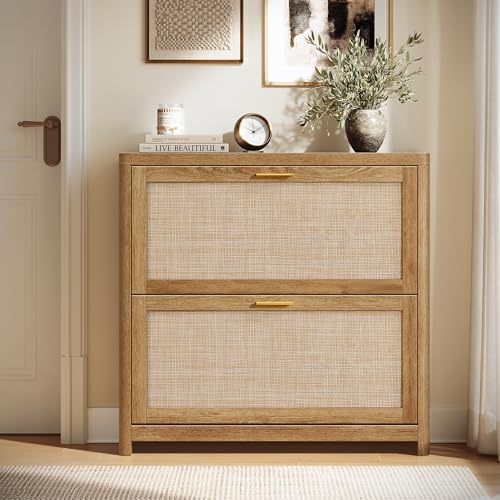
VASAGLE ELLAN Slim Shoe Storage Cabinet
Provides shallow, concealed shoe storage for a narrow or living-room-facing entryway. Best when enough wall width and operating clearance are available.
Verified ASIN: B0GTV6DTTZ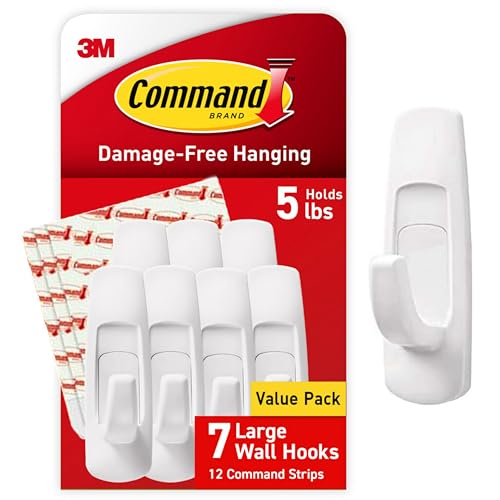
Command Large Utility Hooks, 7-Pack
Creates a limited row of point-of-use hooks for daily jackets, bags, hats, and lightweight accessories without adding floor furniture. Confirm surface compatibility, installation instructions, weight limits, and loaded projection.
Verified ASIN: B0753NHZVQ
Ottomanson Waterproof Boot Tray
Contains moisture, mud, and debris from active shoes and boots while they dry outside closed storage. Confirm the loaded footprint will not obstruct the door or walkway.
Verified ASIN: B09R2632SG
IRIS USA 4-Pack 13-Quart Clear Storage Bins
Stores off-season accessories, occasional footwear, pet supplies, or entryway overflow in a nearby closet, under-stairs area, or secondary room.
Verified ASIN: B0F6FT397Y
VASAGLE Farmhouse Narrow Shoe Cabinet with Two Flip Drawers
Larger concealed shoe-storage option for households needing more active footwear capacity while retaining a narrow freestanding format. Use only after reducing the entryway to current-season shoes and confirming open-drawer clearance.
Verified ASIN: B0GSVFSJ51Affiliate disclosure: Inplanty may earn a commission from qualifying purchases made through links on this page, at no additional cost to you. Availability can change.
Frequently Asked Questions
How do you organize an entryway without a closet?
Create four compact zones for coats and bags, shoes, keys and mail, and seasonal overflow stored elsewhere.
Where should coats go when there is no coat closet?
Keep a small daily rotation on hooks, a rack, or in a wardrobe and move off-season coats elsewhere.
How do you store shoes in an entryway with no closet?
Use a slim cabinet, bench, open rack, or boot tray based on available depth, ventilation needs, and whether the shoes are dry.
Should a small entryway use open or closed storage?
Use open access for a few daily items and closed storage for shoes, overflow, and visually mixed categories.
How do you keep a small entryway from looking cluttered?
Limit visible categories, keep only current-season items near the door, consolidate storage, and leave visible wall and floor space.