
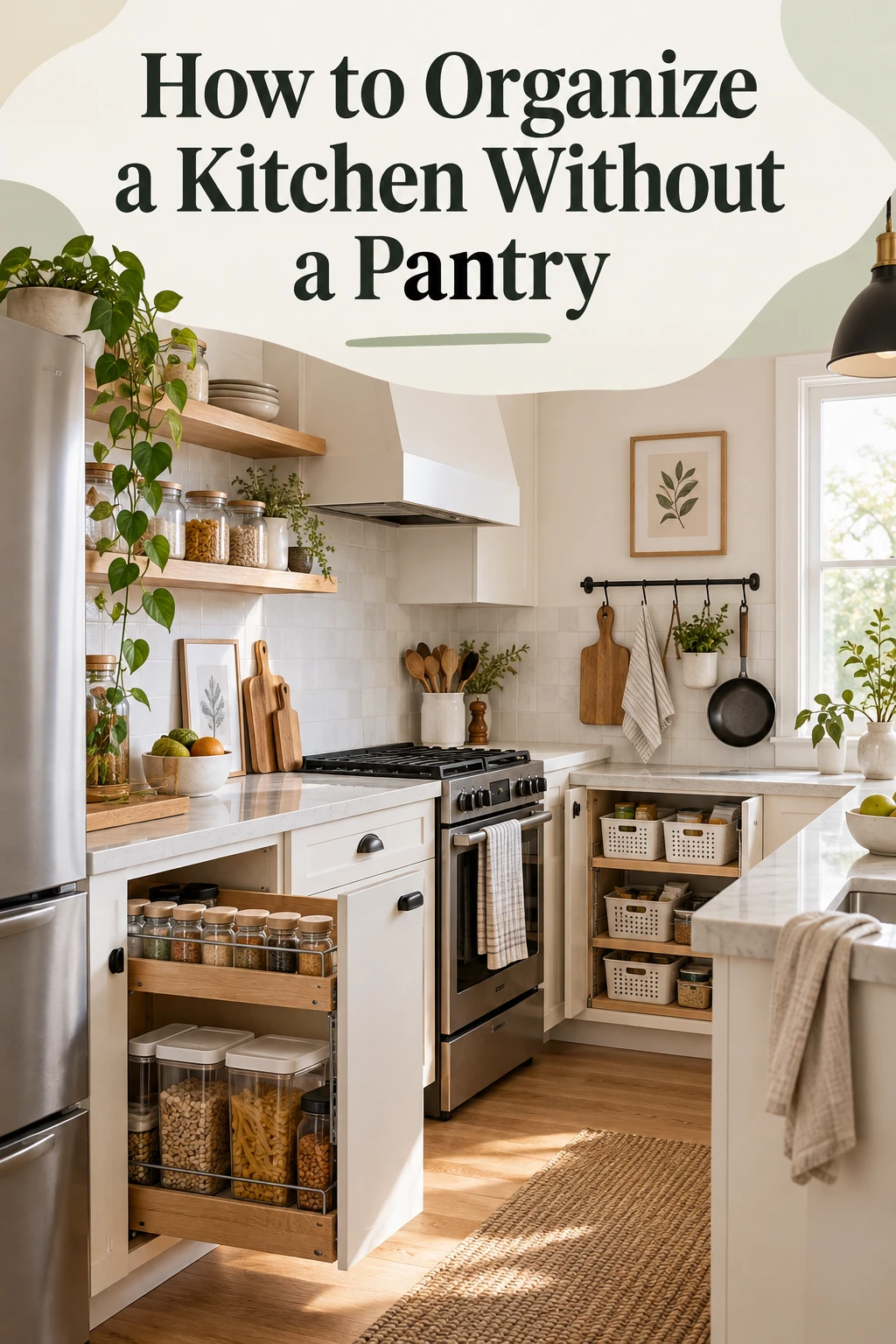
Create one reliable food-storage system by consolidating active food, separating backstock, choosing the right pantry alternative for the space, and keeping counters available for preparation.
The Finished Result
The kitchen has one official pantry system even without a pantry room. Daily food is visible and easy to reach, backstock is controlled, grocery unloading has a clear destination, counters remain usable, and secondary storage does not fragment the system.
- Active food has one primary zone
- Backstock remains limited and separate
- Storage fits real package dimensions
- Food stays away from unsuitable conditions
- Grocery and weekly resets prevent duplication
Quick Answer
Organize a kitchen without a pantry by consolidating dry food into one primary cabinet or freestanding storage zone, separating active food from backstock, and assigning categories based on frequency of use. Keep daily staples close to food-preparation areas, move bulk overflow elsewhere when necessary, and avoid using the entire kitchen counter as pantry storage.
For the broader kitchen system, use the Kitchen Organization Guide. For the wider home system, use the Complete Home Organization Guide.
What Does a Pantry Actually Need to Do?
A pantry system stores shelf-stable food, keeps categories visible, separates active food from backstock, supports grocery unloading, reduces duplicate purchases, contains open packages, protects food from unsuitable conditions, and supports meal preparation.
If you also have a separate pantry space, use the Pantry Organization Guide.
You do not necessarily need a pantry room
You need a reliable, consolidated food-storage system.
Identify Why Food Storage Is Failing
| Symptom | Likely cause | First correction |
|---|---|---|
| Food covers counters | No primary pantry zone | Consolidate active food |
| Groceries fit nowhere | Inventory exceeds active storage | Separate backstock |
| Duplicate food is purchased | Poor visibility | Group categories and bring older food forward |
| Cabinet is packed | Too many categories share one space | Reassign cabinet functions |
| Food is stored in several rooms | No defined primary and secondary zones | Create one official food system |
| Snacks create clutter | No contained snack category | Assign a visible, limited zone |
Review the Food Inventory Before Adding Storage
Remove or review expired food, stale food, damaged packaging, duplicates unlikely to be used, abandoned-recipe ingredients, excess takeout condiments, open packages no one uses, bulk quantities beyond realistic consumption, and food stored in unsuitable conditions.
Do not size the pantry alternative around excess
Expired, unwanted, and sale-driven inventory should not determine the storage system.
Separate Active Food From Backstock
Active food
Opened or soon-to-be-used breakfast staples, snacks, cooking basics, canned goods, baking supplies, grains, pasta, and daily beverages.
Backstock
Unopened extras, duplicate condiments, multipacks, backup beverages, additional canned goods, extra baking ingredients, and bulk items.
Access rule
Active food deserves the easiest access. Backstock can use secondary storage when conditions remain suitable.
Group Food Into Practical Categories
Use broad categories such as breakfast, snacks, grains and pasta, canned and jarred goods, baking, cooking ingredients, beverages, children’s food, pet food where appropriate, backstock, and special dietary items.
Do not create so many categories that grocery unloading and resets become difficult.
How Much Pantry Storage Do You Actually Need?
Capacity depends on household size, shopping frequency, cooking habits, bulk purchasing, dietary requirements, children, refrigerator and freezer storage, distance from stores, backup needs, and the amount of packaged food used.
Count active food categories
Use broad, stable groups.
Estimate normal inventory between shopping trips
Do not plan around the maximum sale haul.
Separate daily food from backstock
Protect prime storage.
Measure the largest packages
Use real cereal, snack, jar, and bottle dimensions.
Identify categories needing visibility
Keep frequently forgotten food easy to see.
Leave limited incoming-grocery space
A completely full system cannot absorb the next shopping trip.
Capacity principle
Pantry capacity should reflect normal household inventory—not maximum sale-driven purchasing.
Measure Food and Storage Spaces
Measure food
- Tallest bottle
- Largest cereal or snack package
- Can diameter
- Jar height
- Bulk-container dimensions
- Bread storage needs
- Pet-food packaging
Measure storage
- Cabinet interior dimensions
- Shelf spacing
- Door clearance
- Furniture depth
- Drawer extension
- Cart footprint
- Wall width
- Walkway
- Baseboards and outlets
- Appliance-door clearance
Use internal dimensions
Exterior furniture measurements do not show the actual shelf capacity.
Choose the Primary Pantry Alternative
Option 1 — Convert a Kitchen Cabinet Into a Pantry
Best for: Small active inventories, kitchens with one available cabinet, concealed storage, and renters avoiding new furniture.
Advantages
- Uses existing storage
- Keeps food in the kitchen
- Conceals packaging
- Avoids floor furniture
Limitations
- May displace dishes or cookware
- Deep cabinets can hide food
- Shelf spacing may waste height
- Large packages may not fit
Assign the whole cabinet to food where possible, group categories, use front and back zones carefully, keep daily food easiest to reach, and avoid mixing unrelated tools into the pantry cabinet.
Improve visibility in deep kitchen cabinets →
Option 2 — Use a Freestanding Pantry Cabinet
Best for: Kitchens with available wall and floor space, moderate pantry inventory, concealed storage, and open-plan rooms where visual calm matters.
Advantages
- Creates a dedicated pantry function
- Consolidates food
- May include adjustable shelves
- Can move to another home
Limitations
- Uses floor space
- Needs door clearance
- May require anchoring
- Can block walkways
- May encourage excess backstock
Check anchoring instructions
Tall, narrow furniture may require secure anchoring according to manufacturer guidance.
Option 3 — Use a Rolling Cart
Best for: Small households, renters, flexible storage, or one defined breakfast, snack, baking, or beverage category.
Advantages
- Portable
- Multifunctional
- Moves during use
- Often needs no permanent installation
Limitations
- Open visual clutter
- Limited capacity
- May block cabinets or appliances
- Can become miscellaneous overflow
Avoid it in extremely narrow kitchens, kitchens without a defined parking position, or households needing large pantry capacity.
Option 4 — Add Open Shelving
Best for: Frequently used foods, limited visible categories, and kitchens with suitable wall space.
Advantages
- Good visibility
- Easy access
- Uses vertical space
- Reduces cabinet pressure
Limitations
- Packaging remains visible
- Dust and grease exposure
- Installation restrictions
- Weight and wall-strength limits
- Can make the kitchen look busier
Open-shelf verdict
Open shelves work best for limited active categories—not the entire household food inventory.
Option 5 — Use Storage in an Adjacent Room
Dining-room cabinets, hall closets, utility areas, built-ins, shelving around the corner, or appropriate laundry-room storage can hold bulk food, backstock, entertaining supplies, appliances, or paper goods.
Use one primary food zone and one clearly defined secondary backstock location. Avoid scattering food across several unrelated rooms.
Option 6 — Create a Pantry Wall
A pantry wall may combine freestanding cabinets, shelving, a narrow cart, closed lower storage, open upper storage, and a breakfast or beverage zone.
Do not assemble unrelated pieces without a plan
Measure combined physical depth, operating clearance, and visual weight.
Choose the Best Solution for the Space
Very small kitchen
Use one consolidated pantry cabinet, broad categories, limited backstock, efficient shelf height, clear counters, and overflow outside the kitchen.
Rental kitchen
Start with cabinet conversion, shelf risers, under-shelf baskets, a portable cart, or a safe freestanding cabinet.
No floor space
Use existing cabinets, measured wall or door storage, above-cabinet space, adjacent-room backstock, and reduced inventory.
No wall space
Use cabinet conversion, a low measured cart, dining-area storage, under-counter drawers, or controlled backstock elsewhere.
Family kitchen
Create visible breakfast and snack zones, safe child access, a lunch-preparation zone, broad categories, defined backstock, and grocery-reset responsibility.
Before adding renter-friendly storage
- Removable does not always mean damage-free.
- Tall furniture may still require anchoring.
- Adhesive accessories have surface and weight limitations.
Organize the Pantry Alternative by Frequency of Use
| Storage priority | Best categories |
|---|---|
| Prime storage | Daily breakfast, snacks, cooking basics, frequent grains, and open packages |
| Secondary storage | Baking supplies, less-frequent canned goods, backup beverages, occasional ingredients |
| High, deep, or remote storage | Lightweight backstock, seasonal supplies, entertaining food, and bulk extras |
Do not bury active food behind duplicates
Older opened food should remain more visible and easier to reach than unopened backstock.
Use Zones Instead of Scattered Containers
Create breakfast, snacks, dinner staples, baking, canned goods, beverages, and backstock zones. A zone may be one shelf, part of a shelf, one drawer, one basket, or one cabinet section. It does not need a separate container for every subcategory.
Use Shelf Risers and Stackable Storage Carefully
Use them when they improve visibility, match can or jar height, preserve access, remain stable, and fit cabinet doors. Avoid them when they create unstable towers, hide lower items, waste depth, or slow grocery unloading.
Use Turntables Only for the Right Categories
Turntables work best for sauces, condiments, small jars, and frequently accessed bottles. They are poor choices for large mixed packages, bags, heavy bulk food, or cabinets where rotation wastes substantial space.
Use Clear Containers Selectively
Containers may help with visibility, freshness, pouring, stacking, or damaged packaging. Avoid unnecessary decanting when the original package is easier to identify, instructions or allergen information are needed, the category changes frequently, or the container does not fit a normal package.
Container principle
Containers should solve a storage problem—not create a second food-transfer routine.
Prevent Countertop Pantry Creep
What Food Can Stay on the Counter?
Food may remain when it is used every day, has one contained location, does not eliminate preparation space, and is stored under suitable conditions.
Possible examples include fruit, bread, coffee or tea, one small snack zone, or daily supplements where appropriate and safely stored.
What Should Move Off the Counter?
- Grocery overflow
- Unopened bulk food
- Multiple cereal boxes
- Large snack assortments
- Baking ingredients
- Backup beverages
- Rarely used condiments
- Packaging waiting to be processed
Counter rule
Counter space is work space—not unused pantry capacity.
Choose Suitable Food-Storage Conditions
Consider heat, moisture, sunlight, pests, cleaning chemicals, appliance exhaust, plumbing leaks, floor contact, children and pets, and package instructions.
Do not store food in unsuitable locations
Avoid damp under-sink zones, excessive heat, chemical storage, pest-prone areas, contamination risks, and conditions contrary to package instructions.
Organize under the kitchen sink without mixing food and cleaning products →
Create a Grocery-Unloading Routine
Review what you already have and clear space for new items.
Keep earlier purchases visible so they are used first.
Put everyday items in the location you reach first.
Keep duplicates and bulk extras in one controlled secondary location.
Discard boxes or wraps that no longer help storage or identification.
Add only items that are actually low or missing.
Finish an open package before starting another when practical.
Review the Pantry Alternative Weekly
- Bring older food forward.
- Close or contain open packages.
- Return misplaced food.
- Remove empty packaging.
- Review snacks.
- Check active versus backstock quantities.
- Clear counter overflow.
- Note low staples.
- Wipe obvious spills.
Review Backstock Monthly or When Full
Check duplicate quantities, dates where relevant, forgotten items, bulk-purchasing habits, storage conditions, category capacity, and whether stock should move into active storage.
Backstock principle
Backstock should support the pantry system—not become a second uncontrolled pantry.
How to Organize a Kitchen Without a Pantry Step by Step
Gather all shelf-stable food
See the full inventory in one place.
Remove expired, stale, damaged, and unwanted items
Do not organize food that should leave.
Group food into broad categories
Keep grocery unloading simple.
Separate active food from backstock
Protect prime access.
Estimate normal inventory between shopping trips
Plan for real habits.
Measure food packages and available storage
Use internal dimensions and operating clearance.
Choose one primary pantry location
Consolidate before expanding.
Choose a secondary backstock location only if necessary
Keep it controlled and suitable.
Assign shelves or sections by frequency of use
Daily food gets the best access.
Protect counter space
Keep preparation surfaces functional.
Add organizers only where they improve visibility or access
Avoid unrelated storage accessories.
Test grocery unloading and meal preparation
Confirm the system works during normal routines.
Adjust categories that remain scattered
Reduce, consolidate, or relocate.
Add weekly inventory maintenance
Prevent duplicates and overflow.
No-Pantry Kitchen Organization Mistakes
Spreading food across too many locations
Nobody knows where groceries belong.
Using counters as permanent pantry storage
Preparation space disappears.
Buying a large cabinet before measuring
The unit may block circulation or appliances.
Storing active food behind backstock
Older open food is forgotten.
Decanting everything
The system creates extra work and information loss.
Using open shelves for too many categories
The kitchen becomes visually busy.
Storing food near chemicals or moisture
The location may be unsuitable.
Keeping excess sale purchases
Backstock grows beyond capacity.
Creating overly detailed categories
Grocery unloading becomes slow.
Skipping grocery resets
The system works only immediately after organizing.
Which Pantry Alternative Should You Choose?
| Reader situation | Best starting solution |
|---|---|
| One cabinet is available | Convert it into the primary pantry |
| Kitchen is extremely small | Consolidate active food and store limited backstock elsewhere |
| Floor space is available | Freestanding pantry cabinet |
| Need flexible storage | Rolling cart |
| Wall space is available | Limited open or closed shelving |
| Rental restrictions | Existing cabinets and portable furniture |
| Large family | Primary food cabinet plus defined backstock |
| Door opens into living area | Closed furniture-style pantry storage |
| Strong visual-clutter concern | Closed cabinet |
| Need fast ingredient visibility | Cabinet zones or limited open shelving |
| Many bulk purchases | Reduce quantity or create controlled secondary storage |
| No room inside kitchen | Nearby dining-room or hall cabinet with one official system |
Final recommendation
For most kitchens without a pantry, convert one cabinet or freestanding unit into the primary food-storage zone, keep active food together, move limited backstock elsewhere, and preserve kitchen counters for preparation.
Frequently Asked Questions
Where should food be stored if there is no pantry?
Use one primary cabinet or freestanding unit for active food, with limited backstock in a clearly defined secondary location when needed.
How do you organize a small kitchen without a pantry?
Consolidate active food, reduce bulk inventory, use one primary pantry zone, protect counters, and store limited backstock elsewhere.
Can a kitchen cabinet be used as a pantry?
Yes. One cabinet can become the primary pantry when its internal dimensions fit the household's normal active inventory.
What is the best pantry alternative for an apartment?
Start with an existing cabinet. Add a measured freestanding cabinet or cart only when a real capacity gap remains.
Can a rolling cart work as a pantry?
Yes for a small defined category or household, but only when it has a safe parking position and does not block cabinets, appliances, or circulation.
Should food be stored on open shelves?
Open shelves are best for a limited number of active categories where dust, grease, weight, and wall conditions are manageable.
Where should bulk food be stored without a pantry?
Use controlled secondary storage in a suitable nearby cabinet, closet, or utility location rather than mixing it with active food.
How do renters create pantry storage?
Use existing cabinets first, then portable furniture and reversible accessories within lease, surface, load, and anchoring limits.
What food can stay on the kitchen counter?
Only daily food in one contained zone that does not remove essential preparation space and is stored under suitable conditions.
Should pantry food be decanted into containers?
Only when containers improve freshness, visibility, pouring, stacking, or protection without losing instructions, dates, or allergen information.
How do you keep food visible in deep cabinets?
Use broad zones, front-and-back planning, bring older food forward, and add measured access organizers only when they improve retrieval.
Can food be stored in a dining room?
Yes, when conditions are suitable and it remains part of one official primary-and-backstock system.
How do you organize snacks without a pantry?
Create one visible, limited snack zone and keep unopened duplicates in controlled backstock.
How do you stop buying duplicate food?
Consolidate food, keep active items visible, separate backstock, bring older food forward, and review inventory during grocery unloading.
Helpful Items for a Pantry Alternative
These verified Amazon US options can help create a functional pantry system without a dedicated pantry. Choose only what solves a real capacity or access problem.
As an Amazon Associate, Inplanty may earn from qualifying purchases.
 Best for dry staples
Vtopmart Airtight Food Storage Containers, 24 pcs
Use when open bags and mixed packaging make the primary food zone hard to scan.
View on Amazon → Best for grouped backstock
Vtopmart Clear Stackable Storage Bins, 6 pack
Useful for keeping snacks, baking supplies, or duplicates together without scattering them across cabinets.
View on Amazon → Best for deep cabinet access
LANDNEOO 10-Inch Lazy Susan Organizers, set of 4
A rotating organizer can make bottles, jars, and condiments easier to reach in deep cabinet zones.
View on Amazon →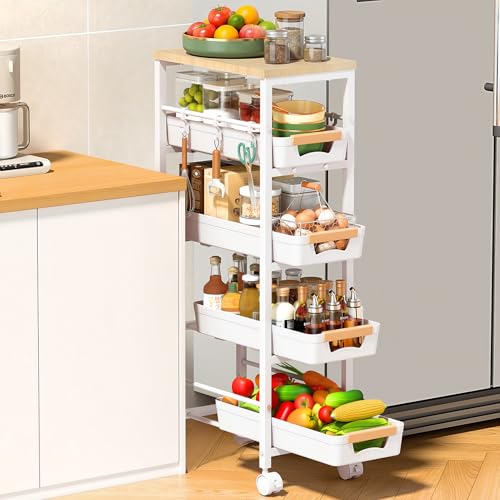 Best when a narrow floor gap exists
SUNALLY Slim Rolling Storage Cart
Adds movable storage when cabinet capacity is genuinely insufficient; measure the parking space first.
View on Amazon →Start with the storage problem: visibility, grouping, deep-cabinet access, or missing capacity. Do not add containers that simply consume usable space.