
How to Organize Hair Tools Safely and Keep Cords Under Control
Organize hair tools by separating daily dryers and styling tools from occasional equipment, creating a safe cooling zone, measuring drawers and cabinet doors, and giving every cord and attachment a defined return location.
What the Organized Hair-Tool Zone Should Do
The finished setup should keep active tools easy to reach without leaving them permanently on the counter. It should separate hot surfaces from cords and products, preserve access to outlets and plumbing, and make every tool easy to unplug, cool, return, and remove for cleaning.
Result checklist
- Daily tools stay accessible
- Hot surfaces cool safely
- Cords remain untangled
- Attachments stay grouped
- Drawers and doors close fully
- Counter stays mostly clear
Quick Answer
Keep only the tools used most often in prime bathroom storage. Unplug tools after use, place hot tools on a suitable heat-resistant surface or approved holder, and return them only according to the tool and storage-product instructions. Store the hair dryer, flat iron, curling iron, brushes, and attachments in separate measured slots or broad zones, and give each cord its own controlled loop.
Table of Contents
Why Hair-Tool Storage Fails
| Symptom | Likely cause | First correction |
|---|---|---|
| Cords are always tangled | Several tools share one loose bin | Assign one cord position per tool |
| Tools stay on the counter | Storage is too slow or inaccessible | Create a daily-use zone near the routine |
| Drawer will not close | Tool length, plug, or cord was not measured | Measure the complete stored footprint |
| Hot tools are put away too soon | No safe cooling zone exists | Add a suitable heat-resistant surface or approved holder |
| Attachments disappear | No grouped accessory zone | Use one small tray or bin per tool family |
| Cabinet door collides | Door organizer is too deep | Test full loaded closure before installation |
Audit the Complete Hair-Tool Inventory
Gather every dryer, diffuser, concentrator nozzle, curling iron, wand, flat iron, hot brush, rollers, clips, brushes, combs, travel tool, stand, sleeve, and extension cord used in the routine.
Active Tools
The dryer or styling tool used most days, plus the attachments required for the normal routine.
Secondary Tools
Special-size irons, travel tools, rollers, event styling tools, and rarely used attachments.
Remove or Relocate
Broken tools, duplicates, unknown attachments, damaged cords, and products that no longer suit the routine.
Reduce Before Adding an Organizer
Remove damaged or unused tools, dispose of electrical products according to local guidance, match every attachment to its tool, and move occasional styling equipment out of prime bathroom storage.
The Hair-Tool Capacity Rule
Prime storage should hold the current routine, not every styling option owned. Daily tools deserve the easiest location; occasional and travel tools can move to secondary storage.
Measure the Tool and the Storage Area
Tool Dimensions
Measure the full dryer length, handle width, nozzle diameter, iron barrel width, cord plug, and any permanently attached guard or stand.
Drawer Interior
Measure usable width, depth, height, drawer slides, plumbing cutouts, and whether the plug or cord raises the stored profile.
Cabinet Door
Measure door thickness, hinge movement, organizer projection, shelf collision, plumbing clearance, and the space needed for cords.
Wall or Counter
Check mounting surface, nearby water exposure, outlet placement, tool removal path, cleaning access, and manufacturer installation requirements.
Always follow the hair tool and organizer manufacturer instructions. Unplug tools after use, keep them away from water, inspect cords for damage, and do not place hot tools inside enclosed storage unless the specific storage product and tool instructions permit it.
Create Functional Hair-Tool Zones
Daily Tool Zone
The dryer or styling tool used most often, stored closest to the routine.
Cooling Zone
A suitable heat-resistant surface or approved holder with open clearance from cords and products.
Cord Zone
One loop, wrap, or compartment per tool, without tight bending or stress.
Attachment Zone
Diffusers, nozzles, guards, clips, and accessories grouped by the tool they belong to.
Brush and Comb Zone
Daily brushes separate from hot tools so bristles and handles remain easy to clean.
Occasional Tool Zone
Travel tools and special styling equipment stored away from prime daily space.
Compare Hair-Tool Storage Methods
| Storage method | Best for | Main advantage | Main limitation |
|---|---|---|---|
| Cabinet-door organizer | Dryer and several tools | Uses door space | May block shelves or closure |
| Wall-mounted holder | Frequent-use tools | Fast access and vertical storage | Requires suitable mounting and clearance |
| Drawer zone | Fully cooled tools | Keeps the counter clear | Needs enough depth and cord space |
| Heat-resistant sleeve | One iron or wand | Creates a defined cooling and travel surface | Must match tool size and instructions |
| Heat-resistant mat | Countertop cooling | Protects a defined surface | Adds no permanent storage |
| Small accessory trays | Clips and attachments | Keeps small items visible | Too many trays create clutter |
Manage Heat, Cords, and Bathroom Conditions
Cool Tools in an Open Zone
Use a suitable heat-resistant surface or approved holder and keep hot sections away from cords, towels, plastic bins, product packaging, and cabinet finishes.
Keep Cords Relaxed
Avoid sharp bends, tight wrapping, pinching in drawers, or storing a plug under the tool's weight. Follow the manufacturer's cord-care guidance.
Protect Against Water
Keep tools and plugs away from sinks, tubs, wet counters, plumbing leaks, and damp under-sink floors.
Inspect Regularly
Stop using tools with damaged cords, loose plugs, cracked housings, or unusual heat or odor, and follow appropriate repair or disposal guidance.
How to Organize Hair Tools Step by Step
Gather every tool and attachment
Include items stored outside the bathroom so the full collection is visible.
Remove damaged and unused equipment
Review cords, plugs, attachments, and duplicate tools.
Separate daily and occasional tools
Reserve prime storage for the current routine.
Choose a safe cooling location
Plan this before choosing enclosed storage.
Measure each tool and cord
Include plugs, nozzles, handles, guards, and required removal clearance.
Measure the drawer, door, wall, or cabinet
Check full movement and nearby water or plumbing conditions.
Choose one primary storage format
Use a drawer, door organizer, wall holder, or cabinet zone rather than several competing systems.
Assign one cord position per tool
Keep cords separate and avoid tight winding.
Group attachments by tool
Use one small bin or tray for each tool family.
Test the full routine
Plug in, use, unplug, cool, and return the tool without moving unrelated items.
Reset weekly
Remove hair and dust, inspect cords, and return attachments.
Hair-Tool Organization Mistakes
Putting hot tools directly into a drawer
Heat can affect cords, products, organizers, and cabinet materials.
Wrapping cords tightly around tools
Repeated stress may damage cords or plugs.
Buying a holder before measuring
The dryer handle, nozzle, iron barrel, or plug may not fit.
Using cabinet doors without testing closure
The organizer collides with shelves, plumbing, or stored products.
Keeping every styling tool in the bathroom
Occasional tools consume the space needed for the daily routine.
Storing tools near water or leaks
Electrical equipment and damp storage should not share the same zone.
Which Hair-Tool Storage Method Should You Use?
| Reader situation | Best starting method |
|---|---|
| Daily dryer and iron share one cabinet | Measured cabinet-door organizer |
| Counter is crowded after styling | Heat-resistant mat plus nearby enclosed storage |
| One iron is used daily | Heat-resistant sleeve or dedicated holder |
| Drawer is deep enough | Divided cooled-tool zone with separate cords |
| Cabinet door cannot support storage | Wall holder or drawer system |
| Attachments are always missing | One labeled tray or bin per tool family |
| Small bathroom has several tools | Keep one daily set and relocate occasional tools |
| Under-sink cabinet is damp or crowded | Choose a dry vanity drawer, wall, or secondary location |
Final Recommendation
For most bathrooms, create one safe cooling surface, store the daily dryer and styling tool in one measured drawer, cabinet-door organizer, or wall holder, keep each cord separate, and move occasional tools elsewhere. The system is successful when tools can be used, unplugged, cooled, and returned without leaving cords and equipment on the counter.
Verified Product Examples
These Amazon US examples were verified on July 28, 2026. Choose only the product role that matches the measured tool and storage location.
Affiliate disclosure: As an Amazon Associate, Inplanty may earn from qualifying purchases.

Simple Houseware Cabinet-Door Hair Tool Organizer
Why it helps: Keeps a dryer and compatible styling tools in one visible door-mounted zone.
Trade-off: It reduces interior cabinet clearance and may collide with shelves or plumbing.
Check: Door thickness, hinge movement, tool diameters, cord space, and full closure.
Check on Amazon
mDesign Over-Door Hair Tool Basket
Why it helps: Provides a broader basket for a dryer, irons, and compatible styling accessories.
Trade-off: The larger footprint uses more door depth and may reduce cabinet capacity.
Check: Loaded weight, basket projection, shelf collision, and door closure.
Check on Amazon
Polder High-Heat Silicone Hot Sleeve
Why it helps: Creates a defined portable surface and sleeve for a compatible iron or wand.
Trade-off: It must match the tool size and be used according to both manufacturers' instructions.
Check: Tool barrel or plate width, total length, cord position, and cooling guidance.
Check on Amazon
Silicone Heat-Resistant Mat and Pouch
Why it helps: Defines a cooling location and can protect a suitable countertop surface.
Trade-off: It adds no permanent storage and should not be treated as permission for unsafe enclosed storage.
Check: Tool size, counter material, heat rating, and use instructions.
Check on Amazon
J JACKCUBE DESIGN Wall-Mount Hair Tool Organizer
Why it helps: Uses vertical wall space for frequently used tools and styling products.
Trade-off: It requires a suitable mounting surface and may create visual clutter in a small bathroom.
Check: Wall construction, mounting instructions, outlet distance, water exposure, and removal path.
Check on Amazon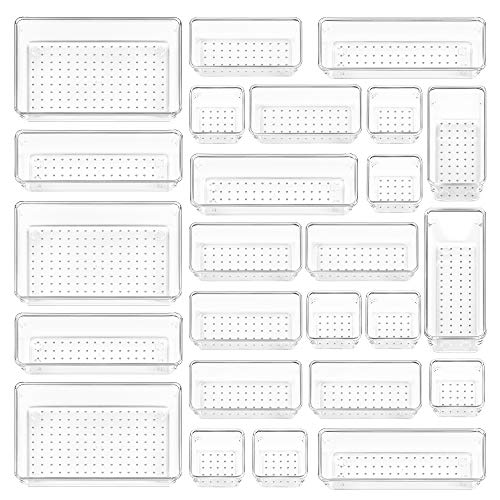
Vtopmart Clear Drawer Organizer Set
Why it helps: Separates clips, guards, nozzles, elastics, and small styling accessories.
Trade-off: The full set is larger than most hair-tool zones need and can create unnecessary categories.
Check: Drawer dimensions and the number of accessory groups actually used.
Check on AmazonFrequently Asked Questions About Hair-Tool Organization
What is the best way to organize hair tools?
Separate daily tools from occasional tools, create a safe cooling zone, control each cord individually, and store tools in a drawer, cabinet, door organizer, or wall holder that fits their actual dimensions.
Can hot hair tools be stored immediately after use?
Follow the tool and storage-product instructions. In general, unplug the tool and place it on a suitable heat-resistant surface or approved heat-safe holder before enclosed storage.
How do you store curling irons and flat irons?
Use a measured heat-safe sleeve, divided holder, or drawer zone that keeps hot surfaces away from cords, plastic products, and cabinet finishes.
How should a hair dryer be stored?
Store it unplugged in a drawer, cabinet, wall holder, or door organizer with enough room for the nozzle, handle, cord, and full door movement.
How do you stop hair-tool cords from tangling?
Give each tool its own cord loop, wrap, or compartment and avoid winding cords tightly around hot or delicate parts unless the manufacturer specifically permits it.
Can hair tools be stored under the bathroom sink?
They can be stored there when the cabinet is dry, the tools are unplugged and fully cool, cords are controlled, and the organizer does not block plumbing or leak inspection.
How do you organize hair tools in a small bathroom?
Keep only the daily dryer or styling tool in prime storage, move occasional tools elsewhere, and use one drawer, door, or wall solution rather than several separate organizers.
How do you keep hair-tool storage organized?
Return tools only after safe cooling, keep cords in assigned positions, remove unused attachments, and reset the storage zone weekly.