
How to Organize a Bathroom Vanity So It Stays Clear
Organize a bathroom vanity by separating the countertop, drawers, cabinets, under-sink area, hair tools, daily products, and backstock into distinct zones. Measure the usable interiors before adding trays, drawers, bins, turntables, or door storage.
What the Organized Vanity Should Do
The finished vanity should support morning, evening, grooming, and cleaning routines without requiring the reader to move unrelated products. Daily items should be closest to the point of use, occasional items should sit farther away, and refills should replenish rather than overwhelm the active zones.
Result checklist
- Counter stays mostly clear
- Daily routines stay together
- Drawers open fully
- Hair tools cool safely
- Backstock stays separate
- Cleaning remains easy
Quick Answer
Empty the vanity, remove expired or unused products, and separate active routines from occasional products and refills. Keep only daily essentials near the sink, divide drawers by routine, use cabinet storage for taller products and limited backstock, and reserve under-sink space for items that fit safely around plumbing. Add organizers only after checking usable width, depth, height, hinges, and drawer clearance.
Table of Contents
Why Bathroom Vanities Become Disorganized
| Symptom | Likely cause | First correction |
|---|---|---|
| Counter is always covered | Daily and occasional products are mixed | Keep only daily-use items near the sink |
| Drawers are full but hard to use | Products are grouped by size instead of routine | Create morning, evening, makeup, or grooming zones |
| Small items disappear | Drawer has no boundaries | Add a limited number of measured trays |
| Cabinet holds duplicates | Backstock has no limit | Keep one working reserve and relocate bulk extras |
| Hair tools tangle with products | No cooled-tool and cord zone | Create a dedicated dry storage location |
| Shared vanity becomes mixed | No personal boundaries | Assign one daily drawer or bin per user |
Audit the Complete Vanity Inventory
Gather everything from the countertop, drawers, cabinet, under-sink area, shower, medicine cabinet, bedroom, and travel bags if those items belong to the same routine.
Active Routine
Tooth care, current skincare, deodorant, daily makeup, shaving products, and tools used most days.
Secondary Products
Special treatments, formal makeup, travel products, rarely used tools, and seasonal or event-based items.
Backstock
Unopened toiletries, spare toothbrushes, cotton products, replacement soap, and duplicates awaiting use.
Reduce Before Organizing
Remove empty packaging, damaged tools, expired products where applicable, products that irritate or are no longer used, excessive samples, duplicate accessories, and bulk refills that do not need prime storage.
The Vanity Capacity Rule
Prime vanity storage should serve the current routine. The countertop, top drawers, and easiest cabinet shelves should not become long-term backstock or storage for products used elsewhere.
Measure the Vanity Before Buying Organizers
Drawer Interior
Measure usable width, depth, height, curved corners, drawer slides, and any center obstruction. Exterior drawer size is not the usable interior size.
Cabinet Opening
Measure clear opening width and height, shelf depth, hinges, plumbing, valves, and whether a bin or drawer can pass through the frame.
Countertop
Measure the usable dry area around the sink, faucet movement, outlet clearance, backsplash depth, and cleaning access.
Door and Tool Clearance
Check whether door-mounted storage collides with shelves, plumbing, bottles, or the opposite door. Measure tools and cords before assigning storage.
Not every cosmetic, medication, device, or personal-care product belongs in a humid bathroom. Follow manufacturer storage guidance, keep electrical tools unplugged and fully cool, and preserve access to outlets, plumbing, and ventilation.
Create Functional Bathroom Vanity Zones
Countertop Zone
Hand soap and the smallest realistic set of products used every day.
Morning Drawer
Products used together after waking, such as tooth care, deodorant, and daily skincare.
Evening Drawer
Nighttime skincare, floss, treatments, and products used before bed.
Makeup Zone
Frequently used cosmetics stored visibly in shallow trays or drawers, with occasional products elsewhere.
Hair-Tool Zone
Fully cooled and unplugged tools with controlled cords and clear door or drawer movement.
Backstock Zone
One limited refill area in a lower cabinet or secondary location, separate from active products.
Compare Bathroom Vanity Storage Methods
| Storage method | Best for | Advantage | Limitation |
|---|---|---|---|
| Drawer trays | Small daily products | Creates visible boundaries | Too many trays create micro-categories |
| Stacked cosmetic drawers | Makeup without built-in drawers | Uses vertical counter or shelf space | Consumes visual and physical counter space |
| Turntable | Bottles in a deep cabinet | Improves access | Uses rectangular space inefficiently |
| Handled bin | One refill or grooming category | Removes as one unit | Deep bins hide small items |
| Door hair-tool rack | Hair dryer and compatible tools | Uses door space | May block door closure or interior storage |
| Under-sink pull-out | Tall products and limited refills | Brings cabinet contents forward | Must clear plumbing and hinges |
Adapt the Vanity to the Household
Shared Vanity
Give each person one defined daily drawer, tray, or bin. Keep shared hand soap, toilet paper, cleaning supplies, and backstock in separate common zones.
Vanity With Few Drawers
Use one shallow tray per active routine and move tall or occasional items into the cabinet. Avoid adding multiple countertop towers.
Vanity With No Cabinets
Use existing drawers efficiently, keep the counter minimal, and move backstock to a nearby linen closet or secondary bathroom-storage area.
Rental Vanity
Favor removable trays, bins, turntables, and freestanding drawers. Check lease and surface instructions before mounting anything to doors or walls.
How to Organize a Bathroom Vanity Step by Step
Empty every vanity zone
Remove products from the counter, drawers, cabinets, and under-sink area.
Remove unused and unsuitable items
Discard empties and relocate products that should not live in the bathroom.
Separate active, occasional, and refill inventory
Prime storage should serve the current routine.
Measure all usable interiors
Record drawer, cabinet, door, countertop, hinge, and plumbing clearances.
Create daily routine groups
Build morning, evening, makeup, grooming, and shared zones.
Assign the counter last
Return only items that genuinely need immediate daily access.
Choose storage formats
Select trays, drawers, turntables, bins, or pull-outs according to the measured category.
Create a safe hair-tool zone
Preserve cooling, cord control, dryness, and full drawer or door movement.
Limit vanity backstock
Keep one working reserve and relocate bulk supplies.
Test every routine
Complete morning and evening use without moving unrelated products.
Build a daily reset
Return products, wipe the counter, and remove empties before clutter accumulates.
Bathroom Vanity Organization Mistakes
Keeping every product on the counter
Cleaning becomes difficult and occasional products crowd daily essentials.
Buying trays before measuring
The drawer closes poorly or wastes usable space.
Creating too many small categories
Putting products away requires too many decisions.
Mixing active products and backstock
Duplicates hide and prime storage becomes crowded.
Storing hot tools immediately
Heat, cords, and nearby products create avoidable risk.
Using door storage without testing closure
The organizer collides with shelves, plumbing, or products inside.
Which Vanity Organization Method Should You Use?
| Reader situation | Best starting method |
|---|---|
| Counter is crowded | Reduce to daily essentials and create one drawer routine zone |
| Drawer contents slide together | Measured shallow drawer trays |
| Makeup has no built-in drawer | Compact clear drawer unit in a measured location |
| Cabinet bottles are hard to reach | Small turntable or handled bin |
| Hair tools take over the cabinet | Dedicated dry drawer or measured door organizer |
| Under-sink area is deep | Pull-out organizer that clears plumbing |
| Two people share the vanity | One personal daily zone per user |
| Backstock fills every drawer | Move bulk refills to secondary storage |
Final Recommendation
For most bathroom vanities, keep the counter nearly clear, use the top drawers for daily morning and evening routines, reserve lower drawers or cabinets for occasional products, create one safe hair-tool zone, and move bulk backstock elsewhere. The vanity is organized when every routine can be completed and reset without moving unrelated items.
Verified Product Examples
These Amazon US examples were verified on July 28, 2026. They are alternatives for different measured vanity problems—not one universal setup.
Affiliate disclosure: As an Amazon Associate, Inplanty may earn from qualifying purchases.
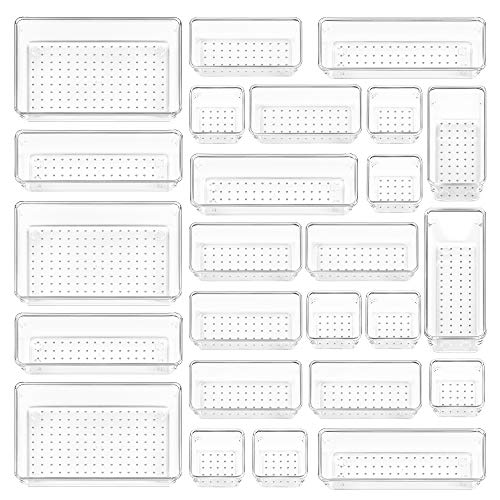
Vtopmart 25-Piece Clear Drawer Organizer Set
Why it helps: Creates flexible boundaries for daily grooming, skincare, and makeup items.
Trade-off: A large set can encourage unnecessary micro-categories.
Check: Drawer interior width, depth, height, and the number of categories actually used.
Check on Amazon
Sorbus 6-Drawer Acrylic Makeup Organizer
Why it helps: Adds visible contained storage when the vanity lacks suitable drawers.
Trade-off: It consumes counter or shelf space and can become a second clutter surface.
Check: Footprint, drawer dimensions, product height, and cleaning access.
Check on Amazon
iDesign 9-Inch Lazy Susan Turntable
Why it helps: Brings bottles forward in a deep cabinet.
Trade-off: The circular footprint uses some rectangular cabinet space inefficiently.
Listed size: 9 × 9 × 1.5 inches.
Check on Amazon
mDesign Narrow Handled Bathroom Bins
Why it helps: Creates removable categories for refills, hair products, or grooming supplies.
Trade-off: The audited listing is an eight-pack, which may exceed the needs of one vanity.
Listed size: 5 × 3.75 × 16 inches per listing title.
Check on Amazon
Simple Houseware Cabinet-Door Hair Tool Organizer
Why it helps: Moves compatible tools off the cabinet floor.
Trade-off: It reduces interior door clearance and may collide with shelves or plumbing.
Check: Door thickness, tool dimensions, cord position, and full closure.
Check on Amazon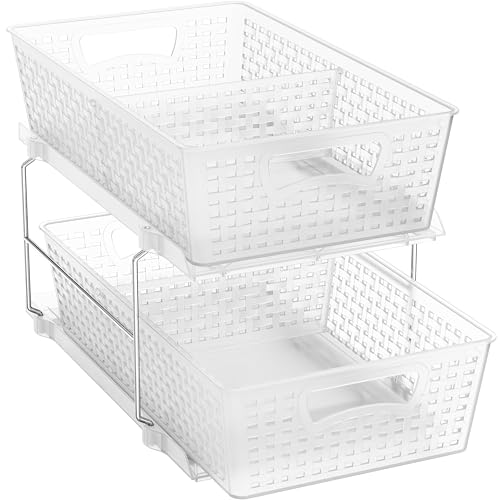
Simple Houseware 2-Tier Pull-Out Organizer
Why it helps: Brings tall products or limited refills forward in a deep cabinet.
Trade-off: The drawer path must clear plumbing, valves, hinges, and door storage.
Check: Cabinet opening, usable height, depth, and full extension.
Check on AmazonFrequently Asked Questions About Bathroom Vanity Organization
What is the best way to organize a bathroom vanity?
Keep only daily-use items on or near the counter, divide drawers by routine, separate active products from backstock, and use organizers only after measuring drawer and cabinet interiors.
What should stay on a bathroom vanity counter?
Keep only the products used every day, hand soap, and one or two tools that can return quickly. Store occasional skincare, makeup, backups, and cleaning products elsewhere.
How do you organize bathroom vanity drawers?
Measure the usable interior, group items by routine, and use a limited number of trays that fit the products rather than filling the drawer with many small compartments.
How should skincare be organized in a bathroom vanity?
Keep the current morning and evening routine together, separate occasional treatments, and follow product storage instructions for heat, light, and moisture.
How should makeup be stored in a bathroom vanity?
Store frequently used makeup in shallow visible drawers or trays and keep backups and rarely used products outside prime space.
Where should hair tools be stored?
Store hair tools in a dry drawer, cabinet, or door-mounted organizer after they are unplugged and fully cool, with cords controlled and door movement preserved.
How do two people share a bathroom vanity?
Give each person a defined daily drawer or bin while keeping shared categories such as hand soap, toilet paper, and cleaning supplies in separate common zones.
How do you keep a bathroom vanity organized?
Clear the counter daily, return products to broad zones, remove empties weekly, and review refills and duplicates monthly.