
How to Organize Kitchen Drawers Without Overcrowding Them
Assign each drawer one primary function, remove duplicates, measure the interior and stored items, then choose the simplest tray, divider, bin, peg system, insert, or no-organizer method that keeps daily tools visible and easy to return.
The Finished Result
Every drawer supports a clear kitchen activity. Daily tools sit near where they are used, long and short items no longer overlap, deep drawers hold stable broad categories, the junk drawer stays limited, and enough open capacity remains for easy resets.
- One primary function per drawer
- Inventory fits without compression
- Organizer dimensions match the interior
- Shallow and deep drawers use different methods
- Daily items are easiest to reach
Quick Answer
Organize kitchen drawers by giving each drawer one primary function, removing duplicates, and arranging tools by frequency of use. Measure the internal width, depth, and height before adding trays or dividers, and keep daily utensils in the easiest drawers while moving occasional and oversized tools elsewhere.
For the complete kitchen system, use how to organize a small kitchen. When small cleaning tools have been misplaced in drawers, move them into the safer system described in how to organize under the kitchen sink.
Why Kitchen Drawers Become Disorganized
| Drawer symptom | Likely cause | First correction |
|---|---|---|
| Drawer will not close | Too many tools or poor layout | Reduce and reassign the category |
| Utensils overlap | No length-based zones | Separate long and short tools |
| Items slide everywhere | Compartments are too large | Add fitted dividers or non-slip support |
| Tray wastes space | Organizer does not match dimensions | Measure and replace or simplify |
| Daily tool is buried | Frequency is ignored | Move daily items to the front or top |
| Junk drawer grows constantly | No category or capacity rules | Limit it to defined essentials |
| Deep drawer becomes a pile | Vertical space is unmanaged | Add broad dividers, pegs, or upright storage |
Drawer principle
A drawer is organized only when items can be found, removed, and returned without shifting unrelated categories.
Assign Every Drawer One Primary Function
Map each drawer’s location, internal size, current contents, nearby activity, frequency of use, and repeated problems.
Common functions
- Cutlery
- Cooking utensils
- Knives
- Baking tools
- Wraps and bags
- Food-storage supplies
- Spices
- Linens
- Small dishes
- Pots and pans
- Household essentials
- Lunch supplies
Location examples
- Cutlery near dishwashing or serving
- Cooking tools near the range
- Wraps near containers
- Baking tools near baking ingredients
- Towels near the sink
When two categories may share a drawer
Combine only closely related categories used in the same activity, visibly separated, and comfortable within the available space. Measuring cups with spoons or wraps with food-storage bags can work. Cutlery with batteries, tools, and receipts cannot.
Declutter Before Dividing
- Empty one drawer.
- Group items by function.
- Remove broken and unused items.
- Identify duplicates.
- Keep the best version of repeated tools.
- Move unrelated items.
- Clean and measure the empty drawer.
Keep the project contained
Do not empty every drawer at once unless the entire project can be completed immediately.
Reduce Duplicate Utensils
Review spatulas, wooden spoons, tongs, whisks, peelers, openers, measuring sets, serving spoons, and specialty gadgets. Ask which version is used most, whether the duplicate serves a unique purpose, whether it is damaged or difficult to clean, and whether it belongs in prime storage.
Capacity rule
Drawer capacity should determine how many versions of one tool remain in prime storage.
Move Oversized or Rarely Used Tools Elsewhere
Long or bulky tools may work better in a utensil container, vertical cabinet bin, wall rail, deep drawer, pantry, baking zone, or secondary cabinet.
Measure Before Buying Drawer Organizers
Measure the drawer
- Internal width
- Internal depth
- Internal height
- Side-wall shape
- Drawer-box taper
- Handle or screw intrusion
- Slide-hardware intrusion
- Opening beneath the counter
Measure the contents
- Longest utensil
- Widest tool
- Knife length
- Cutlery quantity
- Wrap-box length
- Lid size
- Spice-jar height
- Pot or pan diameter
- Dish height
- Towel thickness
Measurement rule
The external cabinet width is not the usable drawer width. Select the organizer according to both the interior and the stored category.
Test Drawer Closure and Movement
- Tools stay below the opening.
- Knife handles do not catch.
- Dividers do not shift upward.
- Wrap boxes fit without crushing.
- Upright items clear the counter.
- Liners do not bunch.
- Contents do not block slides.
Choose the Right Drawer Organizer
Expandable Cutlery Trays
Best for everyday flatware in standard shallow drawers. They are easy to understand and adjustable, but may waste depth or fit poorly in tapered drawers. Measure both the closed and expanded width.
Adjustable Drawer Dividers
Best for cooking utensils, wraps, baking tools, linens, and mixed lengths. Use fewer broad zones rather than many narrow compartments. Check divider height, tension, surface compatibility, and drawer taper.
Small Drawer Bins
Best for clips, measuring spoons, tiny gadgets, tea accessories, or a limited household-utility drawer. Too many bins waste space and increase reset time.
Pegboard Drawer Systems
Best for deep drawers holding dishes, bowls, cookware, or food-storage containers. They help prevent shifting, but need compatible width, depth, height, peg spacing, and stable weight distribution.
Knife Drawer Inserts
Best when knives need to leave the counter and one dedicated controlled drawer is available. Match blade length, protect edges, and consider household access carefully.
Spice Drawer Inserts
Best for compatible jars in a wide shallow drawer near the cooking zone. Confirm jar height, label visibility, and drawer closure.
Plan a complete spice system →
Non-Slip Liners
Useful for reducing movement under trays or a simple no-compartment setup. A liner supports organization but does not create categories or solve excess inventory.
No-Organizer Method
A drawer may need no purchased organizer when it contains only a few large tools in one visible layer and each item can be removed independently.
Simplicity principle
Do not add compartments merely to make the drawer look more elaborate.
Organize Different Drawer Types
Shallow drawers
Use for cutlery, knives, measuring tools, small utensils, wraps, flat linens, or compatible spices. Prioritize one visible layer and low-profile inserts.
Deep drawers
Use for cookware, dishes, containers, baking supplies, appliances, and large utensils. Prioritize broad zones, upright storage, pegs, dividers, and balanced weight.
Narrow drawers
Support one linear category such as long utensils, wraps, towels, knives, or one specialty group.
Extra-wide drawers
Divide into two to four broad activity zones, control shifting, and distribute heavy items evenly.
Organize Specific Kitchen Drawer Categories
Cutlery Drawer
Separate forks, knives, spoons, serving pieces, and children’s cutlery where relevant. Keep daily cutlery closest to the front and move rarely used serving pieces elsewhere when they crowd the tray.
Cooking-Utensil Drawer
Create broad zones for daily tools, long tools, small tools, and specialty tools. Keep the drawer near the cooking zone and remove rarely used duplicates.
Wraps and Food-Storage Bags
Use original boxes, broad horizontal dividers, vertical dispensers only where height permits, and simple bag-size groups. Custom dispensers are not automatically more space-efficient.
Food-Storage Containers and Lids
Remove unmatched pieces, limit container types, nest by shape, store lids vertically, and keep the entire category inside one fixed boundary.
Organize containers and lids →
Pots and Pans in Drawers
Use deep drawers, separate lids, limit nesting, distribute weight, and keep daily cookware easiest to reach.
Build a pots-and-pans system →
Dish Towels and Linens
Fold consistently, store near the sink or range, separate towels from potholders when space permits, and remove worn or excess linens.
Fix the Kitchen Junk Drawer
A limited household-utility drawer can be useful. It should not become a destination for unresolved objects.
Possible defined categories
- Pens and notepad
- Tape measure
- Scissors
- Flashlight
- A few small household tools
- Batteries stored appropriately
- Clips
- Frequently used charging accessories
Usually belongs elsewhere
- Old receipts
- Unidentified keys
- Expired coupons
- Random hardware
- Broken items
- Medicine
- Large tool collections
- Unused chargers
- Important documents
Junk-drawer rule
Use one small bin per defined utility category and a strict capacity limit. The drawer should hold useful household tools—not unmade decisions.
Best Setup by Reader Situation
Small kitchen
Use one function per drawer, daily tools only, compact organizers, multipurpose utensils, and secondary storage for occasional tools.
Rental kitchen
Use expandable trays, portable dividers, loose bins, and removable liners. Check surface compatibility and avoid permanent alterations.
Family kitchen
Use broad categories, safe tool placement, simple labels, lunch-supply zones, and clear reset responsibility.
Frequent cook
Keep cooking tools near the range, knives near preparation, measuring tools near baking, and specialty tools in secondary storage.
Limited reach
Prioritize upper accessible drawers, lightweight organizers, clear top-layer visibility, and no stacked loose tools.
Maintain the Drawer System
Leave deliberate open capacity
A drawer should not require perfect arrangement, catch during closing, hide categories, or force a complete reset whenever one item returns.
Complete a weekly reset
- Return misplaced tools.
- Remove crumbs.
- Match container lids.
- Reset assigned zones.
- Remove duplicates or unused items.
- Check sliding dividers.
- Clear junk-drawer overflow.
- Move occasional tools elsewhere.
Review functions when habits change
Reassign drawers when appliances, cooking routines, household access, or the kitchen layout changes. Drawer functions should follow current routines—not the original cabinet plan.
Use the daily home reset routine for the whole-home maintenance layer.
How to Organize Kitchen Drawers Step by Step
List every drawer and current function
See the full map before moving categories.
Choose one drawer
Keep the project contained.
Remove everything
See the real capacity.
Group by activity
Separate related tools.
Remove broken, unused, and duplicate items
Reduce before organizing.
Move unrelated items elsewhere
Protect the drawer’s function.
Assign one primary function
Use the drawer location to support workflow.
Measure width, depth, and height
Use internal dimensions.
Measure the longest and tallest items
Confirm category fit.
Choose the simplest method
Tray, divider, bin, peg system, insert, or no organizer.
Place daily items in easiest positions
Rank by frequency.
Move occasional tools to secondary storage
Protect prime capacity.
Test closure and movement
Check height, sliding, and drawer hardware.
Leave open capacity
Make resets forgiving.
Review after one week
Simplify zones that still fail.
Kitchen Drawer Organization Mistakes
Buying a tray before measuring
The organizer wastes space or prevents closure.
Keeping every utensil
Duplicates consume prime storage.
Mixing unrelated categories
The drawer becomes difficult to scan and reset.
Creating too many micro-compartments
The system requires unnecessary sorting.
Ignoring tool length
Long items overlap or block the drawer.
Overfilling deep drawers
Items become layered and hidden.
Ignoring spice-jar height
The drawer cannot close.
Storing knives loosely
Blades and users are not adequately protected.
Letting the junk drawer absorb decisions
The category expands without limits.
Using sliding organizers
Zones collapse during normal movement.
Filling every inch
Easy retrieval and future adjustment disappear.
Organizing for appearance instead of workflow
Tools remain far from where they are used.
Which Kitchen Drawer Organizer Should You Choose?
| Reader situation | Best starting method |
|---|---|
| Everyday flatware | Expandable cutlery tray |
| Long cooking utensils | Adjustable dividers |
| Tiny gadgets | A few small bins |
| Knives | Fitted knife insert |
| Spices | Low-profile spice insert |
| Deep dish drawer | Pegboard system |
| Pots and pans | Pegs or broad dividers |
| Wraps and bags | Long horizontal zones |
| Contents slide | Non-slip liner plus simple zones |
| Rental kitchen | Portable trays and dividers |
| Very limited budget | Declutter and use broad no-purchase zones |
| Organizer wastes space | Remove it and use fewer categories |
Final recommendation
Give each drawer one primary function, reduce the category until it fits comfortably, and choose the simplest divider system that keeps daily items visible and easy to return.
Verified Product Examples by Drawer Function
Use these only after assigning the drawer’s function and checking internal dimensions, tool length, item height, movement, and access frequency.
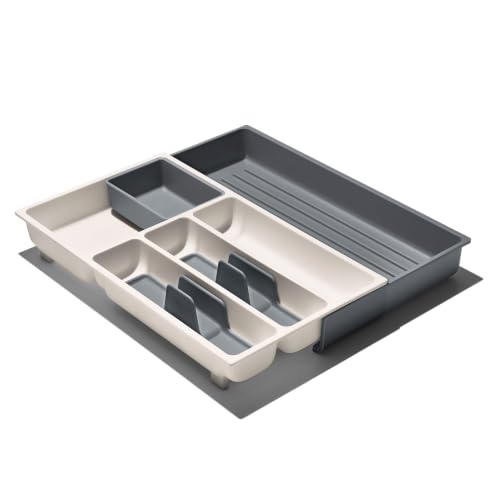
OXO Good Grips Kitchen Drawer, Expandable Utensil Organizer, White
Flexible everyday organizer for flatware and smaller tools. Best for standard shallow drawers where one adjustable insert can create clear daily-use zones. Measure closed and expanded width, drawer depth and height, and utensil length.
Verified ASIN: B09B1CZVWR
6-Pack Bamboo Drawer Dividers
Creates broad adjustable zones for long utensils, wraps, linens, or baking tools. Best for wide or deep drawers with mixed tool lengths. Check internal depth, wall shape, surface compatibility, and clearance below the counter.
Verified ASIN: B07NTMYY3R
Joseph Joseph DrawerStore Compact Utensil Organizer
Stores flatware in overlapping angled compartments to preserve drawer width. Best for narrow drawers and limited flatware collections. Confirm drawer height and flatware length; the layered format may not suit oversized pieces.
Verified ASIN: B072R6CLRC
WÜSTHOF 15-Slot In-Drawer Knife Tray
Creates separated in-drawer knife storage and can remove a block from the counter. It uses substantial drawer capacity, must match actual blade lengths, and requires careful household-access planning.
Verified ASIN: B09163XXXQ
YouCopia SpiceLiner Adjustable Spice Drawer Liner
Positions compatible spice bottles so labels remain easier to see in a shallow drawer. Best for a wide drawer near the cooking zone. Mixed bottle sizes may fit poorly, so measure jar and drawer height.
Verified ASIN: B0979ML1GL
Rev-A-Shelf Trimmable Pegboard Drawer Divider Organizer
Creates adjustable zones for dishes, bowls, containers, pots, or pans in a deep drawer. It requires trimming and precise measurement, and it uses some base space. Check item diameter, peg spacing, and weight distribution.
Verified ASIN: B0028BOTG0
Rev-A-Shelf Trimmable Pegboard Drawer Divider Organizer
Premium customizable system for wide deep drawers holding plates, bowls, cookware, or larger categories. Compatibility depends on exact dimensions, trimming, peg placement, and stable loading.
Verified ASIN: B00H45N45M
GORILLA GRIP powerGRIP Non-Adhesive Drawer Liner
Helps reduce sliding beneath simple trays, bins, or a no-organizer drawer. It controls movement but does not create categories or solve excess inventory.
Verified ASIN: B07W7MG36TRecommended product combination
Use one expandable organizer for everyday flatware or small tools, adjustable dividers for long categories, one specialized insert only where justified, and a non-slip liner only when movement remains a problem. Do not install all products in every kitchen.
Affiliate disclosure: Inplanty may earn a commission from qualifying purchases made through links on this page, at no additional cost to you.
Frequently Asked Questions
What is the best way to organize kitchen drawers?
Give each drawer one primary function, remove duplicates, measure the drawer and stored items, and use the simplest organizer that keeps daily tools visible.
How should kitchen drawers be assigned?
Assign them by nearby activity and frequency: cutlery near serving, cooking tools near the range, wraps near containers, and towels near the sink.
How do you organize a utensil drawer?
Separate daily, long, small, and specialty tools, remove duplicates, and use broad length-based zones.
How do you organize deep drawers?
Use broad zones, pegs or dividers for larger categories, stable weight distribution, and no loose small items beneath larger ones.
How do you organize shallow drawers?
Use one visible layer, low-profile inserts, exact height measurements, and categories such as cutlery, knives, wraps, or small tools.
Are adjustable dividers worth it?
Yes for long utensils, wraps, linens, and mixed lengths when the height, tension, and drawer shape are compatible.
How do you organize drawers without organizers?
Reduce the category, assign one function, keep items in one visible layer, and use broad natural zones.
What should go in top kitchen drawers?
Daily cutlery, cooking tools, knives where safely controlled, measuring tools, wraps, and other frequent small items.
How do you organize a junk drawer?
Limit it to a few defined utility categories, one small bin per category, and a strict review schedule.
How do you keep organizers from sliding?
Use a fitted insert, broad zones, or a compatible non-slip liner and avoid oversized compartments.
How should knives be stored in a drawer?
Use a fitted insert that protects blades, matches blade lengths, and supports controlled household access.
Can spices be stored in a drawer?
Yes when the drawer is wide and shallow enough, jars fit below the opening, and labels remain visible.
How do you organize wraps and food-storage bags?
Use broad horizontal zones or compatible dispensers, and keep original boxes when they fit more efficiently.
How do you stop drawers becoming cluttered again?
Leave open capacity, complete a weekly reset, remove duplicates, and reassign the drawer when household routines change.