Quick Answer
Keep the brewer, daily coffee, a small mug group, and required preparation tools on the main surface. Store pods, filters, syrups, extra mugs, and cleaning products by category in drawers, cabinets, shelves, or lower cart tiers. Arrange espresso tools in workflow order and finish with a two-minute daily reset.
Recommended Coffee Station Organizers by Problem
Readers who already know what is failing can start here. These are current Amazon US examples verified for availability; choose only the category that solves the measured problem.
Affiliate disclosure: As an Amazon Associate, Inplanty may earn from qualifying purchases.


Best Coffee Station Organizers by Use Case
Pod Drawer When Height Allows
Choose a drawer when you want pods hidden beneath the brewer and the combined machine-and-drawer height still clears upper cabinets.
Alternative: Use a carousel when visibility and fast flavor selection matter more than counter footprint.
Workflow Tools in Brewing Order
Prioritize a compatible dosing cup, compact scale, tamping mat, milk pitcher, knock box, brush, and towels rather than decorative organizers.
One Hidden and One Vertical Solution
Use a compact pod drawer, cabinet shelf riser, or under-cabinet mug storage while keeping bulk coffee and extra mugs outside the active station.
Portable Counter or Cart Organization
Use a washable tray, countertop organizer, mug tree, or rolling coffee cart instead of permanent shelving or cabinetry.
What an Organized Coffee Station Should Do
The finished station should support the entire drink routine without searching through cabinets, moving decorative items, or covering the work surface with refills and rarely used accessories.
Result checklist
- Daily tools stay within reach
- Backstock stays off the counter
- Mugs do not crowd the machine
- Water and waste paths stay clear
- Cleaning tools have a home
- The station resets quickly
Table of Contents
Start by Editing the Coffee Inventory
Daily Supplies
The current coffee, pods or filters, regularly used mugs, sweetener, and essential preparation tools.
Backstock
Unopened coffee, bulk pods, extra filters, syrups, cleaning products, and replacement supplies.
Unused Items
Expired coffee, duplicate tools, damaged mugs, unused flavors, empty packages, and equipment for abandoned routines.
Create Six Coffee Station Zones
1. Brewing Zone
The machine, water access, cup placement, and the clear operating space required by the appliance.
2. Coffee Zone
The active beans, grounds, pods, filters, scoop, or scale used for the most common drink.
3. Mug Zone
A small group of frequently used mugs placed close to the serving side of the machine.
4. Preparation and Serving
Milk tools, tamper, sweeteners, syrups, spoons, or stirrers that support the real routine.
5. Cleanup Zone
Towels, brushes, knock box, waste container, and machine-care supplies.
6. Backstock Zone
Refills and occasional accessories stored away from the primary work surface.
The Active-Inventory Rule
The coffee station should hold what is needed for the next several days, not every coffee-related item in the home.
Organize the Coffee Station Counter
| Item | Keep on counter when | Move elsewhere when |
|---|---|---|
| Brewer | Used regularly | It is a secondary brewing method |
| Grinder | Whole beans are ground daily | Pods or pre-ground coffee are the main routine |
| Coffee canister | It holds the active supply | Suitable original packaging already works |
| Mugs | A small group is used daily | The full collection crowds the station |
| Sweeteners | Used regularly | Several packets or flavors remain untouched |
| Decor | It leaves preparation space open | It must be moved to make coffee |
Store Coffee, Pods, Filters, and Syrups
Beans and Ground Coffee
Keep one active supply near the brewer. Store unopened bags and additional varieties in a cool, dry backstock location according to package guidance.
Coffee Pods
Keep a practical quantity in a compatible drawer, holder, jar, or divided bin. Move bulk cartons away from the counter.
Filters and Manual-Brew Supplies
Use one shallow drawer, bin, or shelf zone for filters, scoops, a scale, and the tools required by the active brewer.
Syrups and Sweeteners
Limit the visible selection to flavors used regularly. Wipe bottles and use a washable tray if drips are common.
Organize Coffee Mugs Without Crowding the Station
Active Mug Group
Keep enough mugs for the household’s normal routine, not the full collection.
Guest and Seasonal Mugs
Move them to a cabinet, upper shelf, dining storage, or another secondary zone.
Hanging Storage
Use hooks only when the mugs, mounting method, and clearance are compatible and the display does not obstruct preparation.
Organize an Espresso Station in Workflow Order
Grind and Dose
Place the grinder, beans, dosing cup, and scale on the preparation side of the machine.
Distribute and Tamp
Create a stable washable area for the portafilter, tamper, and any tools used every day.
Brew and Steam
Preserve cup, steam-wand, milk pitcher, reservoir, and machine-control clearance.
Discard
Place the knock box close enough to reduce drips but far enough away to preserve work space.
Wipe and Purge
Keep one active towel and required cleaning tool nearby, with replacements stored separately.
Machine Care
Store manufacturer-specified cleaning products in a labeled secondary zone.
Preserve appliance ventilation, reservoir and lid access, steam clearance, stable footing, outlet safety, and the manufacturer’s operating instructions. Keep cords away from water, heat, and edges where they can be pulled.
Coffee Station Organization by Location
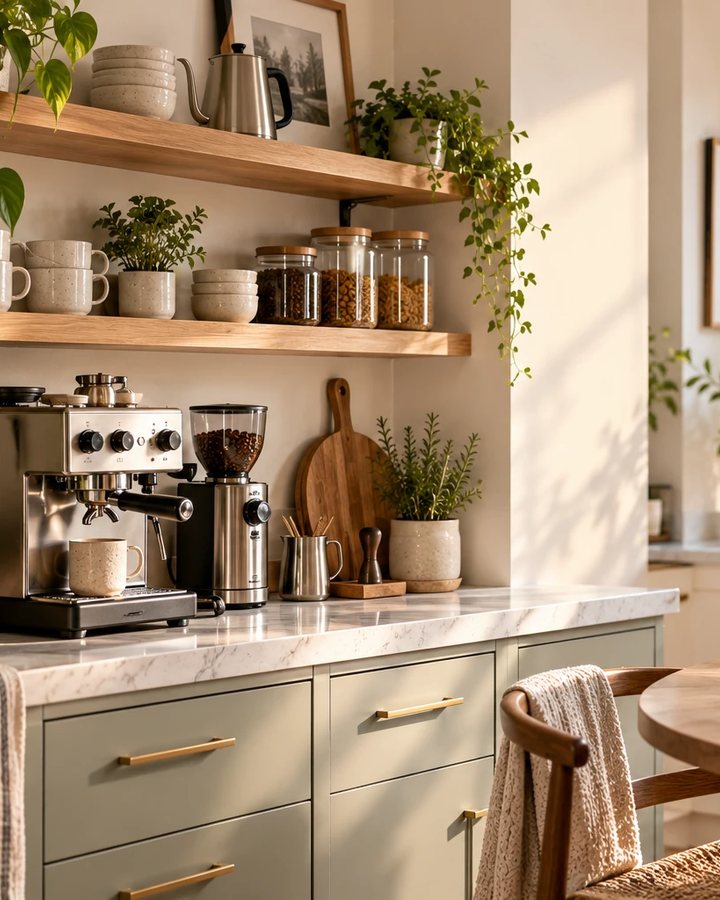
Countertop Coffee Station
Use one washable tray, keep only active supplies visible, and preserve food-prep space. A coffee station buying guide helps confirm appliance and counter requirements.
Coffee Station Cabinet
Use shelf risers and contained backstock while preserving door, heat, steam, outlet, and appliance clearance. See Coffee Station in a Cabinet for a complete layout.
Coffee Station Cart
Keep the brewer and active tools on top, daily supplies in the upper tier, and refills or cleaning products below. Link readers to best coffee carts for small spaces.
Pantry Coffee Station
Use closed shelves for backstock and one open preparation shelf, preserving ventilation and easy water movement.
Floating-Shelf Coffee Bar
Use shelves for lightweight mugs, coffee, or decor—not heavy appliances unless the system is specifically designed and mounted for the load.
Sideboard Coffee Bar
Use the top for brewing and drawers or doors for coffee bar storage, serving tools, napkins, and guest supplies.
Coffee Station Organization by Machine
Espresso Machine
Organize grinder → dosing → tamping → brewing → milk → knock box → wipe-down in sequence. See the home espresso machine setup guide.
Nespresso Station
Prioritize capsule storage, cup sizes, reservoir access, disposal, milk frother storage, and backstock boxes.
Keurig Station
Choose between a drawer, carousel, or cabinet bin based on total machine height and available countertop coffee organizer space.
Pour-Over Station
Keep kettle, dripper, filters, grinder, scale, server, and beans together while preserving a safe pouring area.
French Press Station
Store the press, coffee, grinder or scoop, timer, and serving mugs together; keep the kettle near a safe outlet.
Drip Coffee Station
Keep filters, active coffee, scoop, mugs, and carafe access clear, especially under upper cabinets.
Coffee Station Organization by Household
Small Apartment
Use one brewer, one coffee type, a minimal mug group, hidden backstock, and vertical storage. See small coffee station ideas for apartments.
Family Coffee Station
Use clearly divided coffee, tea, cocoa, mug, sweetener, and cleanup zones without putting every refill on display.
Office Coffee Station
Prioritize cup, lid, packet, pod, trash, refill, and wipe-down zones designed for several users.
Rental Coffee Station
Use carts, freestanding shelves, removable organizers, and concealed backstock rather than permanent cabinetry.
Coffee Station Storage Comparisons
| Decision | Choose the first option when | Choose the second option when |
|---|---|---|
| Coffee canister vs original bag | You need one defined active container and verify capacity | The package already closes well and reduces decanting |
| Pod drawer vs carousel | You want pods hidden beneath a compatible machine | You want visible rotating access and have counter room |
| Mug hooks vs shelf | Mounting, mug weight, and clearance are compatible | You need flexible storage for mixed mug sizes |
| Coffee cart vs cabinet | Portability and renter flexibility matter | Concealed storage and a permanent look matter |
| Open shelf vs closed storage | Items are attractive, uniform, and easy to reset | Backstock, cleaning supplies, and mixed accessories create visual noise |
| Tray vs divided organizer | You need a washable boundary for a few bottles or tools | You need separated compartments for cups, packets, or pods |
Small-Space Coffee Station Organization
No Counter Space
Use a measured cart, cabinet, sideboard, shelf system, or concealed station rather than spreading supplies across unrelated surfaces. See how to create a coffee station without counter space.
Small Apartment
Choose one primary brewer, reduce mug and flavor inventory, use hidden backstock, and keep the station visually simple.
Small Kitchen
Use a dead corner, cabinet end, appliance garage, narrow cart, or one wall zone without blocking food preparation.
Coffee Cart
Keep the machine and active tools on top, daily supplies in the upper tier, and refills or cleaning products below.
Shop the Organization by Setup
Simple Counter Setup
- Original coffee packaging or one canister
- Small washable tray
- Existing cabinet for mugs
- One cleaning cloth and brush
Best for: drip, French press, or simple pod routines.
Compact Pod Setup
- Pod drawer or carousel
- Four to six active mugs
- One compact organizer
- Bulk pods stored away from the station
Best for: Keurig or Nespresso stations with limited counters.
Workflow Setup
- Dosing cup and scale
- Tamping mat
- Milk pitcher
- Knock box
- Brush and barista towels
Best for: portafilter espresso machines and frequent milk drinks.
Styled Coffee Bar Setup
- One coffee canister
- Small mug tree or compatible hooks
- Tray or divided organizer
- Limited syrup display
- Closed cleaning storage
Best for: sideboards, cabinets, and larger counters with Pinterest potential.
How to Organize a Coffee Station Step by Step
Remove everything except the machine
Start with a clear surface so the true operating space is visible.
Discard and relocate
Remove empty packages, expired coffee, duplicate tools, and unrelated kitchen items.
Identify the daily drink
Organize for the routine used most often rather than every possible beverage.
Create the six zones
Assign brewing, coffee, mugs, serving, cleanup, and backstock.
Limit counter inventory
Keep only active supplies and essential tools visible.
Move refills to backstock
Use nearby drawers, cabinets, shelves, or lower cart tiers.
Test one complete drink
Refill, prepare, brew, serve, discard waste, and wipe the area.
Adjust friction points
Move items that require unnecessary reaching, crossing, or repeated cabinet opening.
Create a daily reset
Return tools, wipe drips, discard waste, and refill only what is needed.
The Organization Choices That Create the Biggest Improvement
Across common coffee-station layouts, the strongest systems tend to share the same practical decisions. These are layout-based observations, not claims of laboratory testing.
Fewer Visible Categories
Stations stay easier to reset when the counter holds one active coffee supply, one mug group, and only the tools required for the main drink.
Backstock Outside Prime Space
Bulk pods, unopened beans, extra syrups, filters, and cleaning supplies work better in nearby cabinets, drawers, or lower cart tiers.
Workflow Beats Symmetry
Placing tools in use order reduces reaching, drips, and repeated movement even when the final arrangement is not perfectly symmetrical.
Common Coffee Station Organization Mistakes
Displaying all supplies
Bulk coffee, pods, filters, syrups, and mugs consume the work surface.
Buying organizers before editing
The organizer creates more categories without reducing clutter.
Separating tools from the workflow
Frequently used items are stored too far from where they are needed.
Ignoring cleanup
Grounds, milk drips, pods, and towels have no return or disposal zone.
Overloading vertical storage
Heavy mugs and supplies become difficult or unsafe to retrieve.
Letting decor replace function
Signs, plants, and displays occupy the preparation area.
Coffee Station Organization Ideas to Visualize
These image anchors support Google Images and preserve future Pinterest potential. Each one maps to a distinct layout or long-tail search intent.

Final Recommendation
Organize the coffee station for one primary drink routine. Keep the machine, active coffee, a small mug group, and essential tools on the surface. Move refills, extra mugs, secondary flavors, and machine-care supplies into clearly labeled backstock, then complete a short reset after the final drink.
Coffee Station Accessories and Organizers by Category
These examples are grouped by use case so readers can shop one problem at a time. Compatibility, measurements, mounting, appliance instructions, and actual routine should determine the final choice.
Affiliate disclosure: As an Amazon Associate, Inplanty may earn from qualifying purchases.
Coffee and Pod Storage
Veken Coffee Canister
Use it for: one active supply of beans or grounds.
Check: capacity, shelf height, scoop storage, and whether original packaging is already sufficient.
Check on Amazon
Amazon Basics Pod Drawer
Use it for: hidden compatible pod storage under a brewer.
Check: total machine height, drawer access, machine weight, and cabinet clearance.
Check on Amazon
Keurig Storage Carousel
Use it for: visible rotating access to compatible pods.
Trade-off: occupies counter footprint and keeps the pod inventory visible.
Check on AmazonMug and Counter Organization
MyLifeUNIT Mug Holder Tree
Use it for: a small active mug group on an open counter.
Trade-off: uses counter area and may not fit oversized mugs.
Check on Amazon
DEPAOTLUX Under-Cabinet Mug Hooks
Use it for: reclaiming vertical space beneath a compatible shelf or cabinet.
Check: mug weight, mounting method, cabinet material, door movement, and head clearance.
Check on Amazon
SONGMICS Cabinet Organizer Shelves
Use it for: doubling cabinet height for mugs, coffee, or serving tools.
Check: shelf depth, internal cabinet height, load, and door closure.
Check on Amazon
ALELION Coffee Station Organizer
Use it for: separating a small active group of packets, pods, cups, or stirrers.
Trade-off: becomes clutter when filled with categories the household does not use.
Check on AmazonEspresso Workflow

Maestri House S2 Coffee Scale
Use it for: measuring coffee and timing espresso shots.
Check: drip-tray fit, weight range, charging, and water resistance.
Check on Amazon
Normcore Espresso Tamping Mat
Use it for: defining and protecting the tamping area.
Check: portafilter fit, counter edge, mat size, and cleanability.
Check on Amazon
Auden Arctic Compact Knock Box
Use it for: frequent disposal of portafilter coffee pucks.
Trade-off: requires counter space, emptying, and washing.
Check on Amazon
UMUACCAN 12 oz Milk Pitcher
Use it for: a compact milk-drink workflow.
Check: serving size, steam wand, handle preference, and immediate cleaning routine.
Check on AmazonCleaning and Maintenance

CAFEMASY Cleaning Brush Kit
Use it for: removing loose grounds from compatible grinders and espresso areas.
Check: machine instructions and brush use before cleaning hot or moving components.
Check on Amazon
EubooTree Barista Towels
Use it for: assigning separate cloths to steam-wand, counter, and general cleanup.
Trade-off: towels need a washing and replacement routine.
Check on Amazon
IMPRESA Coffee Machine Descaler
Use it for: compatible machines when descaling is required.
Check: machine manufacturer instructions, compatibility, dosage, and schedule before use.
Check on AmazonFrequently Asked Questions About Coffee Station Organization
How should a coffee station be organized?
Create separate brewing, coffee, mug, serving, cleanup, and backstock zones, keeping only daily-use items on the work surface.
What should stay on a coffee station counter?
Keep the brewer, grinder when used daily, active coffee, a small mug group, and only the preparation tools required for the usual drink.
Where should coffee station backstock be stored?
Store unopened coffee, pods, filters, syrups, extra mugs, and cleaning supplies in a nearby cabinet, drawer, shelf, or lower cart tier.
How do you organize coffee pods?
Keep a practical active quantity in a compatible drawer, holder, bin, or jar and move bulk boxes to backstock storage.
How do you organize an espresso station?
Arrange the grinder, dosing area, tamping surface, machine, milk tools, knock box, towels, and cleanup supplies in the order they are used.
How many mugs should stay at a coffee station?
Keep only the mugs used regularly at the station and store the larger collection elsewhere.
How do you keep a coffee station clean?
Give towels, brushes, waste handling, and machine-care products a dedicated zone and complete a short reset after the final drink.
How do you organize a coffee station in a small space?
Use one compact work surface, vertical or hidden storage, a small active inventory, and nearby backstock rather than displaying every supply. For product selection, continue to the coffee station essentials guide.
Choose the Layout That Fits Your Space
Need the full coffee-station plan?
Start with Coffee Station Ideas & Setup Guides to compare layouts, storage approaches, and space-saving options.
No counter space?
Use How to Create a Coffee Station Without Counter Space to compare carts, cabinets, shelves, and hidden setups.
Want the station hidden?
See Coffee Station in a Cabinet for a contained setup with concealed storage.
Need a movable setup?
See Coffee Station on a Cart for a flexible coffee zone.