
Create a coffee station that keeps daily supplies easy to reach while moving refills, extra mugs, cleaning products and occasional tools out of the active workspace.
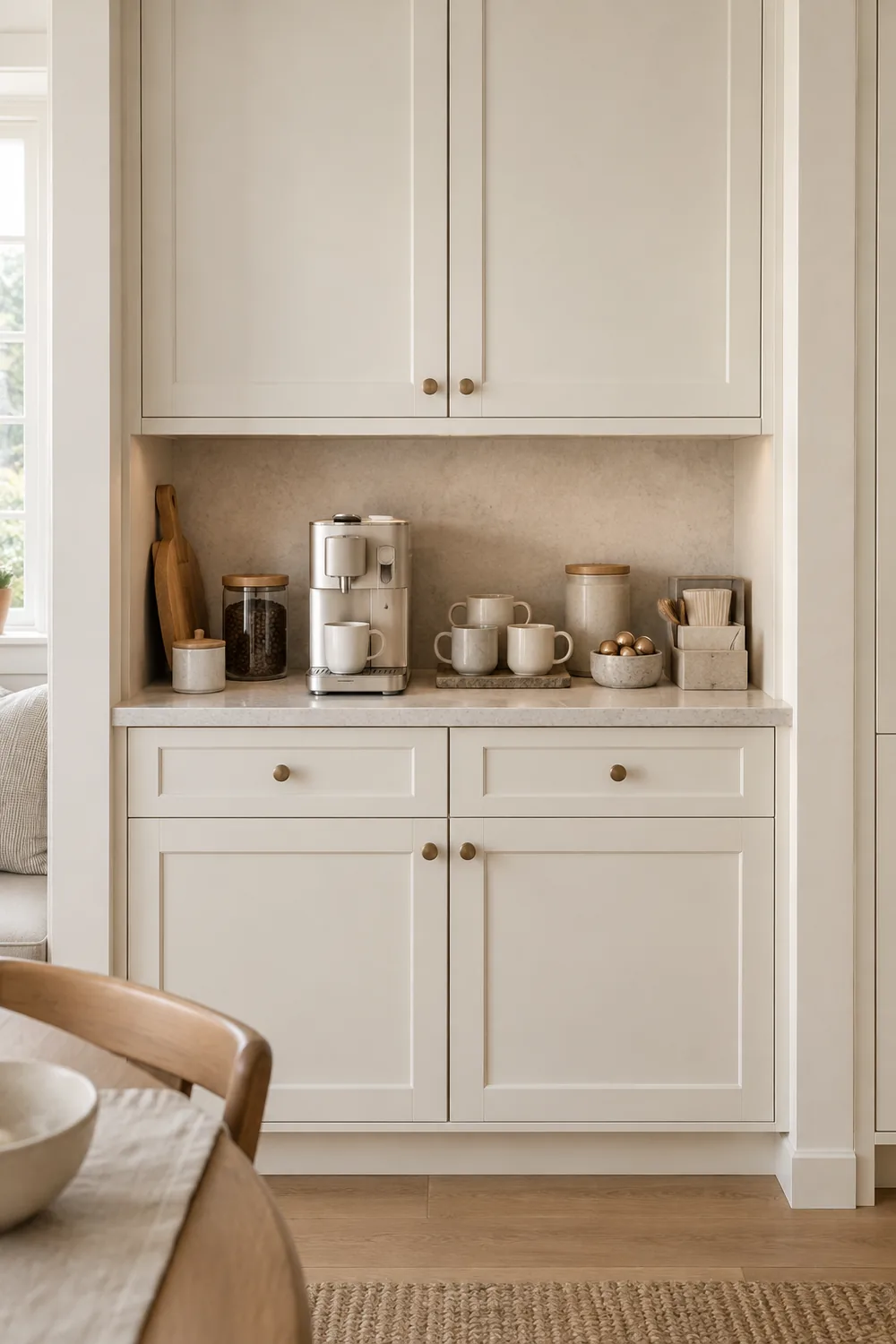 A complete organized coffee station in a believable small kitchen: only daily coffee, a few mugs and essential tools remain active while refills and maintenance supplies are concealed
Quick Answer
Keep only the next several days of coffee supplies at the station. Use a drawer or carousel for active pods, a cabinet shelf or hooks for daily mugs, one canister or original bag for active coffee, a tray for frequently used serving items, and closed storage for refills and cleaning products.
What Good Coffee Station Storage Should Do
The storage should make the morning routine faster without turning the counter into a product display. Each category needs one active location and one backstock location.
Storage result checklist
- Daily items stay within reach
- Bulk packaging disappears
- Mugs do not crowd the machine
- Cleaning supplies stay separate
- Appliance access remains clear
- The station resets in minutes
Table of Contents
Build the Coffee Station Around Storage Zones
Active Coffee Zone
One open bag or canister, the current pods or filters, and only the tools required for the main drink.
Mug and Add-In Zone
Daily mugs, one or two sweeteners, spoons, and frequently used milk or syrup tools.
Preparation Zone
Grinder, scale, scoop, tamper, dosing cup, milk pitcher, or kettle based on the brewing method.
Waste and Wipe Zone
Pod disposal, knock box, towels, brush, and immediate cleanup supplies.
Refill Zone
Unopened coffee, bulk pods, extra filters, syrups, cups, and replacement supplies. When the coffee station is part of a wider storage shortage, use the same principles from adding storage to a small apartment without making it feel smaller.
Secondary Equipment Zone
Guest mugs, seasonal accessories, alternate brewers, and tools used only occasionally.
The One-Active, One-Backstock Rule
Every supply category should have one active location and one refill location. Avoid opening several bags, displaying full pod boxes, or storing maintenance products beside serving items.
Coffee Pod Storage Ideas
Pod Drawer Under the Machine
Hides compatible pods and preserves a clean countertop. Confirm total machine height, machine weight, drawer movement, and upper-cabinet clearance.
Rotating Pod Carousel
Makes flavors visible and easy to select, but consumes counter footprint and can make the station look busy.
Divided Drawer
Uses an existing kitchen drawer and keeps the counter open. This is often the best option when the station is near cabinetry.
Labeled Cabinet Bin
Works well for bulk pods and refill packages. Keep only a smaller active quantity at the station.
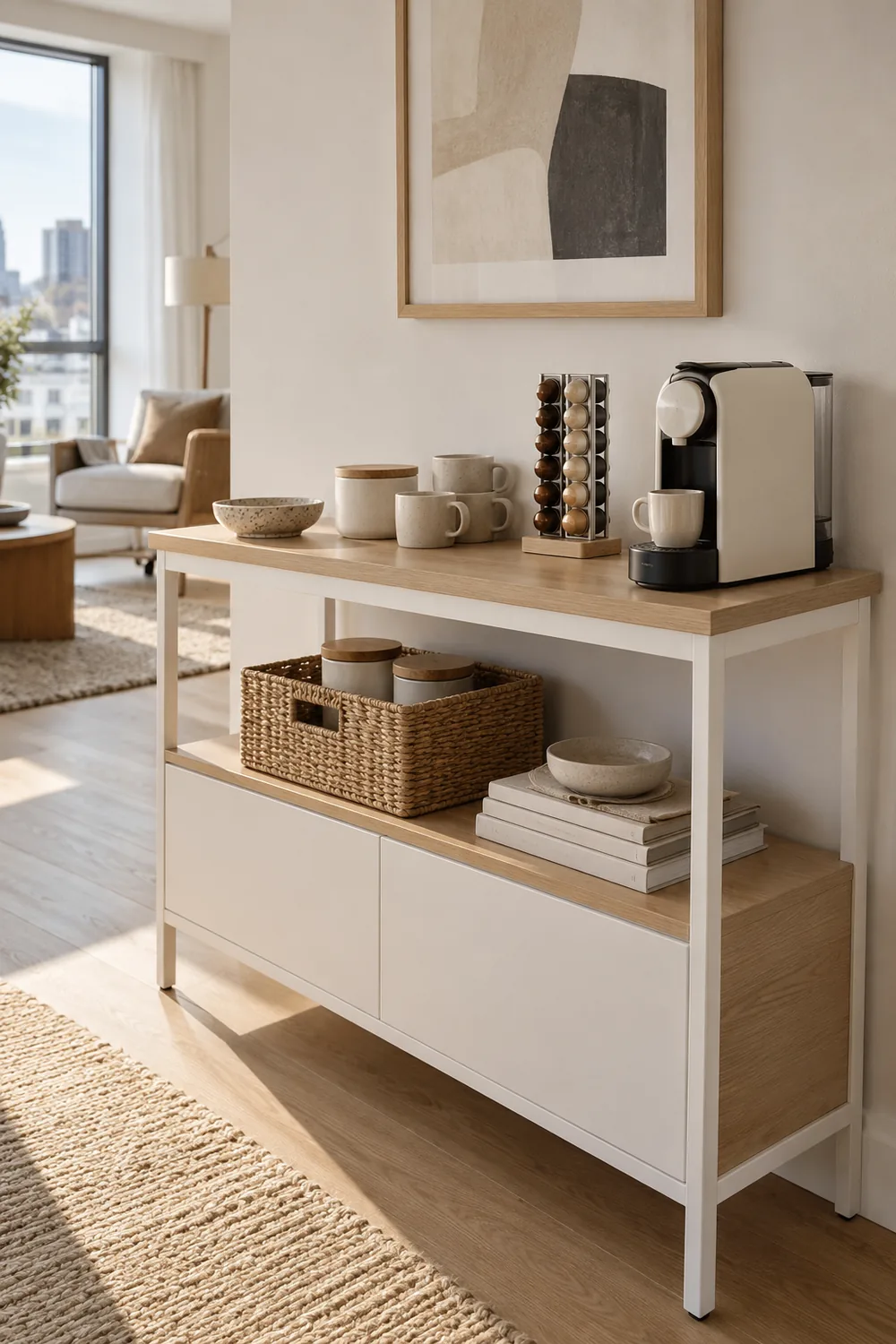 Standalone compact pod station with active pods in a practical drawer or cabinet and bulk cartons hidden as backstock
Coffee Mug Storage Ideas
Cabinet Shelf
The simplest option for mixed mug sizes and visual calm. Keep daily mugs on the easiest shelf.
Shelf Riser
Uses unused cabinet height to create a second mug level without permanent construction.
Mug Tree
Keeps a small active mug group visible and portable, but uses counter area.
Under-Cabinet Hooks
Reclaims vertical space when mounting, mug weight, door movement, and head clearance are compatible. For a broader small-space approach, see how to use vertical storage without making a room feel crowded.
Open Wall Shelf
Creates an attractive display when the mug group is limited and the shelf is securely installed for the load.
Backstock Mug Cabinet
Move guest, seasonal, oversized, and collectible mugs away from the daily station.
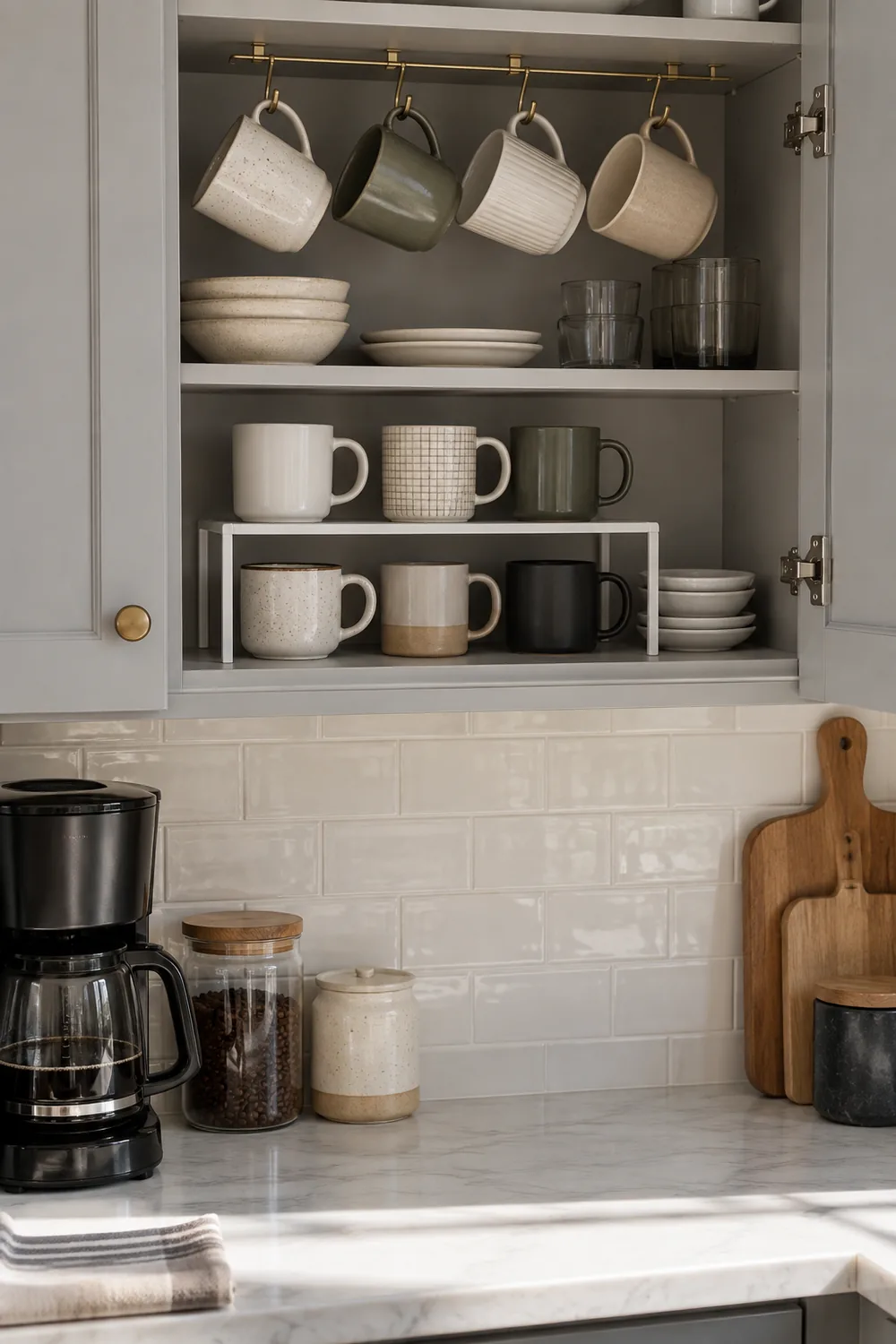 Standalone station with a limited daily mug group using cabinet height, a riser or compatible hooks while overflow mugs remain out of sight
How to Store Coffee Beans and Ground Coffee
Use One Active Supply
Keep one open coffee bag or one appropriately sized canister near the brewer. Multiple open varieties quickly consume the station.
Store Refills Separately
Keep unopened coffee in a cool, dry secondary location according to the producer's storage guidance.
Choose Capacity Before Style
A canister should fit the quantity actually used, the shelf height, and the refill routine.
Do Not Decant Automatically
Original packaging may already provide suitable storage and avoids combining old and new coffee.
Coffee Station Drawer, Cabinet and Shelf Storage
| Storage location | Best items | Avoid storing |
|---|---|---|
| Shallow drawer | Filters, scoops, scales, spoons, pod refills | Tall bottles and bulky coffee bags |
| Upper cabinet | Daily mugs, coffee, filters, lightweight serving tools | Heavy appliances or difficult-to-reach backstock |
| Lower cabinet | Bulk pods, syrups, cleaning backstock, alternate brewers | Unsafe products accessible to children or pets |
| Open shelf | Limited mugs, one coffee supply, attractive daily tools | Mixed packaging and maintenance products |
| Cart tiers | Daily supplies above, backstock and cleanup below | Loose breakables on a cart that moves frequently |
Espresso Station Storage Ideas
Dosing and Tamping Drawer
Store the dosing cup, distribution tool, spare baskets, and accessories in one shallow drawer near the grinder.
Defined Tamping Surface
Keep only the tamper and required preparation tools on the active mat or station.
Milk Pitcher Storage
Store the clean pitcher near the machine without blocking the steam wand or cup area.
Knock Box Position
Place it close enough to reduce drips but far enough away to preserve preparation space.
Towel Rotation
Keep one active towel and store clean replacements in a drawer or nearby bin.
Maintenance Backstock
Store compatible tablets, descaler, brushes, and filters in a labeled secondary zone.
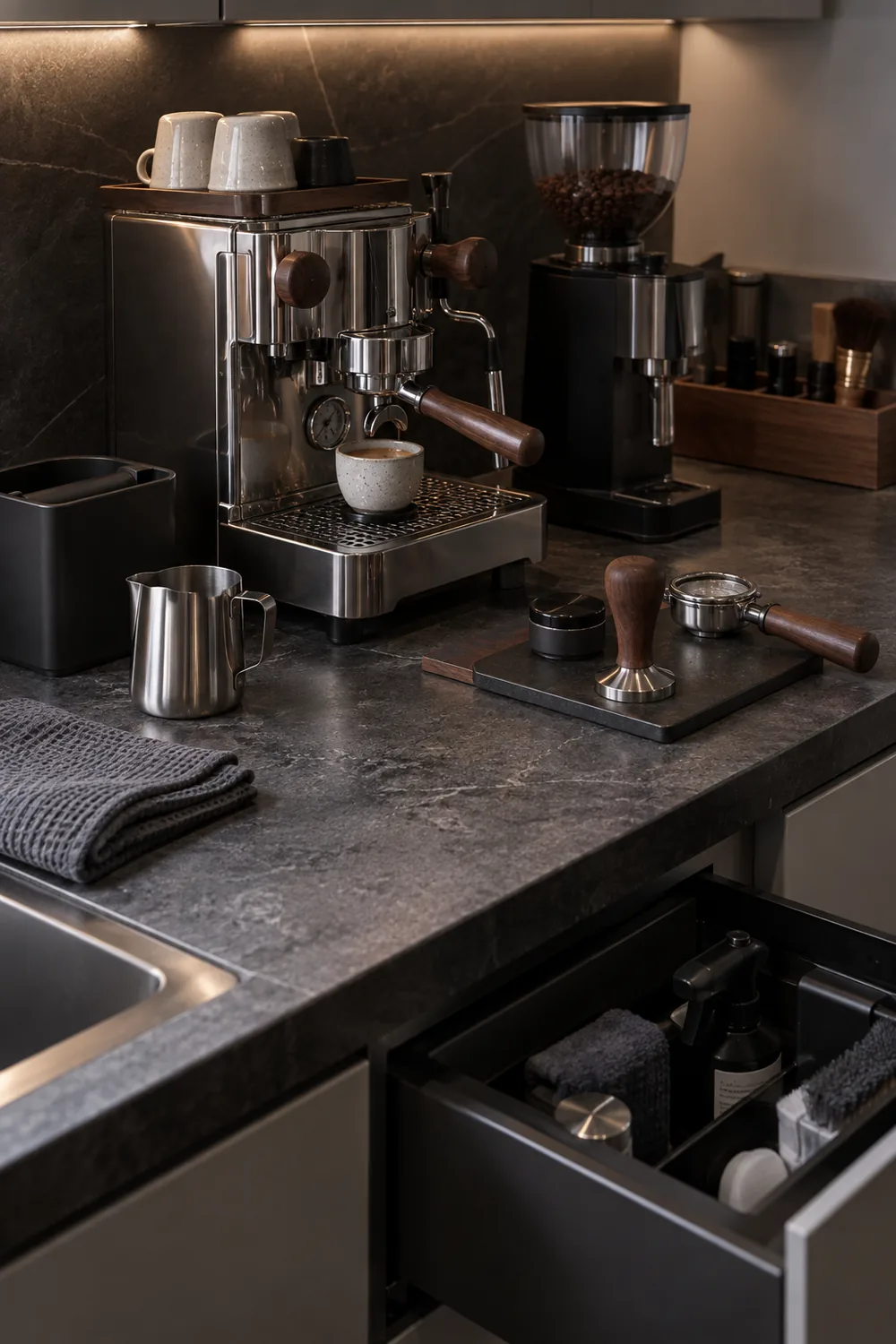 Standalone espresso station with shallow tool storage, defined tamping area, milk pitcher, knock box, active towel and concealed maintenance backstock
Coffee Station Cleaning-Supply Storage
Daily Cleanup Caddy
Keep a small cloth and brush near the station. Avoid leaving a large cleaning collection on the counter.
Machine-Care Bin
Group compatible cleaning products, replacement filters, and instructions in one labeled cabinet bin.
Separate Food and Chemicals
Follow product labels and store cleaning products safely away from coffee, cups, children, pets, heat, and moisture.
Use a Refill Trigger
Replace supplies when the active quantity runs low instead of displaying full multipacks at the station.
Keep shelves, hooks, towels, paper, syrups, and organizers away from vents, steam, heat, moving lids, reservoirs, portafilters, cords, and water paths. Follow appliance and product instructions.
Choose Storage by the Problem You Need to Solve
All ten examples below were reverified on Amazon US. Do not buy every organizer. Pick the smallest solution that fixes a specific friction point in your station.
Affiliate disclosure: As an Amazon Associate, Inplanty may earn from qualifying purchases.

Amazon Basics Pod Drawer
Best for: hiding compatible pods beneath a brewer.
Trade-off: raises the machine and may reduce cabinet clearance.
Check: total height, machine weight, drawer access, and pod compatibility.
View on Amazon →
Keurig Storage Carousel
Best for: visible rotating access to compatible pods.
Trade-off: uses counter space and keeps the pod inventory on display.
View on Amazon →
Veken Coffee Canister
Best for: one active supply of beans or grounds.
Trade-off: unnecessary when suitable original packaging already works.
Check: capacity, shelf height, and refill routine.
View on Amazon →
SONGMICS Cabinet Organizer Shelves
Best for: using unused cabinet height for mugs and supplies.
Check: cabinet depth, internal height, load, and door closure.
View on Amazon →
MyLifeUNIT Mug Holder Tree
Best for: a small daily mug group when counter space allows.
Trade-off: uses counter area and may not fit oversized mugs.
View on Amazon →
DEPAOTLUX Under-Cabinet Mug Hooks
Best for: reclaiming space beneath a compatible cabinet.
Check: mounting, mug weight, cabinet material, door movement, and clearance.
View on Amazon →
ALELION Coffee Station Organizer
Best for: separating a limited group of packets, pods, cups, or stirrers.
Trade-off: becomes clutter when filled with unused categories.
View on Amazon →
Vantimo Coffee Syrup Rack
Best for: households that use several syrup bottles frequently.
Trade-off: too large for minimalist stations or occasional syrup use.
Check: bottle dimensions, counter footprint, stability, and cleaning access.
View on Amazon →
Hencawima Slim Rolling Coffee Cart
Best for: creating storage when the kitchen has no available counter.
Why it helps: combines open access, concealed storage, a basket, and lockable movement.
Check: machine footprint, work height, door swing, outlet path, and stability.
View on Amazon →
EubooTree Barista Towels
Best for: separating active and clean replacement towels.
Trade-off: requires a consistent washing and storage routine.
View on Amazon →Coffee Station Storage Comparisons
| Decision | Choose the first option when | Choose the second option when |
|---|---|---|
| Pod drawer vs carousel | You want hidden storage and have enough machine clearance | You want visible flavor access and can spare counter space |
| Mug tree vs cabinet | You want four to six mugs visible and have counter room | You prefer visual calm or have mixed mug sizes |
| Hooks vs shelf riser | Mounting and load are compatible | You want a removable solution inside a cabinet |
| Canister vs original bag | You need a defined active container | The original package closes well and fits the space |
| Open shelf vs closed cabinet | Items are limited, attractive, and easy to reset | Mixed packaging and cleaning products create visual noise |
| Tray vs divided organizer | You need a washable boundary | You need separate compartments for several small items |
| Counter storage vs cart | The kitchen has a low-use counter zone | The main counter must remain available for cooking |
Copy the Storage System
Simple Counter Package
- One active coffee bag or canister
- Four daily mugs in cabinet
- One tray for spoon and sweetener
- Cleanup cloth in a drawer
- All refills stored elsewhere
Capsule Storage Package
- Drawer, carousel, or divided cabinet bin
- Small active pod quantity
- Bulk cartons in backstock
- Nearby pod disposal
- Mugs on cabinet shelf or riser
Workflow Storage Package
- Shallow drawer for dosing tools
- Defined tamping area
- Milk pitcher near steam zone
- Knock box near machine
- Towels and maintenance supplies separated
Coffee Cart Storage Package
- Machine and active coffee on top
- Daily supplies in upper basket or drawer
- Backstock behind doors or below
- Cleaning products in labeled secondary bin
- Wheels locked during use
 Standalone coffee cart with brewer and active coffee on top, daily supplies in an upper drawer or basket, backstock and cleaning below, wheels locked and the main counter free
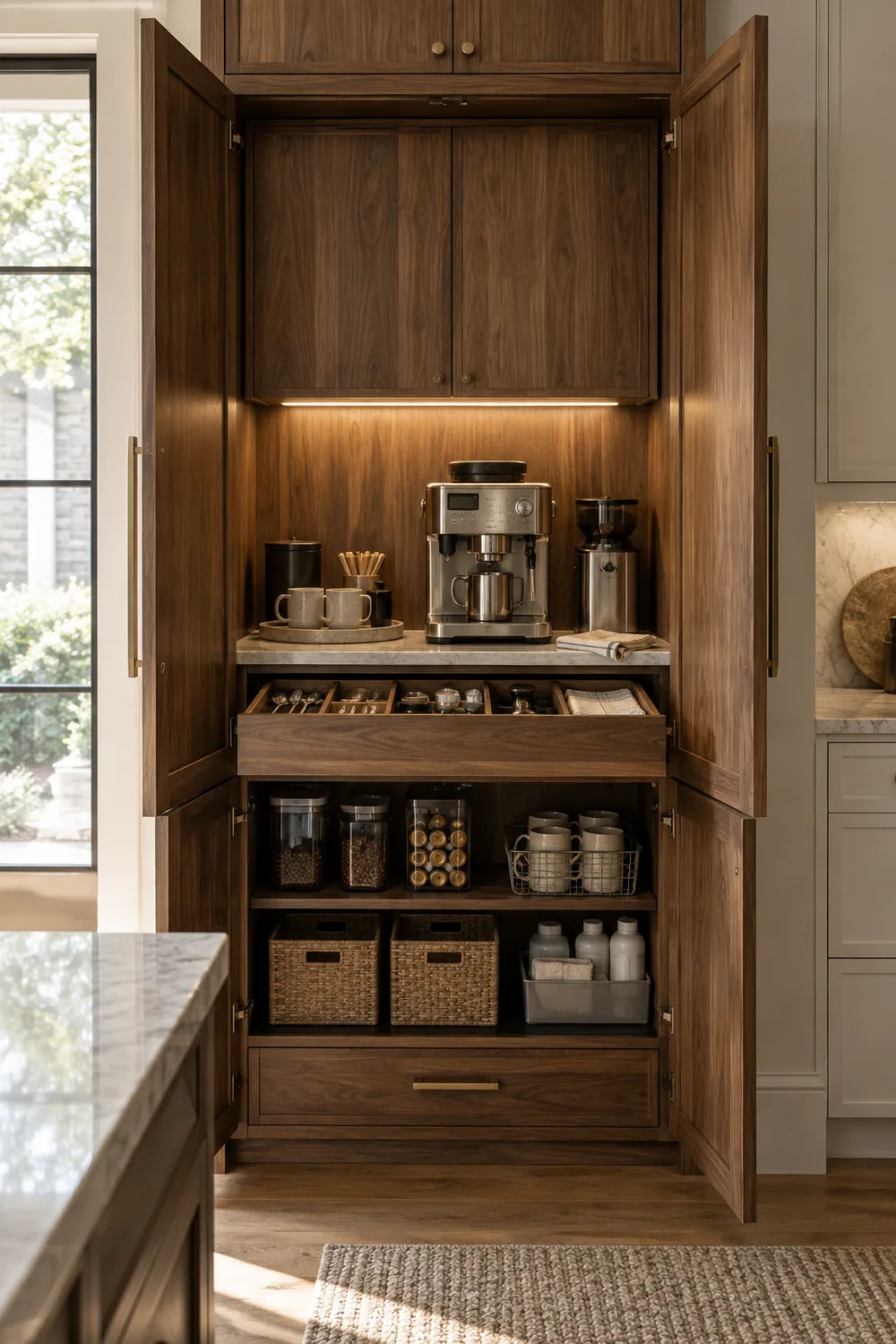
 Finished small-space station using the one-active, one-backstock rule: clear worktop, controlled mugs and coffee, hidden refills and accessible cleanup
Final Recommendation
Use the smallest storage solution that solves each real problem. Keep active coffee, daily mugs, and essential tools near the brewer; move full packages, extra mugs, occasional accessories, and machine-care products into nearby backstock. Start with existing drawers and cabinets before buying more countertop organizers.
Build the Rest of the Coffee Station
Frequently Asked Questions About Coffee Station Storage
How should coffee station supplies be stored?
Keep daily coffee, mugs, and required tools close to the brewer. Store refills, extra mugs, cleaning products, and occasional accessories in nearby drawers, cabinets, shelves, or lower cart tiers.
What is the best way to store coffee pods?
Use a drawer when you want pods hidden beneath a compatible machine, a carousel for visible access, or a cabinet bin when counter space matters most.
How do you store coffee mugs in a small space?
Keep only daily mugs at the station and use a cabinet shelf, shelf riser, mug tree, or compatible under-cabinet hooks.
Should coffee beans be stored in a canister?
A canister can define the active supply, but suitable original packaging may already work. Follow the coffee producer's storage guidance.
Where should coffee machine cleaning supplies be stored?
Store compatible cleaning products in a labeled secondary zone away from food, children, pets, heat, and moisture, following product instructions.