
How to Organize Food Storage Containers
Open one cabinet or drawer and find the right container and matching lid immediately—without lifting three unstable stacks first.
Quick Answer
Most food-container problems are solved by five moves: remove unmatched or unnecessary pieces, nest bases by shape and size, store lids vertically, separate everyday containers from specialty or backstock containers, and add organizers only where the existing space actually needs them.
What the Organized Zone Should Look Like
Open one drawer or cabinet and you should be able to see the container sizes you use most, remove one base without collapsing a stack, and find the matching lid without searching through a pile.
Everyday containers stay in the easiest zone. Lunch pieces and small snack containers have their own section. Oversized and rarely used containers live outside prime storage.
Success Checklist
- Everyday bases are easy to reach.
- Lids are visible and stored separately.
- Lunch containers have a defined zone.
- Specialty pieces do not crowd daily storage.
- The system resets quickly after unloading the dishwasher.
Table of Contents
Before You Buy Any Organizer
Gather every food storage container and lid from the cabinet, drawer, pantry, lunch bags, and dishwasher. Match complete sets before deciding what deserves storage space.
Remove orphaned pieces
Pair every base with a lid. Remove cracked containers, damaged lids, and unmatched pieces instead of building storage around items you cannot use.
Keep a realistic quantity
Keep enough complete sets for leftovers, meal prep, and lunch routines plus a small buffer. The final collection should fit the storage zone without pressure.
Measure the final collection
Measure the drawer or cabinet after decluttering, including usable width, depth, height, hinges, and the tallest lid or container stack.
If containers are only one part of the clutter problem, use the Kitchen Organization Guide to reset the rest of the kitchen. If the collection lives in a drawer with other tools, How to Organize Kitchen Drawers shows how to divide the space into functional zones.
Food Storage Container Organization Ideas That Work
Use only the systems that solve a real problem in your drawer or cabinet. The goal is faster access and an easier reset, not more storage products.
Start with a hard quantity limit
Pull every container and lid out at once. Match complete sets, remove damaged pieces, and decide how many the household realistically uses between dishwashing cycles.
Nest bases by shape
Rectangular containers stack best with rectangular, square with square, and round with round. Mixing shapes makes tall stacks unstable and wastes the corners of drawers and cabinets.
Store lids vertically
A vertical lid zone makes sizes visible from the top and stops lids from disappearing beneath bases. Keep each lid family together instead of arranging them by color.
Build a lunch-prep row
If the same containers leave the house every weekday, keep them together with their matching lids in the easiest-to-reach section.
Use deep cabinets as pull-forward zones
Deep cabinets work better when the entire category can move forward in a bin or tray. Avoid building two loose rows that require unloading the front every time.
Keep specialty pieces out of prime storage
Oversized party containers, holiday tins, and rarely used meal-prep pieces should not occupy the same space as everyday leftovers.
Give small containers a boundary
Tiny snack containers and dressing cups need a small bin or divided zone or they migrate into every gap around the larger pieces.
Create a one-minute reset
When the dishwasher is unloaded, nest bases, return lids to the vertical zone, and remove any unmatched pieces before they become permanent clutter.
Need an Organizer?
Choose the organizer that matches the actual failure point instead of buying a complete system.
Loose lids?
Use a vertical lid organizer.
Wide drawer?
Use adjustable drawer dividers.
Deep cabinet?
Use a pull-out cabinet organizer.
Unused cabinet height?
Use a shelf riser.
Small pieces or backstock?
Use a clear handled storage bin.
Compare the Best Storage Approaches
| Decision | Choose the first approach when | Choose the second approach when |
|---|---|---|
| Drawer vs cabinet | A deep drawer gives top-down visibility and easy access to every stack. | A cabinet works better when you need adjustable shelf height or more overall capacity. |
| Lids on vs lids separate | Keeping lids on can work for a very small collection. | Separate lid storage usually saves space and makes larger collections easier to scan. |
| Matching sets vs mixed brands | Matching sets simplify nesting and lid matching. | Mixed brands are fine when the collection is edited and grouped by shape or container family. |
| Open stacks vs storage bins | Open stacks work well in shallow drawers and cabinets. | Bins are better for deep shelves, small pieces, or secondary backstock. |
| Vertical vs horizontal lid storage | Vertical storage makes lid edges visible and usually works best for daily use. | Horizontal stacks can work for a tiny number of identical lids but become harder to search as the collection grows. |
How to Organize Food Storage Containers Step by Step
Empty Every Container and Lid
Bring the entire category into one place. Check cabinets, drawers, pantry shelves, lunch bags, and the dishwasher so you can see the real collection.
Match Sets and Remove Orphans
Pair each base with a lid. Remove damaged pieces and any lid or base that no longer has a match after the full collection is gathered.
Separate Everyday and Specialty Containers
Keep the containers used for leftovers and lunches in prime storage. Move oversized party containers, holiday pieces, and rarely used formats into secondary storage.
Nest Container Bases by Shape
Build separate rectangular, square, and round stacks. Put the sizes you use most often at the front or top of each stack.
Create a Vertical Lid Zone
Stand lids upright and group them by size or container family. This makes the correct lid visible without lifting a flat pile.
Add Dividers or Pull-Out Storage Only Where Needed
If stacks drift in a drawer, add dividers. If the cabinet is deep, use a pull-out. If lids collapse, add a lid organizer. Do not add products that do not solve a specific problem.
Test the System During Dishwasher Unloading
Return clean pieces during a normal unloading routine. If the system still requires rearranging stacks or searching for lids, simplify the zones until the reset takes about a minute.
Three Complete Food-Container Setups
One Cabinet, No New Furniture
Layout: Nested bases on one side, vertical lids on the other, lunch pieces grouped together.
- Use your existing cabinet or drawer
- Add one lid organizer only if needed
- Keep everyday sets in front
- Move specialty containers elsewhere
Best for: Small collections and renters.
Relevant product: Lifewit lid organizer if loose lids are the only recurring problem.
Why it works: It fixes the failure point without adding unnecessary storage capacity.
Deep Drawer with Defined Zones
Layout: Rectangular, square, and round stacks separated by dividers, with lids in a narrow vertical section.
- Adjustable drawer dividers
- Dedicated lunch-prep row
- Small-parts bin for tiny containers
- No specialty pieces in the prime drawer
Best for: Kitchens where every drawer needs to work hard.
Relevant product: SpaceAid drawer dividers for separating shape-based rows.
Why it works: Top-down visibility makes each stack easy to remove and return.
Daily + Lunch + Backstock Zones
Layout: Everyday containers in the active zone, lunch boxes grouped together, larger specialty pieces stored in a separate pull-out or backstock area.
- Vertical lid organizer
- Drawer or cabinet dividers
- Pull-out storage for deep cabinets
- Clear bin for specialty pieces
Best for: Families using containers every day.
Relevant products: Lifewit lid organizer, Halyuhn pull-out organizer, and Vtopmart backstock bins where the space requires them.
Why it works: Daily, lunch, and specialty storage remain separate without expanding the active zone.
5 Verified Products for Food Storage Container Organization
Each product below solves a different storage problem. You do not need all five—choose only the organizer that matches your drawer or cabinet.
Affiliate disclosure: As an Amazon Associate, Inplanty may earn from qualifying purchases.

Lifewit Kitchen Cabinet Organizer for Food Contanier Lid with 7 Sections
Problem it solves: kitchens where loose lids slide into piles or disappear beneath container bases.
Why it works here: the divided vertical layout supports the core rule of separating lids from bases and grouping them by size or container family.
What to check: cabinet or drawer width, usable depth, lid height, and whether the section layout fits the number of lid families you actually keep.
Use this only after removing unmatched and duplicate lids; otherwise the organizer simply preserves excess.
Check on Amazon
SpaceAid Bamboo Drawer Dividers with Inserts and Labels, Kitchen Adjustable Drawer Organizers, Expandable Organization for Home, Office, Dressers, 4 Dividers with 9 Inserts (17"-22" Natural)
Problem it solves: creating separate rows for rectangular, square, round, lunch-prep, or small-container groups inside a wide drawer.
Why it works here: adjustable boundaries keep nested stacks from drifting together and can turn one large drawer into several predictable zones.
What to check: internal drawer width, divider expansion range, drawer hardware, and the height of the nested stacks.
Dividers work best when the category is already edited enough that each section has breathing room.
Check on Amazon
Halyuhn Pull Out Cabinet Organizer 2 Pack, Black Metal Storage Basket for Kitchen Cabinet, Bathroom, Under Sink, Self Adhesive Slide Out Pantry Shelves Drawer Storage, 15.8" LX 5.9" WX5.9 H
Problem it solves: deep lower cabinets where the back row is difficult to reach.
Why it works here: a pull-out zone brings the stored category forward instead of forcing you to unload the front every time you need a container or lid.
What to check: interior cabinet width and depth, door and hinge clearance, mounting surface, basket dimensions, and whether the container stacks fit without catching.
Use pull-out storage for one defined category rather than mixing food containers with unrelated kitchen supplies.
Check on Amazon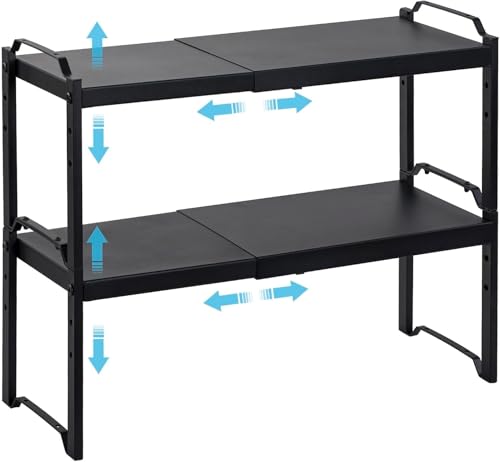
Expandable Cabinet Shelf Organizer, Adjustable Kitchen Countertop Storage
Problem it solves: cabinets with unused vertical space above short container stacks.
Why it works here: adding a second level can separate everyday container bases from specialty pieces without creating one unstable tower.
What to check: cabinet height, organizer width, shelf load, door closure, and whether the added level improves access rather than simply increasing capacity.
A shelf riser should create clearer zones, not encourage keeping more containers than the household uses.
Check on Amazon
Vtopmart 6 Pack Clear Stackable Storage Bins with Lids, Large Plastic Containers with Handle for Pantry Organizer and Storage
Problem it solves: grouping rarely used specialty containers, lunch accessories, or other secondary pieces outside the prime daily stack.
Why it works here: clear handled bins create a visible category boundary and make upper or deep cabinet storage easier to pull forward.
What to check: cabinet dimensions, bin height with lid, handle clearance, and whether stackability still allows practical access.
Keep everyday containers outside the lidded backstock bin if opening it would add unnecessary steps to the daily routine.
Check on AmazonWhat Usually Works Best
For most kitchens, the strongest system is simple: keep fewer complete sets, nest bases by shape, stand lids vertically, and move specialty pieces out of the daily zone.
If the system cannot be reset while unloading the dishwasher, it is too complicated. Remove steps before adding another organizer.
Common Food Container Organization Mistakes
Keeping every takeout container
Free containers still consume storage. Keep only the sizes and quantities you actually use.
Saving unmatched lids
If the matching base cannot be found after the full collection is gathered, remove the orphaned lid.
Stacking lids flat under bases
This forces you to lift the container stack whenever you need a lid and makes dishwasher unloading slower.
Mixing containers with cookware
Keep food containers from spreading into pots, baking dishes, pantry food, and unrelated kitchen storage.
Buying organizers before decluttering
Organizers sized for an oversized collection preserve excess instead of fixing it.
Using prime storage for specialty pieces
Party-size, seasonal, and rarely used containers should not displace the pieces you reach for every day.
Final Reset Checklist
- Every everyday container has a matching lid.
- Bases are nested by shape without unstable mixed-shape stacks.
- Lids are visible without lifting other containers.
- Lunch and meal-prep containers have a defined zone.
- Specialty and backstock pieces do not occupy prime daily storage.
- The system resets in about one minute during dishwasher unloading.
Frequently Asked Questions
What is the best way to organize food storage container lids?
Store lids vertically in one dedicated zone so the sizes are visible. Group them by size or container family and remove lids that no longer have a matching base.
Should food storage containers be stored with lids on?
For a very small collection, assembled sets can work. For most kitchens, nesting bases and storing lids separately saves more space and makes the collection easier to scan.
How many food storage containers should I keep?
Keep enough for your normal leftovers, meal-prep, and lunch routine plus a small buffer. If complete sets no longer fit the planned zone comfortably, reduce the collection.
How do I organize containers in a deep cabinet?
Keep everyday containers toward the front and use a pull-out bin, basket, or tray for the back zone so the entire category can move forward without unloading the cabinet.
How do I keep food storage containers organized after unloading the dishwasher?
Nest bases immediately by shape, return lids to the vertical zone, and deal with unmatched pieces instead of setting them aside. The reset should take about a minute.
What should I do with unmatched lids?
Gather the whole collection first. If the matching base is not present, remove the orphaned lid rather than storing it indefinitely.