
How to Organize Spices in a Pantry
Keep every spice visible and easy to reach by creating one dedicated zone and choosing storage that matches your shelf depth, jar size, and cooking habits.
Quick Answer
Organize pantry spices by keeping them in one dedicated zone, removing empty or duplicate jars, and choosing a layout that keeps labels visible. Use a tiered rack on shallow shelves, a turntable on deep shelves or corners, or a drawer insert if you have a wide drawer near the cooking zone.
What an Organized Spice Zone Should Look Like
You should be able to find a spice without removing several jars first. Labels should face a direction you can read quickly, duplicate bottles should be easy to spot, and the most-used seasonings should sit in the easiest positions.
The goal is not to create a decorative spice display. It is to make the collection fast to scan while preserving enough space for new or replacement jars.
Success checklist
- All spices live in one primary zone.
- Labels are visible at a glance.
- Duplicates are easy to identify.
- Daily spices are easiest to reach.
- The system can reset after cooking.
Table of Contents
Start by Editing the Spice Collection
Take every spice jar, seasoning blend, refill packet, and duplicate bottle out of the pantry. Group exact duplicates together and remove empty or clearly unused containers.
Then choose one organizing logic. Alphabetical order is easy to maintain for a larger collection. Grouping by cooking style—baking, everyday savory, spicy, herbs—can be faster for a smaller routine. What matters most is that you can predict where a jar belongs.
If your whole pantry needs a reset, use the Pantry Organization Guide. If shelf depth is the bigger problem, How to Organize a Deep Pantry can help you decide where spices should live.
8 Ways to Organize Spices in a Pantry
Keep spices in one zone
Do not split everyday seasonings between several pantry shelves unless there is a strong reason. One zone makes duplicates easier to spot.
Use a tiered rack on shallow shelves
Staggered height helps you see the back row instead of creating several hidden layers of jars.
Use a turntable in deep shelves or corners
A rotating organizer is useful when the problem is reach rather than height.
Use a drawer if you can see labels from above
A wide drawer can be excellent spice storage when jars are angled or laid out so names stay readable.
Keep everyday spices in the easiest positions
Salt-free blends, garlic, paprika, cinnamon, or whatever you use most should not be buried behind specialty seasonings.
Separate refills from active jars
Bulk bags and refill containers should not crowd the active spice zone unless they are used as the primary container.
Label only when labels solve a real problem
Original jars are fine if the names are already readable. Matching labels matter most when you decant into uniform containers.
Leave a little expansion room
A spice zone packed to 100% capacity becomes difficult to reset and encourages jars to start stacking again.
If your spice collection is currently mixed into the rest of the pantry, How to Create Pantry Zones can help define a better location. If the pantry itself is very small, see How to Organize a Small Pantry.
Need a Spice Organizer?
Choose the organizer based on shelf shape—not just how many jars you own.
Tiered rack
Turntable
Drawer insert
Measured jar system
Tiered Rack vs Turntable vs Drawer
| Storage method | Best when | Watch for |
|---|---|---|
| Tiered rack | Shelf is shallow and labels disappear behind front rows | Vertical clearance and jar height |
| Lazy Susan | Shelf is deep or located in a corner | Diameter and reach around the full rotation |
| Drawer organizer | You have a wide drawer near the cooking area | Drawer height and jar fit |
| Matching jars | You want uniform containers and are willing to decant | Labeling, product information, and jar capacity |
| Original jars on a flat shelf | You own only a small collection | Can become hard to scan when the collection grows |
How to Organize Pantry Spices Step by Step
Gather Every Spice
Bring together pantry jars, cabinet jars, refill packets, and duplicates so you can see the whole category.
Remove Empty, Duplicate, and Unused Items
Reduce the collection before sizing storage.
Choose One Primary Spice Zone
Pick a shelf, corner, or drawer that is easy enough to reach during cooking.
Choose the Sorting Logic
Use alphabetical order or a simple routine-based grouping and stick with it.
Choose the Organizer for the Shelf Shape
Use height for shallow shelves, rotation for deep shelves, or angled rows for drawers.
Put Most-Used Spices First
Give the easiest positions to seasonings you reach for constantly.
Test the System During Cooking
If jars repeatedly get moved out of order because retrieval is awkward, change the layout rather than adding more labels.
Three Simple Spice Setups
One Tiered Shelf
Ideal for: A shallow pantry or cabinet shelf.
Layout: Daily spices on the front tier, specialty spices behind, all jars facing forward.
Relevant product: Copco tiered rack.
Why it works: It improves visibility without replacing original spice jars.
Rotating Spice Zone
Ideal for: A deep shelf or corner where the back row is hard to reach.
Layout: Active spices on one turntable, refills stored separately.
Relevant product: LAMU two-tier turntable.
Why it works: The back jars rotate forward instead of disappearing.
Angled Label-First Rows
Ideal for: A wide kitchen drawer near the prep zone.
Layout: Spices arranged in angled rows, labels readable from above, everyday jars closest to the front.
Relevant products: Suneerplay drawer insert or KitHero full jar system if you intentionally want matching containers.
Why it works: The whole collection becomes visible in one glance.
4 Verified Products for Spice Organization
These products solve different layout problems. Choose the one that fits your shelf or drawer rather than combining several systems.
Affiliate disclosure: As an Amazon Associate, Inplanty may earn from qualifying purchases.
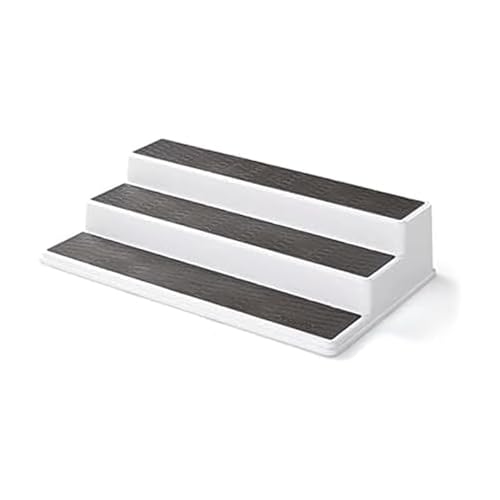
Copco 3-Tier Spice Rack Organizer for Cabinet
Problem it solves: Spice jars hiding behind one another on a pantry or cabinet shelf.
Best for: Straight shelves where you want the back row raised enough to see labels more easily.
Why it works: The tiered design creates staggered height so several rows of spices remain visible at once.
What to check before buying: Measure shelf width, depth, and vertical clearance before buying.
Check on Amazon
LAMU 2 Tier Lazy Susan Turntable Organizer
Problem it solves: Spices disappearing into the back of a deep pantry or cabinet shelf.
Best for: Corners and deeper shelves where rotation makes the rear bottles easier to reach.
Why it works: A turntable can bring hidden jars forward without forcing you to remove the front row first.
What to check before buying: Measure diameter and height, including bottle clearance on both tiers.
Check on Amazon
Suneerplay 4-Tier Acrylic Spice Drawer Organizer
Problem it solves: Spice jars rolling around a drawer or lying flat in a single mixed layer.
Best for: Wide drawers where jars can be angled so labels remain visible from above.
Why it works: The stepped layout helps keep several rows of bottles readable without stacking them.
What to check before buying: Measure drawer width, depth, and height against the bottles you already own.
Check on Amazon
KitHero Spice Drawer Organizer with 28 Bamboo-Lidded Spice Jars and 216 Labels
Problem it solves: A mixed set of jar shapes making a drawer hard to fit and scan.
Best for: Readers who intentionally want to decant spices into a matching drawer system.
Why it works: Uniform jars can create a consistent footprint and labeling system in a measured drawer.
What to check before buying: Decant only when appropriate for the product, preserve any information you need from original packaging, and confirm the rack fits your drawer.
Check on AmazonCommon Spice Organization Mistakes
Stacking jars in several hidden rows
Spices become difficult to scan when one row completely blocks another.
Splitting spices across several zones
Duplicates are harder to notice when the category is scattered.
Buying matching jars before measuring
Uniform containers only help if the full system fits the actual shelf or drawer.
Keeping refills with active jars
Bulk bags and spare bottles can consume the space meant for the working collection.
Choosing organization by appearance only
A beautiful arrangement that hides labels or requires constant rearranging will not stay organized.
Filling the zone completely
Leave some room so new jars can enter without starting another stack.
Final Spice Reset Checklist
- Every spice belongs to one primary zone.
- Labels remain visible without lifting several jars.
- Daily-use spices occupy the easiest positions.
- Duplicate and refill products are separated from the working collection.
- The organizer fits the shelf or drawer without blocking nearby pantry categories.
- The system can reset in under a minute after cooking.
Frequently Asked Questions
What is the best way to organize spices in a pantry?
Group spices in one dedicated zone, keep frequently used jars easiest to reach, and use a tiered shelf, turntable, or drawer organizer so labels stay visible.
Should spices be organized alphabetically or by use?
Either can work. Alphabetical order is easiest for larger collections, while grouping by use or cuisine can be faster if you cook the same types of meals regularly.
Is a spice rack or lazy Susan better?
A tiered rack works well on straight shallow shelves, while a lazy Susan is often better in deeper shelves or corners where the back row is otherwise hard to reach.
Can spices be stored in a drawer?
Yes, if the drawer is deep enough for the jars and the layout lets labels remain visible. A stepped drawer insert can help keep bottles from rolling around.
Should I decant spices into matching jars?
Only if it improves your storage and you can preserve important product information. Matching jars are optional; original containers can be organized effectively too.
How often should I declutter spices?
Review the collection periodically and remove empty, duplicated, stale, or unused items according to the product guidance and your own cooking habits.