
How to Organize Shoes in a Closet So Every Pair Stays Visible
Organize shoes in a closet by reducing the collection to realistic capacity, keeping current-season daily pairs in one visible zone, and moving occasional or off-season footwear to secondary storage. Choose a low rack, vertical tower, adjustable shelf, cubby, or clear box system according to shoe type and closet layout, and keep the floor clear enough for clothing access and cleaning.
The Finished Result
Daily shoes sit in one obvious low zone, boots have a separate tall section, formal pairs stay protected, seasonal footwear no longer occupies prime space, and the closet floor remains clear enough for garments, drawers, doors, and cleaning.
- Active and seasonal shoes are separated
- One physical boundary controls capacity
- Storage matches shoe type
- Boots have their own zone
- Return and rotation stay simple
Quick Answer
Gather every pair, remove unusable shoes, separate daily, occasional, and seasonal footwear, and keep only current-season active pairs in prime closet storage. Use one visible low rack or shelf as the default, add a narrow tower only when height is accessible, reserve boxes for selected protected pairs, create one boot zone, and move off-season shoes to measured secondary storage.
Use the Closet Organization Guide for the full closet cluster, How to Organize a Small Closet when footwear competes with the whole wardrobe, How to Organize a Reach-In Closet for doorway alignment, and How to Organize a Walk-In Closet for shoe walls and circulation.
Why Shoes Take Over a Closet
| Shoe-storage symptom | Likely cause | First correction |
|---|---|---|
| Shoes cover the closet floor | No defined capacity boundary | Assign one rack, tower, or shelf zone |
| Pairs are difficult to find | Shoes are loose or divided | Store complete pairs together |
| Daily shoes sit outside | Prime storage holds occasional shoes | Move daily pairs forward |
| Boots do not fit | Shelf system ignores height | Create one dedicated boot zone |
| Boxes are never opened | Contents are hidden or inaccessible | Improve labels or visibility |
| Shoes block hanging clothes | Rack height conflicts with garments | Move storage beneath short hanging |
| Closet doors do not close | Organizer is too deep | Reduce depth or relocate storage |
| Off-season shoes use prime space | No rotation system | Move them to secondary storage |
| Rack is full but shoes keep arriving | Inventory exceeds the zone | Reduce or rotate pairs |
| Shoes become mixed after use | Return process is inconvenient | Move active storage closer to the dressing path |
Core shoe-storage principle
The system should keep complete pairs visible and easy to return while limiting footwear to a defined amount of closet space.
Audit the Complete Shoe Collection
Gather shoes from the closet, bedroom floor, entryway, under the bed, hall closet, garage or utility storage, original boxes, luggage, seasonal bins, car, and work or gym bags.
Daily shoes
Work shoes, everyday sneakers, current-season casual shoes, and regular exercise footwear.
Occasional shoes
Formal, event, specialty, and travel-specific pairs.
Seasonal shoes
Winter boots, sandals, rain boots, and snow footwear.
By type
Sneakers, flats, sandals, heels, boots, athletic shoes, slippers, and specialty footwear.
Remove shoes that should not return
- Damaged shoes not being repaired
- Uncomfortable or poorly fitting pairs
- Worn-out shoes
- Duplicates
- Unworn footwear
- Single unmatched shoes
- Empty boxes that do not support storage
- Specialty shoes with no realistic use
Avoid rigid shoe-count rules. The appropriate collection depends on climate, work, lifestyle, sports, events, household size, and available capacity.
Group by frequency
Daily or weekly
Prime storage closest to the dressing path.
Occasional
Secondary visible storage or protected boxes.
Seasonal
Rotated in and out of prime storage.
Prime-space rule
Current-season and frequently worn shoes should receive the easiest closet positions.
Set the Shoe-Zone Capacity
Choose one physical boundary: one low rack, one vertical tower, one shelf column, one set of cubbies, one compatible door organizer, one section beneath short hanging, or one wall in a walk-in closet.
The boundary controls inventory
If active shoes do not fit, reduce, rotate, or move occasional pairs before adding more storage.
Decide what belongs in the main closet
Keep in prime storage
- Current-season shoes
- Frequently worn pairs
- Work footwear
- Daily exercise shoes
- One or two relevant formal options
Move to secondary storage
- Off-season shoes
- Rare specialty footwear
- Backup pairs
- Event shoes
- Travel-only shoes
Leave open capacity
The shoe zone should allow pairs to be returned without shifting others, seasonal changes, cleaning access, clear visibility, and one new pair to be evaluated before the system fails.
Choose the Best Closet Location
Under short-hanging clothes
Best for: low racks, shelves, cubbies, sneakers, flats, and low heels.
Check: garment length, rack depth, shoe height, and cleaning access.
On a side wall
Best for: narrow towers, adjustable shelves, boots, wide reach-ins, and walk-ins.
Check: side visibility, hanging width, unit depth, and anchoring needs.
On an upper shelf
Best for: lightweight occasional or off-season pairs in clear labeled boxes.
Avoid: daily shoes, loose pairs, heavy boots, and unstable stacks.
On a hinged door
Best for: flats, sandals, children’s shoes, and lightweight sneakers.
Check: door type, top clearance, hinge load, interior collision, pocket size, and full closure.
Compare Closet Shoe-Storage Methods
Low open rack
Best for: daily shoes, renters, reach-ins, and space beneath short garments.
Advantages: visible pairs, fast return, portable format.
Limitations: floor depth, fixed height, boot incompatibility.
Adjustable shelves
Best for: mixed heights, long-term closet systems, and walk-ins.
Advantages: flexible shelf spacing.
Limitations: installation, cost, wall requirements, and circulation.
Vertical tower
Best for: limited floor width and larger active collections.
Advantages: uses height and creates visible levels.
Limitations: upper reach, hanging-width loss, depth, and stability.
Cubbies
Best for: similar-size sneakers, flats, sandals, and children’s shoes.
Advantages: pair-by-pair boundaries.
Limitations: fixed openings and substantial horizontal space.
Clear stackable boxes
Best for: formal, delicate, or occasional pairs.
Advantages: protection, visibility, and stacking.
Limitations: extra steps, space use, fixed dimensions, and stack access.
Drop-front boxes
Best for: front-access stacks where a verified matching system is available.
Limitation: no confidently matched verified drop-front product was available for this page.
Over-the-door organizer
Best for: lightweight shoes on compatible hinged doors.
Limitations: unsuitable for sliding doors, larger shoes, heavy footwear, and poor closure.
Hanging shoe organizer
Best for: lightweight shoes where rod width is more available than floor space.
Trade-off: footwear storage replaces clothing-hanging capacity.
Under-bed storage
Best for: off-season, occasional, or formal footwear.
Limitations: slower retrieval, fit constraints, and hidden overflow.
Default method
A low open rack is often the strongest starting point when clear floor space exists beneath short hanging clothes.
Organize Shoes by Type
Sneakers
Keep active pairs visible on open racks or shelves. Rotate less-used pairs and avoid deep stacked boxes for everyday sneakers.
Flats and sandals
Use tighter shelf spacing, door pockets, narrow shelves, vertical slots, or low racks while keeping complete pairs identifiable.
Heels
Check heel height, shelf depth, stability, visibility, and protection. Avoid unstable stacking or hanging by delicate straps.
Boots
Create one dedicated tall floor or shelf zone. Account for shaft height, support, weight, seasonal frequency, and removal clearance.
Boot-zone rule
Do not space every shoe shelf for the tallest pair.
Formal and delicate shoes
Prioritize protection, clear identification, shape support where appropriate, and lower-frequency placement. Clear or labeled boxes may be useful here.
Athletic and specialty footwear
Consider frequency, ventilation, equipment pairing, cleaning routines, and whether the footwear belongs closer to sports gear. Follow manufacturer guidance for material care.
Organize Shoes by Closet Type
Small closet
Keep current-season pairs only, use one low rack or narrow tower, minimize boxes, and rotate off-season shoes.
Reach-in closet
Align storage with the doorway, keep one visible low zone, avoid racks extending beyond the opening, and use side towers only when reachable.
Walk-in closet
Use one shoe wall, tower, adjustable shelf section, low perimeter shelves, or protected formal-shoe area while preserving circulation.
Sliding-door closet
Use complete shoe zones behind each opening, avoid door-mounted storage, and keep boxes or racks removable through the exposed section.
Rental closet
Use freestanding racks, stackable shelves, portable boxes, hanging organizers, and compatible door storage while checking lease, load, and anchoring requirements.
Handle Seasonal Shoe Rotation
Keep active
Weather-appropriate daily shoes, work footwear, exercise shoes, relevant formal options, and one or two flexible pairs.
Move to secondary storage
Off-season boots, sandals outside their season, rain or snow footwear when unnecessary, and rarely used occasion shoes.
Prepare shoes before secondary storage
Clean according to material guidance, allow footwear to dry appropriately, pair shoes, label containers, review repairs, and remove pairs no longer used.
Review every rotation
- Was the pair worn last season?
- Does it still fit?
- Is it comfortable?
- Does it need repair?
- Is there a duplicate?
- Does it deserve active closet space?
Preserve Closet Function
Keep shoes clear of long garments
Check dress and coat length, rack height, shelf depth, garment movement, and shoe removal space. Shoe storage works best beneath short garments or in a separate zone.
Preserve drawers and doors
Confirm drawers open fully, doors close, sliding panels expose the shoe zone, racks do not block the opening, boxes remain removable, and towers do not narrow circulation.
Preserve cleaning access
The rack or unit should be movable enough to vacuum or sweep, inspect corners, clean shelves, and retrieve dropped items.
Maintain the Shoe Zone
Daily return rule
- Remove shoes.
- Give them any necessary routine care.
- Return the complete pair to one visible location.
- Keep frequently worn shoes closest to the dressing path.
- Do not leave shoes beside the rack.
Return-time principle
The system should take only a few seconds to use.
Weekly reset
- Pair loose shoes
- Return footwear from the bedroom or entryway
- Move active pairs forward
- Clear the closet floor
- Correct shelf overflow
- Check boot placement
- Remove empty boxes
- Clean the storage area as appropriate
Seasonal capacity review
If active shelves are overcrowded, daily shoes are difficult to reach, or footwear spreads outside the assigned boundary, reduce or rotate the collection before adding another rack.
New-pair rule
- Identify the category.
- Decide whether the pair is active or seasonal.
- Assign a permanent location.
- Check whether the category boundary is full.
- Remove, replace, or rotate another pair when needed.
How to Organize Shoes in a Closet Step by Step
Gather shoes from every storage location
See the full collection.
Remove damaged, uncomfortable, unused, and unsuitable pairs
Reduce before organizing.
Group shoes by frequency, season, and type
Build the correct categories.
Identify current-season daily shoes
Protect prime storage.
Move occasional and off-season pairs to secondary storage
Reduce active volume.
Measure the floor, shelves, opening, and hanging clearance
Use real dimensions.
Give shoes one physical boundary
Control capacity.
Choose the storage format by the collection
Rack, tower, shelf, cubby, box, or door system.
Create one dedicated boot zone
Handle tall footwear separately.
Keep frequently worn pairs visible
Support fast daily return.
Protect formal and delicate footwear
Use selected boxes or secondary shelves.
Preserve door, drawer, garment, and cleaning clearance
Protect the rest of the closet.
Divide shared storage physically where relevant
Use clear boundaries.
Add a daily return rule
Make putting shoes away effortless.
Review weekly and seasonally
Maintain capacity.
Closet Shoe-Organization Mistakes
Keeping every pair in prime storage
Daily footwear becomes difficult to access.
Filling the entire closet floor
Clothing access and cleaning become difficult.
Choosing one system for every shoe type
Boots, heels, flats, and sneakers require different dimensions.
Boxing every daily pair
The return process becomes too slow.
Using opaque boxes without labels
Pairs become forgotten.
Placing a rack beneath long garments
Clothes cover or touch shoes.
Choosing a tower that blocks hanging
The closet loses more capacity than it gains.
Using door storage without clearance checks
The door may not close or may hit interior shelves.
Mixing current and off-season shoes
Prime storage becomes crowded.
Stacking boxes too high
Access and stability decline.
Keeping shoes in several unofficial locations
The inventory becomes difficult to check.
Buying more storage before reducing shoes
The collection expands to fill the new system.
Ignoring boot height
Tall footwear remains loose or poorly stored.
Skipping the return routine
Shoes remain beside the rack instead of on it.
Which Closet Shoe-Storage Method Should You Choose?
| Reader situation | Best starting method |
|---|---|
| Small active collection | Low open shoe rack |
| Limited floor width | Narrow vertical tower |
| Mixed shoe heights | Adjustable shelves |
| Similar-size sneakers or flats | Cubbies |
| Formal or delicate shoes | Clear or labeled boxes |
| Large stacked collection | Verified front-access boxes when available |
| Compatible hinged door | Over-door organizer |
| Spare hanging width | Hanging shoe organizer |
| Small closet with seasonal overflow | Under-bed secondary storage |
| Many boots | Dedicated tall boot zone |
| Walk-in closet | One vertical shoe wall |
| Reach-in closet | Low visible zone aligned with the opening |
| Shared closet | Physically divided shelves |
| Shoe area always overflows | Reduce active pairs and rotate seasonally |
Final recommendation
Keep current-season daily shoes on one visible low rack or shelf, create one separate boot section, and move occasional or off-season footwear into clearly labeled secondary storage.
Verified Product Examples
Choose one or two formats based on active-pair count, shoe types, door configuration, garment clearance, floor depth, seasonal rotation, and return speed. Do not buy every system.

Simple Houseware 3-Tier Stackable Mesh Shoe Rack
Creates one visible floor-level boundary for current-season daily shoes. Check closet width, rack depth, garment length, door opening, shoe height, and cleaning access.
Verified ASIN: B0B6GZV3R4
SONGMICS Home 10-Tier Tall Narrow Shoe Rack
Uses height for a larger active collection with a relatively narrow footprint. Check height, width, depth, shelf spacing, doorway visibility, shoe dimensions, and anti-tip guidance.
Verified ASIN: B0GX3BDPG8
ClosetMaid 15-Cube Stackable Storage Organizer
Gives similarly sized shoes pair-by-pair boundaries. Confirm cubby dimensions, overall width and depth, garment clearance, doorway alignment, and stability requirements.
Verified ASIN: B002IPG46Y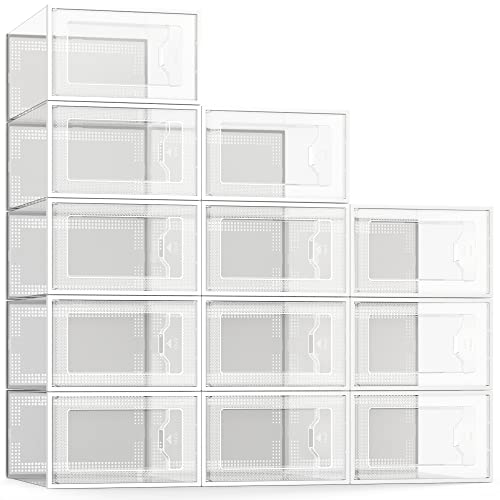
SEE SPRING X-Large Clear Stackable Shoe Boxes, 12-Pack
Separates occasional, formal, or less frequently worn pairs while keeping them visible. Confirm actual interior dimensions, shoe size and height, stack stability, shelf depth, and whether twelve boxes are necessary.
Verified ASIN: B09276QSJJ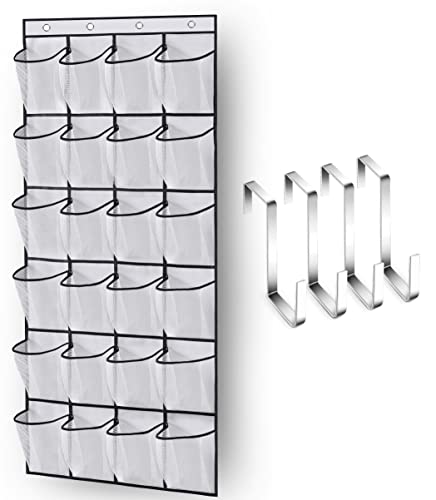
MISSLO Over-the-Door Shoe Organizer
Moves lightweight flats, sandals, children’s shoes, or small sneakers off the floor. Use only on a compatible hinged door after checking thickness, top clearance, hinge load, projection, and loaded closure.
Verified ASIN: B01N2JICUM
Whitmor 10-Section Hanging Shoe Shelf
Converts spare rod width into vertical footwear compartments. Confirm organizer dimensions, shoe size, garment clearance, and whether clothing capacity can be sacrificed.
Verified ASIN: B000JTDX4W
Household Essentials Boot Shapers, 2 Pairs
Helps selected tall boots remain upright inside a dedicated boot zone. Check shaft height and width, shelf clearance, storage position, and footwear guidance.
Verified ASIN: B006M9F50S
Onlyeasy Under-Bed Shoe Storage Organizer
Moves off-season or occasional shoes out of prime closet space. Check bed clearance, organizer height, shoe dimensions, handle access, floor conditions, and actual capacity.
Verified ASIN: B0CH86SJMP
Seville Classics 3-Tier Stackable Steel Shoe Rack
Creates a larger open shoe zone beneath short clothing or along a walk-in wall. The verified listing confirms a stackable rack, not adjustable shelf heights.
Verified ASIN: B09QRGPTC9Recommended product combination
Use one low open rack for active daily shoes, add a narrow tower only when height is accessible, reserve cubbies for similarly sized footwear, use clear boxes for selected formal or occasional pairs, add a compatible door or hanging organizer only when the closet layout supports it, create one boot section, and move off-season shoes to under-bed or secondary storage.
Affiliate disclosure: Inplanty may earn a commission from qualifying purchases made through links on this page, at no additional cost to you.
Frequently Asked Questions
What is the best way to organize shoes in a closet?
Keep current-season daily shoes in one visible zone, move occasional and off-season pairs to secondary storage, and choose storage by shoe type and closet layout.
How do you organize shoes in a small closet?
Keep current-season pairs only, use one low rack or narrow tower, minimize boxes, and rotate off-season shoes elsewhere.
Should shoes be stored in boxes or on shelves?
Use open racks or shelves for daily shoes and clear or labeled boxes for selected formal, delicate, or occasional pairs.
Are clear shoe boxes worth using?
They can protect and identify selected occasional pairs, but they add steps and consume more space than open storage.
How do you organize boots in a closet?
Create one dedicated tall zone with enough shaft, shelf, and removal clearance rather than spacing every shelf for boots.
Can shoes be stored on the top closet shelf?
Only lightweight occasional or off-season pairs in stable, clearly labeled, safely removable storage.
How do you organize shoes in a reach-in closet?
Use one low visible zone aligned with the doorway and avoid racks or towers hidden behind sliding-door overlap or side walls.
How do you organize shoes in a walk-in closet?
Create one shoe wall, tower, adjustable shelf section, or perimeter zone while keeping daily pairs near the entrance and the center clear.
Are over-the-door shoe organizers useful?
They can work for lightweight shoes on compatible hinged doors after checking closure, hinge load, pocket size, and interior collisions.
How many shoes should stay in active closet storage?
As many current-season frequently worn pairs as fit comfortably within the assigned boundary while remaining easy to return and remove.
How should off-season shoes be stored?
Use clearly labeled secondary storage such as under-bed organizers, upper shelves, or another closet after checking dimensions and access.
How do two people share closet shoe storage?
Divide shelves, towers, cubbies, or floor zones physically according to actual needs rather than mixing pairs together.
How do renters organize shoes in a closet?
Use freestanding racks, stackable shelves, portable boxes, hanging organizers, and compatible door storage while checking lease and anchoring requirements.
How do you keep shoes from covering the closet floor?
Give footwear one fixed rack, shelf, tower, cubby, or door boundary and reduce or rotate pairs when it is full.