
Entryway Organization Mistakes to Avoid
A small entryway rarely fails because it needs more baskets. It usually fails because too many categories are stored there, the walking path is ignored, or the daily reset is harder than the clutter itself.
Quick Answer
The most common entryway organization mistakes are keeping too many shoes and coats by the door, adding furniture before measuring the walking path, creating vague catch-all baskets, ignoring wet-weather gear, and failing to give keys, bags, and daily essentials fixed homes. Fix the system by limiting the entryway to the active daily rotation and making every zone easy to reset.
What a Well-Organized Entryway Should Do
The entryway should support coming and going. You should be able to open the door fully, walk through without stepping around shoes, hang a coat without moving someone else's belongings, and find the essentials you need before leaving.
Storage should make the routine faster, not turn the first few feet of the home into a dense wall of bins, hooks, benches, and racks.
Success checklist
- Door swing and walkway stay clear.
- Only daily-use shoes and coats remain.
- Small essentials have one landing zone.
- Wet footwear is contained.
- The whole space resets quickly.
Table of Contents
10 Entryway Organization Mistakes to Avoid
Keeping every pair of shoes by the door
The entryway should hold the current daily rotation, not the household's full shoe collection.
Keeping every coat in the entryway
Bulky outerwear fills hooks quickly. Move formal, backup, and off-season coats to secondary storage.
Buying furniture before measuring the walkway
A deep bench or cabinet can solve storage while making the entrance physically harder to use.
Using several catch-all baskets
Undefined baskets often become homes for mail, gloves, toys, receipts, cables, and random objects all at once.
Ignoring vertical wall space
When floor space is limited, coats and bags usually belong on hooks rather than on chairs or freestanding racks.
Mixing wet shoes with dry footwear
Wet-weather shoes need a defined washable zone instead of spreading moisture and grit through the entrance.
Creating no landing zone for keys and essentials
Small daily items migrate to counters and shelves when there is no single predictable place to return them.
Making storage harder than dropping items on the floor
If shoes require opening several doors or bags have no easy hook, the household will default to the fastest option.
Letting the entryway store unrelated household items
Boxes, reusable shopping bags, sports gear, paperwork, and random overflow should not stay simply because the entrance has an empty corner.
Skipping the daily reset
A working entryway needs a quick end-of-day routine to return shoes, bags, keys, mail, and outerwear to their proper zones.
What to Do Instead
Keep the entryway limited to the arrival-and-departure routine: current shoes, current outerwear, daily bags, keys, and weather-related essentials. Everything else should earn its place based on how often it is used.
Use How to Keep an Entryway Clutter-Free for a maintenance routine, and use the Entryway Organization Guide if the entire entrance needs to be rebuilt.
Set capacity limits
Give shoes, coats, and accessories a maximum amount of space. When the zone is full, something must rotate out.
Use vertical storage first
Hooks and wall-mounted landing zones usually preserve more floor space than additional freestanding furniture.
Make the daily action obvious
Keys go on one hook, shoes go in one zone, bags use one hook, and mail either leaves the entryway or goes into one dedicated process.
Protect the walkway
Door swing, hall width, and safe movement matter more than squeezing in another cabinet.
Need an Organizer?
Buy storage only for the specific failure point you have already identified.
Wall hooks
Storage bench
Boot tray
Wall landing zone
Mistake vs Better Entryway System
| Common mistake | Better system | Why it works |
|---|---|---|
| Shoes lined across the floor | Daily-shoe limit + one defined storage zone | Keeps the walking path open |
| Coats on chairs or doors | Dedicated wall hooks | Uses vertical space |
| Several catch-all baskets | One category per container | Makes reset obvious |
| Wet shoes mixed with dry shoes | Separate washable tray | Contains moisture and grit |
| Keys and small items everywhere | One landing zone | Reduces searching and surface clutter |
| Oversized entryway furniture | Measured storage sized to the walkway | Preserves circulation |
How to Reset a Failing Entryway Step by Step
Empty the Entryway
Remove shoes, coats, bags, baskets, mail, seasonal gear, and unrelated items so you can see the actual space.
Protect the Door Swing and Walking Path
Mark the area that must stay open before putting any furniture or storage back.
Choose the Daily Shoe Limit
Keep only the current frequently worn pairs near the entrance and move the rest elsewhere.
Choose the Daily Coat and Bag Limit
Reserve hooks for what is actively used now, not for every jacket and tote owned.
Create a Small Essentials Landing Zone
Give keys and other true daily small items one predictable place.
Add a Wet-Weather Zone if Needed
Keep muddy or wet shoes on one washable surface instead of mixing them into dry storage.
Test the Reset for One Week
If the system still ends in floor piles, make storage easier or reduce what is allowed to remain in the entryway.
Three Entryway Fixes
Hooks + Shoe Limit
Ideal for: A small entryway with no room for more furniture.
Layout: Current coats and bags on wall hooks, only daily shoes near the door, keys in one existing tray or hook.
Relevant product: Homode wall hooks with shelf.
Why it works: It solves vertical clutter without taking more floor area.
Closed Bench + Clear Floor
Ideal for: An entrance where visible footwear is the main source of clutter.
Layout: Daily dry shoes behind bench doors, one or two active weather-exposed pairs outside, coats handled separately.
Relevant product: Homleke shoe storage bench.
Why it works: It combines seating with concealed shoe storage in one footprint.
Hooks + Wet Zone + Key Station
Ideal for: Several people using the same small entrance.
Layout: Hooks for current outerwear, one boot tray for wet shoes, one wall landing zone for keys and small daily essentials.
Relevant products: Homode wall hooks, SUPENUIN boot tray, FifthQuarter key holder.
Why it works: Each recurring source of clutter gets a separate simple destination.
4 Verified Products That Fix Specific Entryway Problems
These are not products to add automatically. Use only the item that fixes the specific mistake your entryway is making.
Affiliate disclosure: As an Amazon Associate, Inplanty may earn from qualifying purchases.
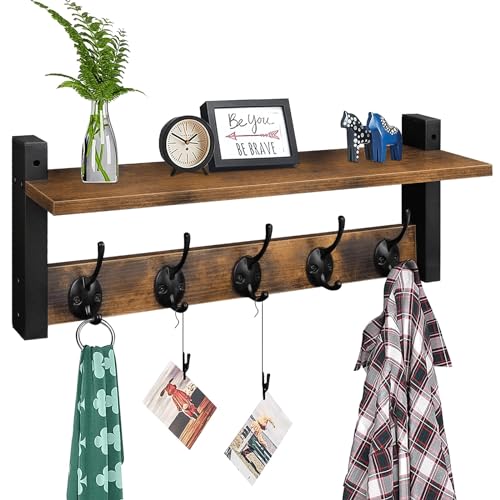
Homode Wall Hooks with Shelf
Problem it solves: Coats, bags, and hats collecting on chairs, benches, or doorknobs because the entryway has no defined vertical drop zone.
Best for: Small entryways with a suitable wall and a need for one compact hanging zone.
Why it works: Hooks create predictable vertical storage while the shelf can hold lightweight grab-and-go items.
What to check before buying: Confirm wall type, mounting requirements, available width, and the product's load guidance.
Check on Amazon
Homleke Shoe Storage Bench with 4 Doors & Padded Seat Cushion
Problem it solves: Shoes spreading across a narrow floor because there is no capacity limit or closed footwear zone.
Best for: Entryways where one footprint can provide both seating and concealed everyday shoe storage.
Why it works: Closed doors reduce visible footwear clutter while the top still serves as a bench.
What to check before buying: Measure the entryway width, depth, door clearance, and footwear dimensions before buying.
Check on Amazon
SUPENUIN Heavy Duty Rubber Boot Tray
Problem it solves: Wet or muddy shoes spreading moisture and grit beyond the entrance.
Best for: Homes that need one clearly defined wet-footwear zone by the door.
Why it works: A washable tray creates a physical boundary for weather-exposed shoes instead of letting them take over the floor.
What to check before buying: Measure the available floor area and keep the tray out of the main walking path.
Check on Amazon
FifthQuarter Key Holder Wall Mount with Drawer and 6 Sturdy Hooks
Problem it solves: Keys, sunglasses, dog-leash accessories, and other small daily items landing on random surfaces.
Best for: Entryways that need a small dedicated landing zone without adding another table.
Why it works: Wall-mounted hooks and a drawer keep tiny essentials from creating countertop or shelf clutter.
What to check before buying: Use only for small compatible items and confirm mounting instructions, wall type, and door or walkway clearance.
Check on AmazonFinal Entryway Audit Checklist
- The front door opens fully without hitting storage.
- The walking path is clear of shoes, bags, and furniture.
- Only current daily shoes and coats remain in the entryway.
- Wet footwear has a separate washable zone when needed.
- Keys and other daily small items have one defined landing place.
- Every basket, hook, and cabinet has a specific purpose.
- The space can be reset in a few minutes at the end of the day.
Frequently Asked Questions
What is the biggest entryway organization mistake?
The biggest mistake is treating the entryway as permanent storage instead of a transition zone. Keep only the daily rotation of shoes, coats, bags, and essentials near the door.
How many shoes should stay in an entryway?
Keep only the pairs currently used most often. The exact number depends on household size and available storage, but excess and off-season footwear should move elsewhere.
Why does my entryway get cluttered so quickly?
Entryways collect items from multiple routines at once. Clutter builds when shoes, coats, bags, keys, mail, and seasonal gear do not have strict capacity limits or defined homes.
Should I put a bench in a small entryway?
Only if the bench solves more than one problem and leaves enough walking space. A storage bench can be useful, but oversized furniture can make a narrow entryway harder to use.
How do I keep an entryway organized every day?
Use a short reset: put shoes back, hang coats and bags, return keys to their landing zone, remove mail or items that belong elsewhere, and clear the floor.
What should not be stored in an entryway?
Avoid storing large amounts of backstock, off-season gear, unrelated household items, and anything that narrows the walking path or blocks the door.