
How to Store Brooms and Mops
Get long-handled cleaning tools off the floor by creating one vertical storage zone in a closet, laundry area, pantry, or other dry utility space.
Quick Answer
Store brooms and mops vertically instead of leaning them together in a corner. Use a wall-mounted rack when you can drill, removable grippers for a small renter-friendly setup, or over-door storage when wall space is limited. Keep frequently used tools together, give dustpans and small brushes nearby hooks, and let wet mop heads dry fully before they go into closed storage.
What an Organized Cleaning-Tool Zone Should Look Like
You should be able to remove one broom or mop without the rest falling over. Handles should stay upright, dustpans and brushes should have predictable positions, and the floor below should remain clear enough to sweep or wipe.
The strongest setup is usually one compact vertical zone rather than storing cleaning tools in several rooms.
Success checklist
- Long-handled tools stand or hang vertically.
- Nothing leans loosely in a corner.
- Wet mop heads can dry before storage.
- Small accessories stay nearby.
- The floor remains clear.
Table of Contents
Choose the Storage Location Before the Organizer
Gather the broom, mop, dustpan, floor duster, scrub brushes, and any spare handles. Remove broken tools and duplicate pieces you no longer use.
Then choose one dry location close enough to the cleaning routine: a utility closet, laundry room wall, pantry side wall, mudroom, or another appropriate service zone. Check that the tools will not block doors, shelves, appliances, or walking paths.
If you need to build more vertical capacity in a small home, see How to Use Vertical Storage. For a broader household reset, the Home Organization Complete Guide can help assign better homes to cleaning supplies and other utility categories.
8 Ways to Store Brooms and Mops
Mount handles vertically on the wall
A multi-grip rack can keep several long-handled tools off the floor while using a narrow strip of wall.
Use individual removable grippers
For a smaller tool collection, individual holders can create a flexible vertical row without one large rack.
Use the back of a compatible door
Over-door storage works when the door can still close freely and hanging tools do not hit shelving or the floor.
Keep dustpans and brushes on hooks
Small cleaning tools should stay near the handles they are used with instead of disappearing into unrelated drawers.
Separate wet and dry tools
Let damp mop heads dry fully before moving them into a closed closet or cabinet.
Keep floor-cleaning tools in one zone
A broom, mop, duster, and dustpan are easier to return when they share one predictable storage area.
Use hooks for lightweight extras
Microfiber dusters, reusable cloth bags, or small brushes can use nearby hooks without taking another shelf.
Keep the floor under the tools empty
Clear floor space makes the utility zone easier to clean and stops buckets or random supplies from trapping the handles.
Need a Broom or Mop Holder?
Choose the organizer based on where the tools can realistically live.
Multi-tool wall rack
Removable grippers
Over-door holder
Wall Rack vs Door Storage vs Individual Grippers
| Method | Best when | Watch for |
|---|---|---|
| Wall rack | You have several long-handled tools and a suitable mounting surface | Wall type, tool diameter, mounting hardware, load guidance |
| Individual grippers | You have one to three tools or want a flexible renter-friendly setup | Surface compatibility and manufacturer weight limits |
| Over-door holder | Wall space is limited but a compatible door is available | Door thickness, closing clearance, tool swing |
| Leaning in a corner | Temporary only | Tools fall, spread, and consume floor space |
How to Store Brooms and Mops Step by Step
Gather All Long-Handled Cleaning Tools
Bring together brooms, mops, dusters, dustpans, brushes, and spare handles so you can see the real storage need.
Remove Broken and Duplicate Tools
Do not build a wall rack around tools that are already worn out or never used.
Choose One Dry Utility Zone
Pick a closet, laundry wall, pantry side, or other service area close enough to the cleaning routine.
Measure Handle Height and Available Width
Check that full-length tools fit vertically and will not hit a shelf, appliance, door, or ceiling obstruction.
Install the Appropriate Holder
Use the product's mounting instructions and spacing guidance instead of assuming every rack suits every wall or door.
Add Small Accessory Hooks
Keep dustpans, brushes, and lightweight extras next to the main tools so the cleaning kit stays together.
Test Drying and Retrieval
Make sure wet tools can dry appropriately and that removing one handle does not knock the others out of place.
Three Simple Broom-and-Mop Setups
Three Individual Wall Grippers
Ideal for: A broom, mop, and duster in a rental or small home.
Layout: Three vertical handle positions with a nearby hook for the dustpan.
Relevant product: Command broom and mop grippers.
Why it works: It creates a narrow tool zone without adding floor storage.
Wall Rack + Hooks
Ideal for: Several long-handled cleaning tools sharing one closet.
Layout: Handles in grip slots, dustpans and brushes on hooks, floor kept clear.
Relevant product: AceMining wall-mounted holder.
Why it works: One rack organizes the full cleaning-tool category in a compact vertical footprint.
Over-Door Tool Zone
Ideal for: A laundry or utility door with adequate clearance.
Layout: Broom and mop hang on the door; chemicals and cloths stay in separate safe storage.
Relevant product: Lorbro over-door holder.
Why it works: It uses an otherwise empty vertical surface.
3 Verified Products for Broom and Mop Storage
These products solve different installation problems. Choose the one that matches your wall, door, and tool collection rather than combining several systems.
Affiliate disclosure: As an Amazon Associate, Inplanty may earn from qualifying purchases.
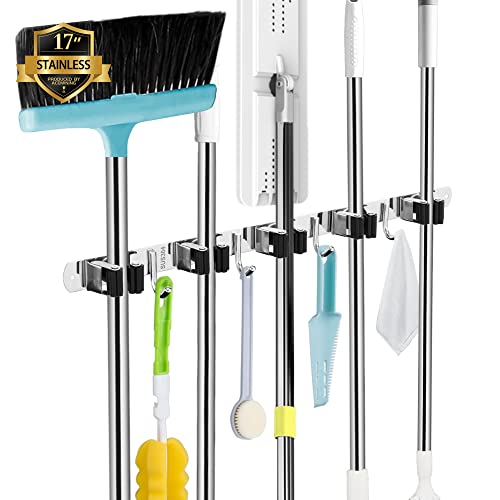
AceMining Broom Holder Wall Mount, 5 Racks 4 Hooks Heavy Duty Mop Organizer
Problem it solves: Brooms and mops leaning in a corner and falling over.
Best for: Utility closets, laundry rooms, garages, or pantry walls with a suitable mounting surface.
Why it works: Separate grip slots give long-handled tools defined vertical positions while hooks can hold smaller cleaning accessories.
What to check before buying: Confirm mounting requirements, wall type, available width, handle diameter, and the manufacturer's stated load guidance.
Check on Amazon
Command Broom and Mop Gripper, 3-Pack
Problem it solves: A few long-handled tools needing wall storage where drilling is undesirable.
Best for: Compatible indoor wall surfaces and a small collection of lightweight cleaning tools.
Why it works: Individual grippers let you create a narrow vertical cleaning-tool zone without installing one large rack.
What to check before buying: Follow the surface-preparation, weight, placement, and removal instructions exactly and verify each handle fits the gripper.
Check on Amazon
Lorbro Broom Holder Door Mount, Wood Over the Door Broom and Mop Holder
Problem it solves: No open wall inside a small utility or laundry area.
Best for: Compatible doors where hanging storage will not interfere with closing, hinges, trim, or the walking path.
Why it works: The organizer uses vertical door space instead of taking floor space or requiring tools to lean in a corner.
What to check before buying: Measure door thickness and clearance and verify that loaded tools will not hit the wall, floor, shelving, or door frame.
Check on AmazonCommon Broom and Mop Storage Mistakes
Leaning every tool in one corner
The handles spread, fall over, and make the floor harder to clean.
Storing a wet mop in a closed closet
Let damp tools dry according to their care guidance before closed storage.
Mounting before checking full tool height
A rack can fit the wall while the broom handle still collides with a shelf or ceiling.
Ignoring door clearance
Over-door systems need enough room for the door to close and for tools to hang without hitting surrounding surfaces.
Mixing chemicals with loose tools
Cleaning products should follow their own safe-storage requirements instead of being wedged randomly around broom handles.
Keeping broken extras
Remove worn-out tools before expanding the storage system.
Final Broom and Mop Storage Checklist
- Every long-handled tool has a defined vertical position.
- No broom or mop leans loosely in a corner.
- Wet mop heads can dry appropriately before closed storage.
- Dustpans and small brushes stay near the main tools.
- The organizer does not interfere with doors, shelves, appliances, or walkways.
- The floor below the tools remains easy to clean.
Frequently Asked Questions
What is the best way to store brooms and mops?
Store long-handled cleaning tools vertically in one dry zone using a wall rack, individual grippers, or compatible door storage. Keep the floor clear and let wet mop heads dry before closed storage.
Can you store brooms and mops in a closet?
Yes, if the closet has enough height and airflow and the tools can be secured vertically rather than leaning into other supplies.
How do you store brooms and mops without a closet?
Use a suitable wall-mounted, removable adhesive, or over-door holder in a laundry area, pantry, utility nook, or another dry location close to where the tools are used.
Should mops be stored with the head up or down?
Follow the mop manufacturer's storage guidance. The important point is that the mop can dry fully and the head is not left compressed against a dirty or damp floor.
How do you keep brooms from falling over?
Give each handle a fixed grip or hook instead of leaning several tools together in a corner.
Where should cleaning supplies be stored with brooms and mops?
Keep frequently used compatible supplies nearby in a separate shelf, bin, or hook zone while following product safety labels and keeping chemicals away from children and pets.